Tamara Rojo was a staunch supporter of women choreographers when she ran English National Ballet, so it’s no surprise that her inaugural season as San Francisco Ballet’s director in 2024 featured a commission by a woman, Aszure Barton. Rojo and her fine dancers have now brought Mere Mortals to Sadler’s Wells.
Much has been written already about the intent of the piece, repeated in the programme essays, which is to employ AI in creating aspects of the staging while presenting a narrative that suggests the potential impact of the technology. For this, Barton has co-opted the Pandora myth, as a cautionary tale about overweening human curiosity. When Pandora opens her jar (Barton claims translators have misrepresented the jar as a box), all the evils in it fly out, leaving just a small creature called Hope.
Barton has expanded this simple plot into a 70-minute extravaganza that deploys what looks like a sizeable part of the company. But we are greeted first by an electronic buzzing, then a stage swathed in bright red smoke, against which a solitary figure in a shiny dark one-piece stands – Wei Wang on opening night, who danced a superbly controlled solo full of sustained arabesques and nimble, jaunty footwork. But the function of this character isn’t clear at this point.

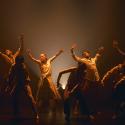
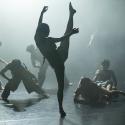
Soon he is surrounded by what seems to be a large group, followers of a dynamic leader. This turns out to be Prometheus (Joseph Walsh, pictured above, on opening night), but you had to consult the programme to establish that. The clue is possibly that the screens around the stage feature more bright red elements, the central one like a planet with a scarlet aura, which presumably could be read as fire.
The corps are given robust, lengthy routines, sometimes reminiscent of vaudeville moves, with exaggerated running on the spot and sideways capering. It’s distinctive but, again, rather unreadable. Are we supposed to see them as squads serving a totalitarian leader? Their black long-skirted gowns with padded shoulders suggest a tribe of exotic people, though not a militaristic one. When they form a mound, Prometheus rises up out of it. They bounce and nod their heads a lot, but the length of their routines doesn’t appear to lead anywhere specific. Finally a second man arrives and he and Prometheus jostle like young boys in a playground.
The pace quickens, the red visuals turn to white smoke, a new mound is created and another figure in a shiny dark one-piece emerges, this time a woman: Pandora (Jennifer Stahl). Stahl then delivers an extraordinary solo, full of wonky limbs and sideways splits, as this new creature starts to negotiate terra firma. Her confidence grows and soon she is like a cocky Odile, moving among the corps, until the man previously seen with Prometheus arrives to claim her, dipping his body like a courting bird. This is her designated husband, Epimetheus (Harrison James). They seal their relationship with a sensual, tender duet full of slithering limbs and odd couplings (at one point Stahl does a forward roll over his shoulders), to the delicate arpeggios of a harp.
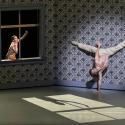
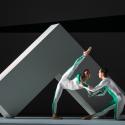
The screen, which has now changed to a sky-blue amoeba-like image, suddenly explodes to dramatic music and cymbal clashes, signalling urgency and danger. Images pulse and mutate rapidly, clouds race by, lightning flashes. The corps reappear in light, shiny one-pieces, while Pandora’s mouth forms an O-like howl. Then the first dancer returns, who turns out to be Hope, this time in a gold one-piece, bowing his head to Pandora, who melts away, while he reprises his first solo, like a triumphant bird with imperious flapping wings. The corps, whose costuming is now revealed to be gold, mimic his moves, then repeat their earlier routines. They finish by kneeling and linking arms, then perform Mexican waves, bodies rippling up and down, with Hope in their midst doing an extraordinary handstand (pictured below), with his cheek resting on the stage.

I think this counts as a happy ending, but I found the narrative as murky as much of the stage lighting.
Accompanying the piece is a score by Floating Points (aka Sam Shepherd, present in the pit playing a Buchla and other electronics), which melds electronica with regular orchestral sounds from strings, brass and the like. The combination of this score with Hamill Industries’ visuals – presumably the source of the AI in the piece? – is arresting at times, but overall makes for an oppressive evening. The mood only lifts when a golden Hope reappears for the finale, like a supple Oscar statuette. Perhaps repeat viewings would illuminate matters. The dancers are worth it, an athletic, well drilled troupe with outstanding soloists, especially Wang and Stahl. I'd like to see them put through their paces in other work. But this piece fails to meet the expectations set up for it.
- Mere Mortals at Sadler’s Wells until 10 October
- More dance reviews on theartsdesk