Living the unison curve and its attendant shimmer with which Wagner outlines a religious mystery in the Prelude to Parsifal, Jakub Hrůša tells you immediately why the Royal Opera's orchestral musicians urged him to be appointed Music Director. Haloed in front of a black drop-curtain, he visibly urges the intensity we hear, and it doesn't let up until the last chord; tempi never feel too fast or too slow, just right, and infallibly vivid.
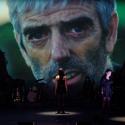
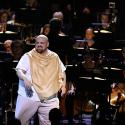
Then we see what he's up against to express the vision. Director Evgeny Titov has us in what seems like a dark, massive bunker with a bloodied figure and a sinister controller in Brindley Sherratt's Gurnemanz (an ambiguous spirit-guide in Wagner's text, he doesn't get much of a shot at the good here, and nobility is undercut by a hard-pressed top of the range). There's no hint of the nature that passingly lights up Wagner's music, while the ritual on which this creepy brotherhood depends is ugly: well might the innocent Parsifal ask "who is the Grail?", since it's the blood that flows from the unstaunchable wound of sinner Amfortas (Christian Gerhaher and members of the Royal Opera Chorus pictured below).

It's a depressing vision, but still a compelling one to sustain what we hear from the pit, as lit by D, M. Wood - any illumination comes from out front - and as sung by Gerhaher as a titanically suffering Amfortas, who isn't allowed even a clean shirt after his "bath" (in a grubby shower at the back of the stage, only partly cohering with Gurnemanz's long narrative of past events). Gerhaher's delivery runs the tonal and dynamic gamut in showing us the extreme consequence of a wound that seemingly cannot be healed, but he bears the burden of Titov's negative view. If there's wonder, it's in how Stanislas de Barbeyrac's holy fool views the goings-on, but unobtrusively shifting pillars in Etienne Pluss's set don't make time become space, as Gurnemanz insists.
Having kept calm but incandescent in Act One, Hrůša goes for the most focused of blazes in self-castrated exile Klingsor's castle and "garden" after the interval, matched for intensity by Mark Stone's besuited magician-collector who harvests young girls to become seducers. Here Titov's singular vision doesn't let him down. Parsifal, stripped down to boxer shorts by a compellingly weird group of "Flower Maidens" - their hair concealed, breasts exaggerated, moving fluently despite Esther Bialas's sci-fi costumes - has to face spell-bound Kundry as the child she tries to make him before confusing unmotherly kiss.

Stanislas de Barbeyrac takes the boyishness, confusion and anguish further than any other tenor I've heard in the role (Jonas Kaufmann at the Met looked good, but is nowhere near as various or flexible an actor). Having been allowed her strangeness as the tortured flyer-in on the religious community in Act One, Ekaterina Gubanova delineates the shift of power from Kundry to Parsifal just as well (again, the costume doesn't hamper her). As a mezzo, she may have a problem or two with the high register in the desperate later stages of the confrontation, but she's otherwise more than a match for de Barbeyrac's golden heroic tone. The act ending with the delivery of the stolen spear is unconventional but compelling; there's no point at which production and music don't vividly cohere.
The fellowship of the grail to which Parsifal returns after years of wandering under Kundry's curse - achingly delineated in the Act Three Prelude - could hardly have become much more extreme in distress, as Gurnemanz tells the newly poised wanderer it has, but the visuals underline it as best they can. The columns have further shattered; the acolytes are carrying out dead bodies; the flowers of "this most holy day" are nowhere to be seen - you yearn for the vision of Barrie Kosky's Siegfried denouement - except in a brighter light and inside the characters' heads. Titov does not interfere with the cleansing and baptisms between the three main characters, movingly depicted in spare gestures and underlined by the most poignant of clarinet solos; he has Kundry released from the cycle of suffering in an ecstatic dance to the exquisite Good Friday Music.

Parsifal's task, it seems, is to bring a salvation of sorts to those who could not die. So after a terrifyingly angry chorus - magnificent throughout - his last duty is, as dramaturg Janine Ortiz's synopsis tells us, to bring Amfortas's suffering to an end with the "wonder-working" spear. Left on stage with Gerhaher's physically and vocal extraordinary sinner (pictured above), de Barbeyrac faces a last massive challenge - and seals a truly great performance. Titov's interpretation may be flawed, and occasioned predictable boos during the curtain calls, but it asks as much of the singer-actors as Hrůša does of the orchestra. I look forward to seeing what this singular director does next.