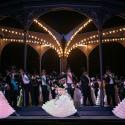
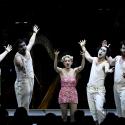
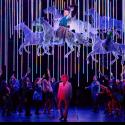
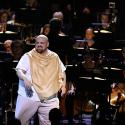
An epiphany of golden Chinese palaces and magically-lit Egyptian pyramids, not to mention the highest standards of singing and playing, won me round to the Arena di Verona experience. I'd always shunned it. Wouldn't the voices be miked? They aren't. Wouldn't the entertainment for 10,000 spectators in Italy's third largest Roman colosseum after Rome and Capua ruin Verdi's many intimate scenes? They proved very moving, thanks especially to sensitive lighting, Wouldn't the physical aspect of the performances be mere semaphoring? Yes, it mostly was, but you can't have everything.
Above all the professional handling of every aspect in the longest season ever under sovrindente Cecilia Gasdia, well-known soprano and clearly an excellent coach, constantly impressed. Even the slogan - "the most Italian place on earth" - is good. Of course this is Italian conservatism which would no doubt please Meloni - she's been to the Arena thrice this year, though not as far as I know to the operas - and the festival is way too ready to accept Anna Netrebko, controversial not just for her ambiguous attitude to Putin's Russia but also for her willingness to do blackface as Aida here (next year she sings in three performances, and they're publicising it like crazy).
Yet I realised, after witnessing too many only semi-successful attempts to strip Aida and Turandot of their "exoticism" - and it's time for the Royal Opera to retire the handsome-looking Turandot production by Andrei Serban - that I did need to see both to some degree as Verdi and Puccini imagined them, if only once. And seeing them on consecutive nights is still resonating, a subject of fascination as to how the two composers fashioned their last grand operas (I'll be exploring them side by side in the spring term of my Opera in Depth course on Zoom).

Under its founder, the great tenor Giovanni Zenatello, the 150th anniversary of whose birth we celebrate this year (excellent publication, in Italian only, pictured left), the festival was often more wide-reaching in its repertoire. Turandot was only two years old when it reached Verona in 1928, with the French tenor Georges Thill as Calaf; Italian operas which are now rarities appeared, as did Wagner's Lohengrin, La Valkiria, I Maestri cantori and Parsifal. In 1913, Zenatello, who had been the first Pinkerton in Puccini's Madama Butterfly, decided to celebrate the centenary of Verdi's birth with Aida in the Arena; he sang the role of Radames - his rather stentorian recordings of "Celeste Aida" can still be heard - and after the post-World-War-Two resurrection of Verona seasons he helped launch the career of the 25-year-old Maria Callas, casting her as Ponchielli's La Gioconda.
Zeffirelli arrived on the gran scena in 2002, having designed and directed a much-cut "little Aida" for the small theatre in Verdi's home town of Busseto the previous year (a reminder that "pocket" Aidas can serve the intimacy of the central relationships well). His Turandot first descended the massive steps in 2010, in a production which has been tailored to other venues, not least New York's Metropolitan Opera.

Though the organisation presented another Aida for the Arena's centenary, directed, designed and choreographed by Stefano Poda and running again this year, it doesn't look half as effective; and since what Germans would call the Personenregie, the interaction between singer-actors, goes for little on this scale, it's hard to see what the gains might have been, Poda's production returns next year alongside a recreation of the 1913 grand opener. Whether or not they use the sword wrought for Zenatello by the local iron workers, and inscribed with pride, the original is there to consult in a glass case by one of the bars.
Arrival through one of the passageways into the arena is surprisingly efficient (an abundance of young ushers helps); temperatures, still at 9pm hovering around the 30-degree mark, meant that there was no leeway for sweaty fluster. Our seats were to the side of what would be called the main parterre or stalls area. Puccini's fierce orchestral summons, on the first of our two evenings, felt a bit muted, the thrust of his late homage to The Rite of Spring somewhat muted under young Veronese conductor Andrea Battistoni; that may have been partly affected by where we were, but the following night's Verdi had more drive and brilliance. Battistoni is certainly a master at keeping his singers with the orchestra - not always easy with an I-do-it-this-way tenor like Yusef Eyvazov.
I'm sorry I'd avoided Eyvazov live since the days Netrebko would only perform with him as her tenor when they were married. He has a curious but rock-solid technique and never misses a top note (and didn't we know it in the longer-even-than-usual clinging on to the top B flat in "Nessun dorma", superbly sung on its own terms). Game of him, too, to sport in the heat the heavy coat Zeffirelli's costume designer, Emi Wada, presumably had in store for all Calafs. More of him - and more surprises - for his stepping-in as Verdi's Radamès the following night.

The most vivid singer of the evening, though, was one of two familiar Italian soprano names, Maria Agresta, as sweet and ultimately courageous servant Liù (so often the star). Not only did she float all the soft top notes; her acting also turned the gestural into a wonder of informed dramatic conviction. First intimation of how more intimate singing could work in such a space came with her "Signore, ascolta", sustained in Eyvazov's "Non piangere, Liu". The rare tears-in-eyes moments continued with the idyll of courtiers/masks Ping, Pang and Pong remembering their country homes far away from Turandot's bloodthirsty palace. Gezim Myshketa's High Chancellor poetically led the way.
Then comes the reveal of the golden palace: for once, you can't blame the audience for applauding (though I'd have been irritated if any of the many folk holding up cameras for that were in front of me). Anna Pirozzi, whom I found so impressive in a Palermo Nabucco some years back, was apparently under the weather given the temperatures - no official announcement was made - but while cipherish, hit everything in the upper register bang on.

The chorus made as full an impact in the crucial central scene as you could possibly wish. True, the final duet seemed more improbable than ever after this Liù's death, Alfano's completion in the cut version - Scottish Opera will present it complete this coming season - more than usually crude, but that's the problem posed by Puccini. And everyone loves the after-show parades in Verona.
The Turandot problem, shorn of the orchestral glamour and experimentation which is Puccini's last trump card, only threw Verdi's perfection in writing an exotic opera to order into higher relief. I'd been hoping to speak to Gasdia during the day, but she'd been busy working as pianist with two stand-ins. Eyvazof had some notice, and had sung one of the five advertised Radames - Jonas Kaufmann among them, due on 10 September - but the Amneris was thrown in the deep end. And young mezzo Irene Savignano gave us a vocally sumptuous and involving performance, from imperious love rival to impassioned tragic figure (pictured below, centre). I'd be happy to see her again anywhere in the world.

The male roles were all superbly taken, from Riccardo Rados's impressive Act 1 cameo as mere messenger through to Mariano Buccino's stentorian King, Simon Lim's dark high priest Ramfis and the instantly imposing Youngjun Park as Aida's daring father Amonasro. Eyvazof started "Celeste Aida" at odds with an authoritative conductor, Francesco Ommassini, but quickly achieved the right gear changes. Clearly we were going to get a generic Aida from Maria José Siri. But both followed Amneris's superb big scene with amazingly sensitive responses in the tomb where they are due to suffocate. Verdi's vision of heaven, ending as quietly as he began the opera, is always extraordinary, but you rarely get a tenor and soprano quite as able to float the phrases as these two. And that I hadn't expected from Eyvazof.
Ceremonials? Magnificent, down to the six trumpeters on the left echoed by three more on the right in the Triumphal Scene: that made the rum-ti-tum of the march especially impressive. And we were so lucky to get first-rate dancers executing Vladimir Vasiliev's choreography at the highest level, Zeffirelli's dodgy original concept of blacked-up savages in Anna Anni's costuming toned down to half-black, half-white body paint. Full credit to the three primi ballerini (as apparently you can call men as well as women) Giorgia Ricciardi, Virna Toppi and Nicola Del Freo. (Pictured below: Park's Amonasro and Siri's Aida with the Ethiopian prisoners).

If intimate tragedy compounded by atmospheric lighting was the abiding impression, as it should be in this magnificent opera - and a much better-behaved audience helped with quiet atmosphere - the Egyptiana still looked impressive. Four days later, as we returned from baking sojourns in Sestri Levanti and Pavia, we found ourselves unexpectedly back in the centre of Verona due to the UK air traffic control crisis which meant the plane we were due to board that evening was cancelled as we sat waiting to board. The airport bus deposited us in Piazza Bra before we headed back to the pleasant hotel we'd been booked into before (fortunately there was a room free), and there were all the giant props welcoming us back as Kaufmann et al sang within the arena. It felt oddly like a homecoming.