The 90s: Art and Fashion starts well. The first thing you see are Sarah Lucas’s boots. With razor blades inserted under the toe caps, they evoke the “fuck-you, I’ll fight my corner” attitude of the times. There she is again – funny, clever and confrontational – with a supermarket chicken slung from her knickers, its gaping neck doubling as a vagina (pictured below right: Chicken Knickers 1997).
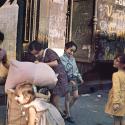
There’s Sam Taylor Wood (now Johnson) posing defiantly in her FUCK, SUCK, SPANK, WANK T-shirt, her jeans round her ankles as if she’s ready for anything. And that freaky Wolfgang Tillmans picture of Susanne and Lutz, white dress, army skirt 1993 of a guy wearing a kit bag beside a contortionist whose arms are draped round her neck like dangly ear rings. Corinne Day’s England’s Dreaming 1993 (main picture), a grunge photo taken for The Face of a spaced-out teenager slumped on a scruffy sofa, was photographed in her Soho flat. They all exemplify art and fashion in creative dialogue – challenging the status quo.

I remember interviewing Damien Hirst in similarly squalid surroundings. Those were the days when young British artists (YBAs) like Hirst, Lucas, Anya Gallaccio and Tracey Emin were putting on shows in empty factories, warehouses, shops and offices – businesses bankrupted by the latest economic crash. The economy was in free fall, but they carried on regardless and changed the cultural landscape for good.
Along with Britpop and street fashion, their efforts converted London into “the coolest city on the planet” and transformed Britain from a conservative backwater into Cool Britannia. More importantly, they also helped change attitudes towards disability, racism and the LGBTQ+ community.
Curator Edward Enninful, former editor of British Vogue, acknowledges this by including some key works, but trivialises them with juxtapositions that are either meaningless or downright insulting. And everything is installed so badly that all you see is clutter.
Take, for example, Hamad Butt’s delicate glass sculptures, which are beautiful but dangerous. Containing carcinogens and toxic gases, if broken they could inflict real harm. The artist was a gay Pakistani at a time when racism and homophobia were rife; his partner died of AIDS and, in 1994 aged only 32, he also succumbed.
At the Whitechapel Gallery last year, his work was accorded due respect; here it is shunted into the corner of a gallery whose theme is macabre body horror. It shares the space with a steel corset and a jacket stuck through with antlers by Alexander McQueen and Great Deeds Against the Dead 1994 by Jake and Dinos Chapman. The silly and unwearable rub shoulders with poignant memorials to trauma and a sculpture that raises serious questions about violence and its portrayal.

Insensitivity also governs a room devoted to black practitioners. Donald Rodney’s In the House of My Father 1997 is a photograph of the artist’s hand cradling a fragile sculpture of a house made from his own skin. Rodney died the following year of sickle cell anaemia, a disease largely affecting those, like himself, of Afro-Caribbean descent and the work is a moving comment both on his illness and his heritage.
Nearby hangs Chris Ofili’s No Woman No Cry 1998, a painting dedicated to Doreen, the mother of Stephen Lawrence who was murdered by a gang of white youths. The tears shed by the woman contain tiny portraits of her dead son.
Juxtaposed with these powerful works are photographs by Jason Evans of young black men posing in suburban streets in nifty suits and a vitrine containing elegant Saville Row jackets – as if smart threads could be equated with heartfelt responses to racism, murder and inherited vulnerability.
Damien Hirst, a prime mover and shaker of the ’90s, is represented here by a single tame sculpture of two small sharks swimming in a circle, (pictured below: Two Similar Swimming Forms in Infinite Flight 1993) which gives no hint of the shock value of his visceral early work.

Enninful has re-classified him as a minimalist – as if electrocuted flies, pickled sharks and bisected cows were pure geometry. Such nonsense is indicative of the sloppy thinking underlying this whole enterprise.
So I’ll say it again. It’s impossible to overstate the importance of the ‘90s both for British culture and the economy. It paved the way for Tate Modern, for the Frieze art fair and the presence of commercial galleries like Gagosian, which have transformed London into an international centre for contemporary art and the art market.
And the Tate should be ashamed to (mis)represent such an important decade with this travesty of an exhibition.
- The 90s: Art and Fashion is at Tate Britain until February 14th 2027
- More visual arts reviews on theartsdesk