Subtitled The Birth of Art Photography, Tate Modern's Light and Magic begins with photographers like Alfred Stieglitz who were determined to be thought of as artists rather than craftsmen or scientists. Known as "Pictorialists", they made their photographs look as much like paintings or drawings as possible and, as a result, produced many exceptionally beautiful images and some sentimental duds, both of which are on show.
Robert Demachy’s behind-the-scenes shots of young ballerinas, for instance, could easily pass for sketches by Degas, (who, ironically, was heavily influenced by photography) while his photograph of two men caulking the hull of a boat looks just like a charcoal drawing on hand made paper.

So do Alvin Langdon Coburn’s atmospheric views of smoggy London. They are so grainy you can almost feel the moisture-filled air on your skin (pictured right: Regents Canal 1909). His view of Wapping, a masterpiece of contrasting textures and tones, must surely have been inspired by Japanese prints. Sharply silhouetted against the river is a black sail, while on the far bank the factory chimneys appear in the gloom like a smudge of charcoal.
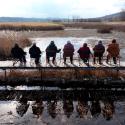
At the other extreme from the drama of these urban scenes are Peter Henry Emerson’s photographs of life on the Norfolk Broads (main picture). Working with the painter Thomas Goodall, he composed his images as carefully as a Millet painting of French peasants. Shot in soft, uniform light, the platinum prints have a quiet and gentle dignity.
Effects like these were mainly achieved in the darkroom involving messy chemicals in complicated procedures. The full range of techniques on offer at the turn of the 19th century are described later in the show and there’s also a working darkroom and workshops demonstrating some of the processes.
Portrait photographers often chose to dress their sitters in historical costumes and pose them in the guise of Old Testament prophets, languid Pre-Raphaelite damsels or subjects in old master paintings. Emma Barton won a Royal Photographic Society Medal for The Awakening, a picture oozing with sentimentality of a mother and child that imitates a Raphael Madonna. Julia Margaret Cameron created many masterpieces in this genre, yet she is inexplicably absent from the show. Why? To leave out such a prolific trail-blazer is like omitting Braque from a show on cubism!

As though to compensate for Cameron’s absence, the curators have included two of Madame Yevonde’s Goddesses, which owe nothing to Pictorialism. Her photos of society women dressed as mythological figures like Europa or Shakespearean inventions like Ariel may have been inspired by Peter Lely’s swagger portraits, but they never imitate paintings (pictured left: Mrs Richard Hart-Davis as Ariel, 1935). And there’s another crucial difference; while art photography was determinedly monochrome, Yevonde pioneered the use of vibrant colour to create gloriously unreal images that belong in a class of their own.
On the plus side, the exhibition offers some amazing revelations. I had no idea that Pictorialism was a global phenomenon or that in Asia it continued to thrive for many decades. Long Chin-San’s exquisite landscape Riverside Spring 1942 was, then, a complete surprise. Looking uncannily like a traditional Chinese watercolour, it was created using multiple negatives to produce an ethereal sense of immaculate detail floating in infinite space. Another revelation is Hong Kong photographer Tchan Fou-Li. Determined to honour the tradition of Chinese painting, he made romantic views of misty landscapes right into the 1960s while his colleague, Ho Fan recorded urban life as a ghostly incarnation of light and shadow (pictured below: Smokey World, 1959).
Back to 1907. Taken on board a steamer sailing from America to Europe, The Steerage was a turning point for Alfred Stieglitz, because it made him realise that beautiful and interesting compositions were to be found in the real world as well as in the darkroom. From then on he began turning his attention outwards and, like many other Pictorialists, developed a style that was sharper in focus – literally and metaphorically.

Light and Magic acknowledges this development, but instead of accepting that Pictorialism had its day, the show promotes the idea of an ongoing afterlife. By claiming that they “underscore Pictorialism’s enduring legacy”, the curators even enrol pioneers of modernism like the Russian constructivist Alexander Rodchenko. Having dedicated his career to freeing photography from all painterly allusions, Rodchenko would turn in his grave at the suggestion that he owed anything to this essentially nostalgic genre!
- Light and Magic: The Birth of Art Photography at Tate Modern until February 21 2027
- More visual arts reviews on theartsdesk