As the colour drains from the sky and autumn closes in, the Royal Academy is offering an antidote to London’s various shades of grey. Spanning ninety years – from the 1870s to the 1960s – Painting the French Riviera provides an overview of the artists who were inspired by the sun, the brilliant blue sky and turquoise sea of the Mediterranean to produce some of their most vibrant canvases.
Ever since Cézanne began visiting L’Estaque, a fishing village near Marseille, in the 1860s, French painters have been going south to soak in the light and air of the Cote D’Azure. In the 1880s, Renoir and Monet joined him there and soon the French Riviera would become a place of pilgrimage for artists escaping Paris for the unspoiled beauty of the Mediterranean coast.

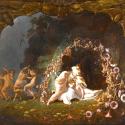
Cézanne and Renoir painted side by side. This gives one the chance to compare the feathery brushstrokes used by Renoir to evoke the foliage of olive trees and the brick-like strokes with which Cézanne structured views of the same rocky landscape. In response to the sense of freedom engendered by the seaside, they both painted imaginary scenes of bathers; but whereas Renoir’s female nudes are intentionally seductive, Cézanne’s androgynous figures (main picture) personify the health and vitality associated with being out in nature.
The trip to L’Estaque made such an impression on Monet that he returned to the Cote D’Azure in 1884 and spent five months frenetically trying to capture the intense colours and dazzling light. Four years later he was back again and in canvases like Cap Martin, near Menton, 1884 one can almost smell the pines and feel the hot dust underfoot, while Morning at Antibes,1888 (pictured above) fairly sizzles with what he described as “the fairy-like air” enveloping everything.
The next group of artists to visit were pointillists such as Seurat and Signac. You might think the little dots of colour they used to capture the endlessly changing effects of light would be the perfect tool for evoking the dazzle of the Mediterranean. And in his painting of The Bay of Cavaliére, 1906 Henri-Edmond Cross does manage to convey the shimmering heat that appears to dissolve solid substance while making the air feel thick.

But most are too stilted and too laboured to evoke the ephemeral scintillations of atmosphere. Along with their dogged presence, though, is a revelation – a painting by Cross of Les ÎIes d’or, ÎIes d’Heres, 1892 (pictured right). From the sandy beach he looks across an expanse of ocean towards the distant islands, their hills bathed in a heat haze. Divided into irregular bands of freely applied dots, this gloriously subtle canvas is reminiscent of an Agnes Martin in its contemplative calm, yet it predates abstraction by some 14 years!
The raucous canvases of Les Fauves (the Wild Beasts) bring you down to earth with a joyous thump. In 1904, during a nine-week stay in the fishing village of Collioure near the Spanish border, Matisse and Derain developed a much freer, more gestural version of pointillism while dialling up the colour to fever pitch. Even Braque, best known for sombre forays into cubism, joined the joyous party (pictured below Seascape, L'Estaque, 1906 by Georges Braque).
Bonnard is rightly honoured with a gallery to himself. After visiting the south regularly for many years, in 1926 he bought a house at Le Cannet, in the hills overlooking Cannes, and settled there. Breakfast, Radiator (Breakfast at Le Cannet), 1930 (pictured below; private collection, photo: Sotheby’s) portrays the artist’s wife Marthe breakfasting in a room drenched with light flooding in through the open doorway. Visually, though, this apparently simple scene gets complicated. The distant bay is visible through the door and behind Marthe there’s a mirror reflecting her and also her husband. So Bonnard puts himself in the picture, thereby emphasising his role as a voyeur recording intimate moments of his domestic life. It makes Marthe seem very lonely and makes the painting, with its emotional ambiguity, the most intriguing in the whole show.

Matisse went south again in 1917, this time to Nice which he visited regularly for the rest of his life. Several of his paintings of hotel rooms are included, but the selection is disappointing and doesn’t do him justice. At roughly the same time, Picasso began spending his summers on the Riviera and playful watercolours like A Windy Day in Cannes 1933, of a mobile dancing in the breeze, suggest how much at home he felt in the Mediterranean.
By this time the Riviera had become a playground for rich socialites like Gerald and Sara Murphy, flamboyant American expats who were friends with Picasso and an inspiration for F. Scott Fitzgerald’s Tender is the Night.
Diaghilev’s Ballet Russes satirised these self-indulgent pleasure seekers in Le Train Bleu. The piece took its name from the first class express linking Calais with the French Riviera, which opened up the resort to wealthy foreigners in the 1920s. On show is a film of the English National Ballet recreating the dance for the opening of V&A East last year in front of the famous backdrop based on Picasso’s painting Two Women Running on the Beach (The Race), 1922.

Fabulous performances by dancers like Precious Adams and Katja Khaniukova highlight the absence of women from the rest of the exhibition. When she accompanied Picasso to the Riviera, Dora Maar must have taken photographs, but none are included. Françoise Gilot didn’t stop painting when she lived with the Spaniard, nor did Jacqueline Roque stop making ceramics after marrying him and living at the Villa La Californie near Cannes; but neither gets a look in.
The most unexpected inclusions are the Expressionists Max Beckmann and Chaim Soutine. Fascinated by the manicured lawns and palm trees of the increasingly fashionable resort, Beckmann visited the Côte d’Azur many times before and even during World War II. Outlining everything in black, he imposes his gloom laden view of the world onto the light filled landscape. And turning the narrow streets of the charming hilltop village of Cagnes into a dangerous warren of crumbling instability, Soutine similarly projects his unease onto the terrain.
The Russian painter Nicholas de Stael also bucks the trend. Living in Antibes in the mid 1950s, he abandoned the bright impasto abstractions for which he is best known, switched his palette to monochrome and began painting seagulls and seascapes.

The exhibition ends gloriously with Yves Klein, who was born in Nice. Obsessed with the blue of the Mediterranean sky, he developed International Klein Blue. Created by suspending ultramarine pigment in resin, the result are so intense they can be hard to focus on. He soaked sponges in it, painted canvases with it and in Anthropometry, an (in)famous performance staged in 1960, had models coat their bodies in it before pressing themselves against paper or canvases to create a bodily imprint. (Pictured above: ANT 84 by Yves Klein).
Klein referred to the women as “living paintbrushes” and the event can either be seen as a way of elevating them from passive models to active contributors or, given that he and the audience were wearing evening dress while the women were naked, as an extreme example of sexual exploitation.
The azure blue of the sky gave the coast its name and acted as a magnet to generation after generation of artists. Many of the visitors felt overwhelmed by the blazing intensity of the light. It took a local to claim it as his own and to have the last word: “I have written my name on the far side of the sky,” Klein proclaimed!