Fancy a trip to the seaside, if the fine weather returns? Then make Margate your destination. On my visit the sea was blue and the light was glorious, and at Turner Contemporary there’s an exhibition of work by French artist Sophie Calle.
Her main subject is absence, in its many guises. Loss, lack, loneliness and heartache are approached with a sardonic detachment that makes the work by turns, poignant, sad, funny and philosophical.
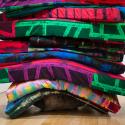
When invited by the Picasso Museum in Paris to respond to the maestro’s work, she declined because the task felt too daunting. But during lockdown, she visited the museum and found the pictures swathed in protective coverings; and these ghostly presences were no longer terrifying.
Photographs of the shrouded pictures are presented with their titles (pictured below: Picassos in Lockdown (detail), 2022. Photo Jo Underhill), so prompting the viewer to imagine what Baigneuse a la Cabine 1929 or Minotaure Violant une Femme 1933 might look like. One could be an etching of a bull abducting a woman while the other might be a nude in Picasso’s neoclassical or surrealist style. Whether you are right or wrong is not the point. The attempt to conjure the picture in your mind’s eye, and the absurdity of the task, is what matters.

What do you See? 2013 was also inspired by invisible pictures. In 1990 thieves broke into the Isabella Stewart Gardner Museum in Boston and stole paintings by Vermeer, Flinck and Rembrandt by cutting the canvases out of their frames. As a memento of the paintings that were lost, the curators decided to leave the empty frames hanging on the wall.
Calle photographed the frames and asked visitors and staff members to describe what they saw in them. The answers range from bitterness and rage to wistful recollection. “I see a sacred space,” one person says in response to the missing Rembrandt. “Nothing belongs inside the frame except Rembrandt’s Storm on the Sea of Galilee. Nothing… The Storm and that’s it”. Another sees only the exposed wallpaper, while a third is more upbeat. “I see a frame that helps me imagine the painting. It is a seascape… The illusion is still in my head that I’m seeing a Rembrandt”.
Whereas the Picassos were hidden only briefly, these masterpieces might never be restored to public view. Calle’s response therefore feels more sombre – an invitation for people to consider what pictures mean to them and why they matter.
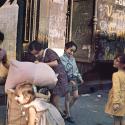
In Because 2018-26 Calle asks herself a similar question. Going through a stack of old photographs, she tried to remember why she took them. What was it about the subject that had appealed to her? The answers – sad, whimsical, funny or ironic – are embroidered on pieces of felt hung over the pictures. An armchair shrouded in dust sheets is labelled “Because it was his”, while a photo of a white line leading into deep water is titled “Because of the temptation to follow it”.
The need to create an archive of one’s work can often become an obsession. Calle goes one step further by creating an absurdist catalogue raisonné of projects she abandoned. It’s a comedy of errors, of ideas that vary from the tragic to the ridiculous. IMPOSSIBLE TO CONVEY, for instance, is a dining table from Calle’s studio on which illegal abortions were carried out during 1973. “I often wanted to tell its story,” explains Calle of the table, “but was afraid that words would betray it.”
Written in capitals on a farmhouse door is the phrase “Je Suis au Crepon”. This was how Calle’s first love, Gégé let her know he’d dumped her for a neighbour. TOO LATE is the reason she gives for abandoning the attempt to revisit the event, pointing out that when she returned 25 years later, nothing remained of the place except the door. Yet the scrawled message was still visible. “For a quarter of a century,” remarks Calle, “Gégé has never stopped leaving.”
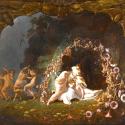
Each year she photographed two sets of identical twins until one of them died and the project was abandoned. (Pictured below: Twins, MAX DIED from Catalogue raisonné of the unfinished, 2023).

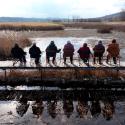
Voir la Mer 2011 (main picture) is the most moving work on show. Calle was offered an exhibition in Istanbul, a city surrounded by sea. On discovering there were people who lived inland and had never seen the sea, she decided to give them the opportunity. Each is filmed from behind, staring at the ocean for the first time. When they turn to look at the camera, they seem shell shocked, overwhelmed, and on the verge of tears.
And I am deeply moved, but I also find myself wondering whether I’m projecting my own feelings and expectations onto these strangers. How, after all, can I presume to read these unfamiliar faces? And another question quickly follows: how does one read any image and understand its meaning and import?
Calle’s work has this power. It destabilises your thinking in a gentle but persuasive way and makes you question your assumptions and preconceptions. She often uses humour – I Iaughed my way round the exhibition – but as a device to prompt introspection.
And as though to alert you to the untrustworthy nature of images, the show opens with a tiny black and white photo of Sophie as a little girl. Or so you think. In fact, the picture is an oil painting by Elisheva Biernoff that mimics a childhood photograph.
Things are rarely what they seem, especially in the age of AI!