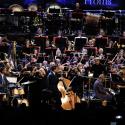
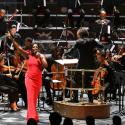
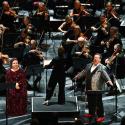
It needs saying yet again, until the message gets through: Bohuslav Martinů is one of the great symphonic masters of the 20th century, and his fellow Czech, chief conductor of the BBC Symphony Orchestra Jiři Bĕlohlávek, once more proves the right man to marshal a golden Martinů revival. It needs saying above all because, for all the beauties and oddities in every bar of the six symphonies, composed at the height of the exiled composer's mastery in America and France between 1942 and 1953, the Third Symphony is perhaps the one which cries out masterpiece from embattled start to shatteringly moving finish. I never thought I'd be writing this, but last night it even outshone by a long way two intriguing but problematic works by Stravinsky and Prokofiev.
In the case of the Stravinsky, his Symphony in Three Movements premiered in January 1946 only three months after the first performance of Martinů's Third, the problem is one of underlying symphonic logic. Every sound the orchestra makes, from the combative jazz punches of piano to the twitchy chamber-musical genuflections of the slow movement, is unforgettable, vintage Stravinsky; but the way the ideas are cut and pasted together can't be disguised even in such a handsome and lithe performance as last night's. Stravinsky assembled his themes over several years; so "three movements for orchestra" might be a more honest title. At any rate, there were some ineffable textures on parade here, crowned by flautist Daniel Pailthorpe and one of the world's top harpists, Sioned Williams, in the vision Stravinsky originally intended for Franz Werfel's superior weepie The Song of Bernadette, before disagreements ensued and Alfred Newman took over.
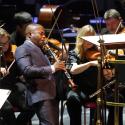
Prokofiev's youthful Second Piano Concerto is a monster apart. No chink of light appears as this tyrannosaurus rex of concertos lumbers and flashes its way through three sometimes soulful juggernaut movements and a coruscating scherzo. The scherzo, in fact, was the only one that found Barry Douglas, one of the few pianists alive able to play the work, in less than diamantine form. Maybe a certain sustaining-pedal muddiness was his way of getting through it; for even Prokofiev himself, having conjured the beast for his own pianistic brilliance, writes in his diaries how he had to take a break after the first movement with its vast cadenza, and then play the entire toccata pianissimo to stay alive. Douglas's version of high-octane power, forthright and muscular elsewhere, didn't perhaps get to the desperate sadness at the heart of the opening Andantino; uniquely, he had more in reserve for the thoughtful solo in the tempestuous finale. BBC Symphony brass and wailing woodwind supported him to the hilt, though cohesion wasn't always perfect.
This was an oppressive ash-cloud of a programme, desperately seeking someone to make the transcendent leap into clear blue skies. It was eventually to get it, but the grim mood persisted in the first movement of the Martinů symphony, even if its lean counterpoint and lilting rhythms took the lid off the turgid flailings of young Prokofiev. Bĕlohlávek now gets world-class playing from his BBC strings, the odd smudge in the lopsided phrasing forgivably excepted; and in none of the six symphonies are they more exposed. You imagine they're going to get the lion's share of the extended tragedy in the Largo, but Martinů's fluid imagination cuts them dead and produces instead a threnody for solo woodwind supported only by stuttering rhythms in timpani and double basses and dry little scales from the all-important piano part (Elizabeth Burley, crucially focused as ever). Here's what's missing in the Stravinsky - a long-term symphonic argument that moves in waves of emotion, but never predictably.
If that weren't enough - and this is as fine a Largo as any in the symphonic literature - Martinů goes further in his greatest finale. His severe depression in early 1944, a delayed reaction to the shock of exile, the loss of his great love, the promising composer Vitĕzslava Kapralová, and a non-stop workload, still overhung his laboured start in composing the symphony, and an optimistic ending seemed doubtful. But the D-Day landings gave him some cause for hope that June. So an embattled Allegro burns itself out; the violas, sounding fabulous last night, lead us onwards and a concerto grosso-like quartet of solo strings haloed by the rest of each section treads air towards an uncertain future. Even that's not all there is. Woodwind pipe exultant miniature fanfares, the optimism cuts off again; E major warmth returns to hover in the air, but the question marks and dissonances butt in to the very last note.
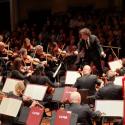
In all this, no one alive knows better than Bĕlohlávek how to move towards the centre of Martinů's peculiar earth, how to drive home a single chord as climax, how to make us shed inexplicable tears. I wasn't the only one to emerge from the concert reeling from my first live acquaintance with this work of genius, convinced that what I'd heard was up there with the greatest Shostakovich or Nielsen symphonies. If this series doesn't mark a turning point in Martinů's fortunes, nothing will.
Prokofiev's youthful Second Piano Concerto is a monster apart. No chink of light appears as this tyrannosaurus rex of concertos lumbers and flashes its way through three sometimes soulful juggernaut movements and a coruscating scherzo. The scherzo, in fact, was the only one that found Barry Douglas, one of the few pianists alive able to play the work, in less than diamantine form. Maybe a certain sustaining-pedal muddiness was his way of getting through it; for even Prokofiev himself, having conjured the beast for his own pianistic brilliance, writes in his diaries how he had to take a break after the first movement with its vast cadenza, and then play the entire toccata pianissimo to stay alive. Douglas's version of high-octane power, forthright and muscular elsewhere, didn't perhaps get to the desperate sadness at the heart of the opening Andantino; uniquely, he had more in reserve for the thoughtful solo in the tempestuous finale. BBC Symphony brass and wailing woodwind supported him to the hilt, though cohesion wasn't always perfect.
This was an oppressive ash-cloud of a programme, desperately seeking someone to make the transcendent leap into clear blue skies. It was eventually to get it, but the grim mood persisted in the first movement of the Martinů symphony, even if its lean counterpoint and lilting rhythms took the lid off the turgid flailings of young Prokofiev. Bĕlohlávek now gets world-class playing from his BBC strings, the odd smudge in the lopsided phrasing forgivably excepted; and in none of the six symphonies are they more exposed. You imagine they're going to get the lion's share of the extended tragedy in the Largo, but Martinů's fluid imagination cuts them dead and produces instead a threnody for solo woodwind supported only by stuttering rhythms in timpani and double basses and dry little scales from the all-important piano part (Elizabeth Burley, crucially focused as ever). Here's what's missing in the Stravinsky - a long-term symphonic argument that moves in waves of emotion, but never predictably.
If that weren't enough - and this is as fine a Largo as any in the symphonic literature - Martinů goes further in his greatest finale. His severe depression in early 1944, a delayed reaction to the shock of exile, the loss of his great love, the promising composer Vitĕzslava Kapralová, and a non-stop workload, still overhung his laboured start in composing the symphony, and an optimistic ending seemed doubtful. But the D-Day landings gave him some cause for hope that June. So an embattled Allegro burns itself out; the violas, sounding fabulous last night, lead us onwards and a concerto grosso-like quartet of solo strings haloed by the rest of each section treads air towards an uncertain future. Even that's not all there is. Woodwind pipe exultant miniature fanfares, the optimism cuts off again; E major warmth returns to hover in the air, but the question marks and dissonances butt in to the very last note.
In all this, no one alive knows better than Bĕlohlávek how to move towards the centre of Martinů's peculiar earth, how to drive home a single chord as climax, how to make us shed inexplicable tears. I wasn't the only one to emerge from the concert reeling from my first live acquaintance with this work of genius, convinced that what I'd heard was up there with the greatest Shostakovich or Nielsen symphonies. If this series doesn't mark a turning point in Martinů's fortunes, nothing will.
- Last instalment in Bĕlohlávek's Martinu symphonies series with the BBCSO, featuring the Sixth Symphony alongside Tippett and Schumann, is at the Barbican on 8 May
- Check out the BBCSO's 2010-11 season at the Barbican
- This concert is due for broadcast on Radio 3 on 20 April, available online for seven days afterwards via the BBC iPlayer