

En Équilibre addresses the impact of disabling and irreparable injury, thwarted ambitions, the questionable practices of insurers, and the connection between two dissimilar, yet both frustrated, characters. Despite its different strands, the film adeptly draws them together into a coherent and unexpectedly enthralling whole.
The director of En Équilibre (In Harmony) is Denis Dercourt. His benchmark film The Page Turner (2006) echoes through En Équilibre. Both feature a female would-be concert pianist who has ended up in a job which frustrates (at a solicitors rather than, in En Équilibre, an insurance company). As in The Page Turner, one of the leads has a relationship with a supporting character who crops up coincidentally elsewhere in the film during interactions with the other lead. Both films show the trauma which comes after an accident (a car crash rather than an accident on a film set). None of this is to say En Équilibre is formulaic or predictable, more that Dercourt knows how to exploit his deft style for maximum effect.
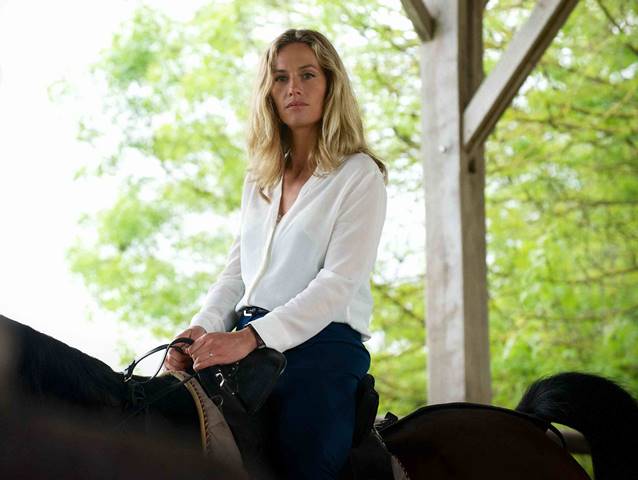 Marc (Albert Dupontel) is a stunt-rider who is injured while working on a film. His horse steps on his back after a stunt, damaging his spine. Now paraplegic, he will be in a wheelchair for the rest of his life. Although his insurance company pay for the necessary alterations to his farmhouse home in west France, they want to limit the pay-outs so despatch Florence (Cécile de France, pictured right) to cajole him onto taking the deal they offer. He protests that it is his body that is injured, not his brain. Soon, it’s clear the insurers have little regard for openness and honesty.
However, Florence is drawn to Marc and he to her. His burning desire to ride again inspires her to dredge up old ambitions to be a concert pianist. They sleep together and Florence decides to help Marc in his battle against her employers. Her salesman husband, knowing nothing of the relationship, arrives at Marc’s home with a quad-bike he has sold him to bring some mobility. Ultimately, she is sacked and both set about achieving their ambitions.
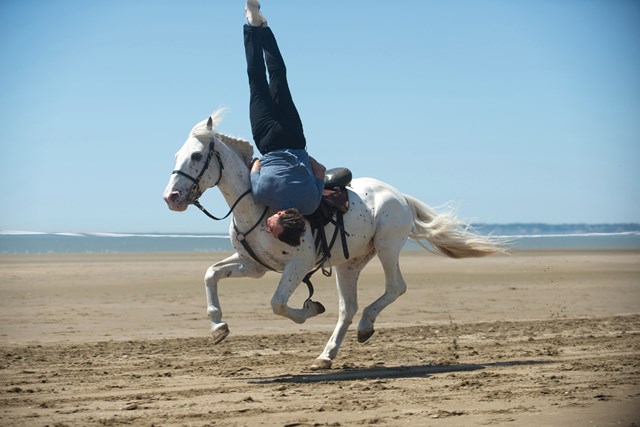 The film draws from the real-life story of Bernard Sachsé, an equestrian stuntman whose book Sur mes quatre jambs touched upon his fight with an insurance company after he was left in a wheelchair due to injuries sustained after a stunt. Dercourt took Sachsé’s story, added the character of Florence and amplified the battle over the insurance. Sachsé was on set as an advisor on equestrian matters. Like Marc, he also eventually managed to get back on horseback.
Although an outline of En Équilibre and its background suggests it could be dry, this is a poignant, warm film with moments of humour, and centres on the unlikely relationship between the insurance agent, who is not the hard case she is meant to be, and the emotionally and physically wounded, yet unbowed, Marc. Dupontel is matter-of-fact but affecting. In flashback scenes, he extraordinarily undertakes all the stunts himself – there is no stunt double (pictured above left). The nuanced and stately de France gradually reveals Florence’s depths. Her first scene on horseback actually captures her very uncertain real-life maiden ride on a horse – and in high heels too (pictured above right). The film has an enviable spontaneity.
It is easy to see how En Équilibre could be remade in America as an overly sentimental account of striving against the odds. Hopefully, that will not happen. Any remake would be a parody of Dercourt’s finely formed film.










Add comment