

The perception of Steven many-hats Berkoff as “one of the major minor contemporary dramatists in Britain” makes sense when you see this. Here are two chamber pieces, both two-handers, written 20 years apart, which gain hugely from being run together. Indeed, it’s hard to imagine either of them having much of a life as a single entity, since even combined they make a short evening at the theatre. But “minor” isn’t a term you’d normally reach for to describe a playwright whose name has become descriptive: Pinteresque, Beckettian, Berkoffian… Undeniably his is a style, an outlook, a poetic diction that – love it or loathe it – is bracingly distinct.
Berkoff’s lifelong campaign against what he sees as the bourgeois theatre of realism means that his characters (mostly “ordinary” people) do not speak as ordinary people do. They blurt out, often in the course of long, tortuous monologues, fears and cravings and resentments that can only be subconscious. And the language in which they express them is equally startling. It can be crude, caustic, florid-poetic and even sometimes beautiful, but never mundane.
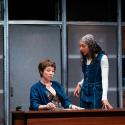
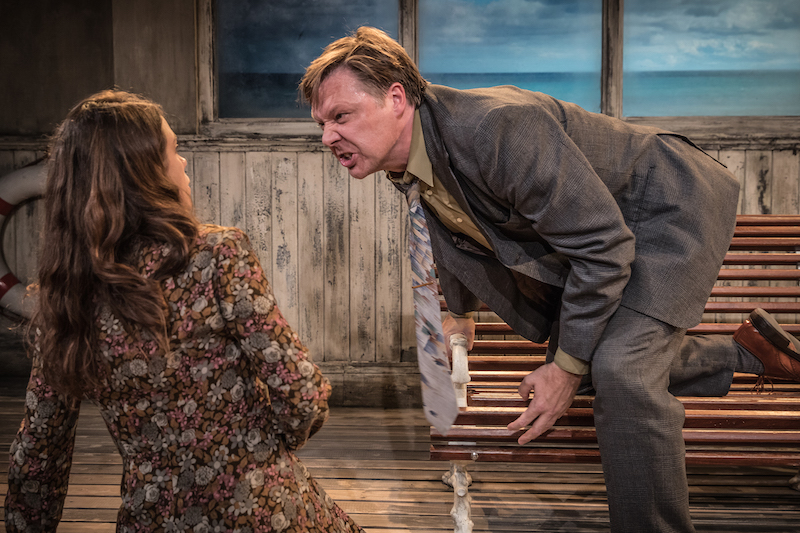 The naming of the dramatis personnae as merely “Man” and “Woman” led an earlier production of Lunch to present the actors in whiteface, as if they were stock characters in commedia. Nigel Harman, directing this revival at the intimate Trafalgar Studios, goes the other way. To look at them, Shaun Dooley and Emily Bruni (both pictured above) would pass for any small-time advertising salesman and bored housewife taking a mid-day break on the pier – suggested attractively by Lee Newby’s sea view, salt-bleached decking extending under the audience on three sides.
So far, so ordinary. She has just finished her fish and chips. He is looking for a place to sit. It’s only when Dooley goes into an extravagant, comically prolonged, whole-body spasm on clocking an attractive lone female that you realise the need to recalibrate your definition of “ordinary”. For a play that involves two strangers sharing a bench in a public place, it gets remarkably physical remarkably quickly. It also, peculiarly, breaks the fourth wall from the off, with Dooley tipping a wink at the audience about the bird he thinks he’s about to snare.
Do they really have full coitus behind the bench, or only in their heads?
The comedy, and there is plenty of it, comes largely from the actors’ control of tone, and the text’s constant collisions of fantasy and earthy reality. “Her buttocks are sailing towards my hands like a tea clipper,” salivates Dooley, waggling his fingers revoltingly. “Strange thing to say on a beach,” responds Bruni, in the voice of dull put-down perfected by Dandy Nichols in Till Death Us Do Part.
Do they really have full coitus behind the bench, or is the sex in their heads? It’s a testament to the artfully tangled web of frankness and delusion and lust, on both sides, that it doesn’t matter to the drama either way. The Bow of Ulysses, written in 2003, returns to the same Man and Woman 20 years on, sharing the same seaside bench, but now poisoned by marriage to each other. This is as bleak a view of the traditionally coupled life as it’s possible to take. He resents having had his manly juices sapped by her “neurotic needs”. She more straightforwardly loathes everything about him. And if this sounds grim, it is: comedic moments are scarce in this half of the evening, but the play’s very extremity allows the audience some distance. You would be unlucky indeed to end up like either of these two.
The play’s other saving grace is the way it showcases the actors’ subtlety and skill. Those monologues are triathlon-like in their demands on stamina and technique. But why revive the experimentalism of two generations ago? True, one decade’s experiment is another’s period classic, but it is still too soon to know how long a shelf-life Berkoff will have. What is interesting to discover is that this material still has the power to shock, and without showering the text with expletives. Today’s effing young playwrights might take note.




Add comment