David Pinner's 1973 play showcases a string quartet working out their own problematic relationships while world leaders decide the shape of post-war politics. Between bouts of playing Haydn, Bartok and - at Stalin's request - Borodin in the conference chamber, they bicker in the anteroom next door.
That anteroom setting seems to offer opportunities for juxtaposing the values of art and politics, but in the end merely provides a backdrop. The four-string players would be bickering in just this way if they were entertaining guests at a posh wedding in the Home Counties. They even reassure the young armed Soviet soldier who stands guard over them that their bitchy outbursts don't threaten real violence as they are part of a familiar ritual. However, the soldier's potentially dangerous presence stands in for Stalin's unpredictable power, while the musicians' fractious exchanges reflect a search for elusive harmony.
No historical person appears in The Potsdam Quartet, although the characters of Aaron Green and his three colleagues were inspired by the Griller Quartet who did indeed entertain Stalin, Truman, Churchill and Attlee at Potsdam and whose professional career ended in disarray after similar personal differences. Attlee, incidentally, replaced Churchill at the table after the 1945 election.
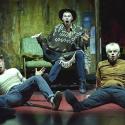
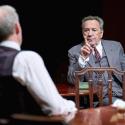
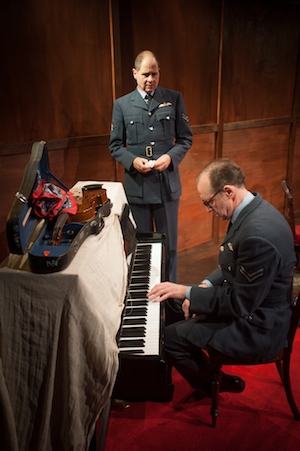 Pinner focuses on the interaction between people who know each other very well, to the point of destruction. The quartet has some of the characteristics of a souring marriage and includes a couple who are partners well used to threatening and blackmailing each other. Their relationship is also a potential threat to the quartet: homosexuality was illegal and public revelation could lead to scandal and career suicide. What a shame that Stefan Bednarczyk (pictured right, at the piano) as needling John Healey and Philip Bird as his manipulative, pill-popping lover Ronnie are not given the opportunity to move much beyond queenie stereotypes.
Hurtful bickering only becomes a spectator sport if the jibes are landed squarely, with perfect timing. This rarely happens here, unfortunately, so the humour is muted. Neither does Anthony Biggs' direction provide sufficiently varied tone and colour: when John suddenly mentions the smell of corpses in the pinewoods there is no jolt of horror.
Michael Matus as Aaron Green gets to the kernel of the matter when he makes a speech about his overriding passion for the quartet's sublime music-making. He has sacrificed everything else and regards the perpetual quarrelling and even the revelation of the cellist's symptoms of Parkinson's disease as mere hurdles to be overcome or ignored in the cause of making a beautiful sound. The quartet is his reason to live; war, peace, love and parenting all take second place. Douglas the cellist (Daniel Crowder) regales the others with tedious limericks, nicks "Winnie's" vodka and goes along - for now - with Green's fiction of a successful future.
Eventually a combination of music and childishness appears to cement the quartet's bond but they are merely papering over the widening gulfs between them. A musical Cold War is as inevitable as the political one.
The Potsdam Quartet is at Jermyn Street Theatre until November 23