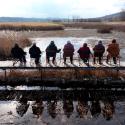
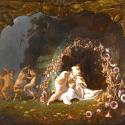
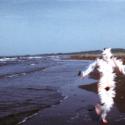
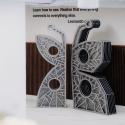
Terry Setch can lay claim to being the most underrated artist in Britain. Not that the Cardiff-based Londoner has been entirely neglected: acclaimed as one of Britain’s most powerful painters by his contemporary John Hoyland, he’s been garlanded with awards, granted a retrospective at The Serpentine and was recently made an RA. Yet Setch (born 1936) has still had nothing like the recognition he deserves as one of Britain’s most intelligent and inventive painters. And the crime for which he’s been sentenced to this relative obscurity: simply, not being based in London, but in Wales.
If the idea of a Londoner moving to Wales suggests a retreat from the real world into a perpetual holiday of Celtic myth and elemental landscape, nothing could be further from the truth in Setch’s case. His subject since the early 1970s has been the post-industrial coastline around Cardiff, where the second highest and lowest tides in the world wash household detritus and chemical swill over limestone beaches and endless miles of gelatinous mud. Rather than observing this from the comfort of a cliff-top, Setch drags his canvases out onto the mud, putting himself physically in the picture in the manner of Jackson Pollock, while commenting on the process with an ironic wit worthy of Robert Rauschenberg. Except that where Rauschenberg seemed to scarcely move on from the glories of the early 1960s, Setch’s work has continually evolved. From early paintings of walls that are a fascinating, but little known aspect of British Pop Art, he created epic works on ecology in the 1980s embedding found objects in sumptuously layered oil and wax paint – as in Tate’s Once Upon a Time There Was Oil – while his current works take a superficially more traditional approach to landscape.
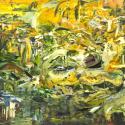
As the proposed Severn Barrage threatens to change Setch’s chosen land and seascape for ever, his Lavernock series looks at this dynamic confluence of man, land and sea with a sideways glance at the Impressionist Alfred Sisley, who painted on the cliffs at Lavernock, a few miles south of Cardiff. If the paintings show a touch of Turner too in their lavish but ethereal encrustations of paint, these are the works of an artist who has gone almost to the end of painting, and come back with a wealth of experience behind him. The exhibition at Islington’s Art Space Gallery makes a worthy introduction to an endlessly intriguing artist.
Click on a picture to enter the slideshow.
[bg|/ART/mark_hudson/Terry_Setch]
- Lavernock 11, 2009.
- Lavernock Sun Up, 2009.
- Lavernock 16, 2009.
- Lavernock 2, 2009.
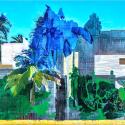
- Teasels, 2010.
- Lavernock Cliffs, 2010.
- Terry Setch at Art Space, London N1 until 25 July.
- Find Terry Setch on Amazon.
- View theartsdesk's Photographic Gallery: A Landscape of Wales