

Although the composer singled out as the flagship promotional hook for the Bournemouth Symphony Orchestra’s concert was the “Brilliant Mendelssohn”, the programme also highlighted Mozart, Schubert and Britten to complete a quartet of musical child prodigies.
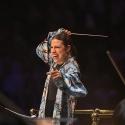
Nurtured in Vienna via choral, orchestral and operatic work as well as studying the violin, the Austrian-Spanish conductor Teresa Riveiro Böhm has recently been Leverhulme Conducting Fellow in partnership at the Royal Conservatoire of Scotland with the BBC Scottish SO, as well as working towards a Specialised Master’s Degree in conducting at the Zürich University of Arts. Her conducting experience now attracts significant international attention extending throughout Europe and beyond.
Opening with the Overture to Mozart’s Così fan tutte, the music ducked and dived at every twist and turn, immediately announcing a distinctive calling card of natural rapport with the orchestra. The concisely contrasted four vignette movements of the young Britten’s deceptively Simple Symphony went on to consolidate a stylish spontaneity that turned on the composer’s expressive pinhead with needle-sharp focus, gravitas and winning flexibility – a telling demonstration of how less really can be more.
Mendelssohn’s Violin Concerto followed with Hungarian violinist Kristóf Baráti playing a 1702 "Lady Harmsworth" Stradivarius, a richly sonorous instrument that made for an unusually robust and chunky solo performance that at times sounded slightly mis-matched with the leaner collective sound from the 8.6.5.4.3 configuration of the orchestral string section as well as offering less intimacy with the ever-articulate BSO wind ensemble. That said, there was a welcome seriousness of purpose befitting the later composer’s more romantically inclined intensity in the first two movements that contrasted ideally with the mercurial Midsummer Night’s Dream chase in the finale. Baráti’s sovereign playing of the brief Sarabande from Bach’s solo Partita No. 2 in D minor as an encore allowed the Strad to shine with full splendour.
Schubert’s Fifth Symphony proved to be a gift for Riveiro Böhm to show her strengths to the full. With confident precision of stick technique, notably willowy body language that mirrored the phrasing of the music and smiling encouragement throughout, the performance thrived on shared inspirational openness and spontaneous energy between conductor and orchestra. The composer’s most lightly scored and sunniest tribute to Mozart sparkled and glowed with full and exuberant realisation of his early style and genius.







Add comment