If Florian Zeller isn’t a Wordle fan, I’d be very surprised. As with the hit online game, the French playwright likes to offer up a puzzle for the audience to solve, clue by clue, before the curtain falls. His latest play, The Forest, which had its world premiere at the Hampstead Theatre in an unusual move for this writer, is his most purely puzzle-like yet, and also his least rewarding.
Whereas Zeller’s standout play, 2012’s The Father (a double Oscar-winner in its screen adaptation last year), wrung poignancy from its theatrical tricks at every turn, his shtick here is all trick: what he calls “an experiment with form”. Nothing stays the same from scene to scene. You watch the first one and think you are in for another helping of the bourgeoisie’s discreet charm, ie hypocrisy and infidelity. An eminent surgeon (Toby Stephens) has returned to his elegant home to mop up the tears of his daughter (Millie Brady), who has discovered her partner’s infidelity in the time-honoured way of finding an incriminating letter in his jacket pocket.
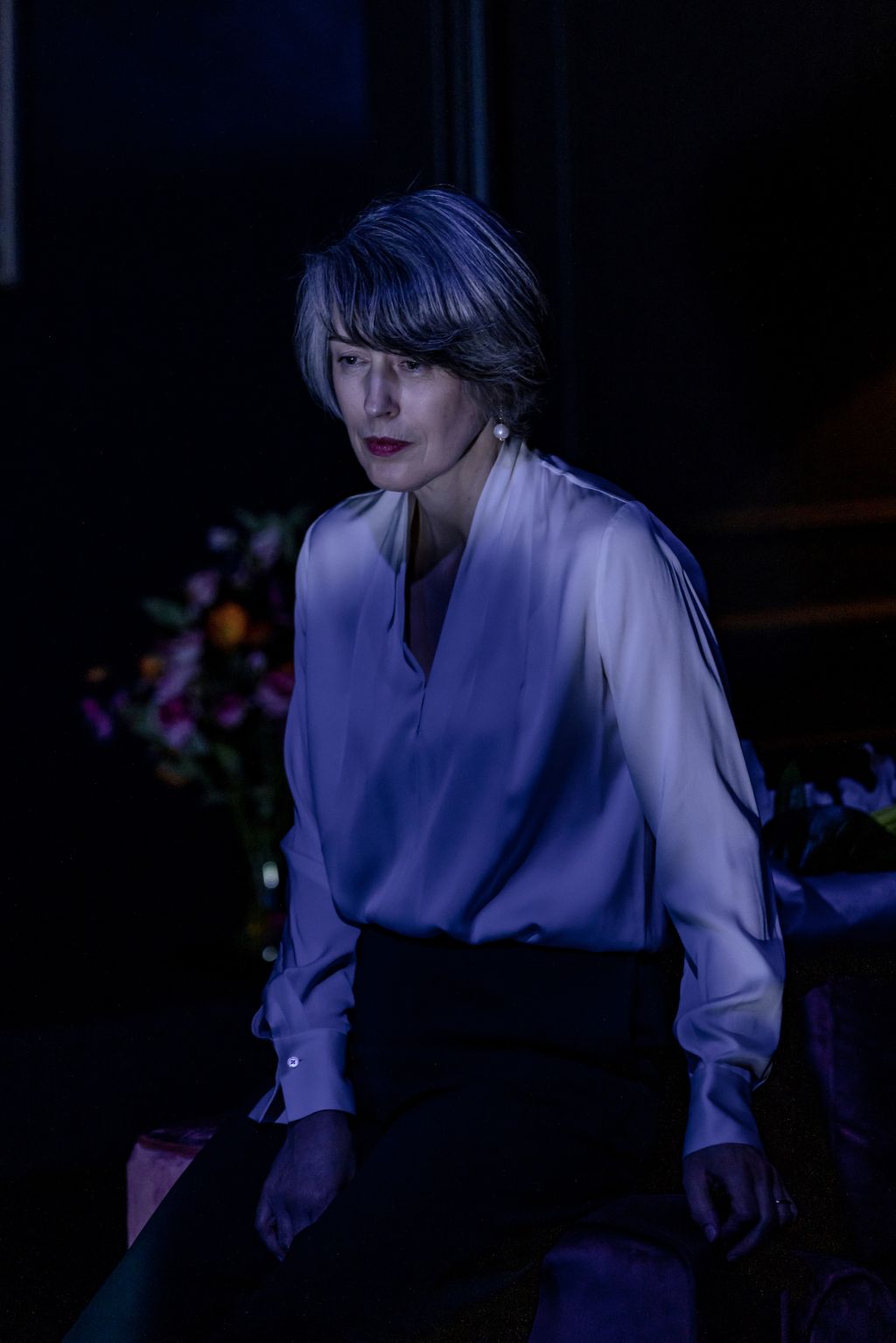 The father’s insouciance about this turn of events immediately prompts the suspicion that he, too, has been guilty of this kind of affair; meanwhile, he protests to his kindly, elegant wife (Gina McKee, pictured right) that the affair doesn’t mean anything and should be forgiven. Surely Zeller isn’t revisiting the world of The Truth, his 2016 London play about unfaithful married professionals?
Not exactly, as the action next zooms up to a second set built directly atop the first (impressive designs throughout from Anna Fleischle), this a bedsit papered in a busy pattern of prison-bar-like fencing and roses, where an older man (Paul McGann) is dressing after having had sex with a young woman called Sophie (Angel Coulby). The ambience is boho yet volatile, the young lover a little loud and pushy, their parting tainted with her jealousy of his wife. Are these two men – identified in the cast list only as Man 1 and Man 2 – connected in some way? Is this man, Man 2, the kind of lover Man 1 from the first scene would like to be? Is Man 1 dreaming about Man 2?
We next move to a third stage area, a small office to one side, where Man 1 is talking to a hangdog young man (Eddie Toll) we assume is Sophie’s straying lover. He resents the interrogation and suggests Man 1 is a hypocrite if he says he doesn’t lie. By now we assume Man 1 does indeed lie, but about what? A couple of scenes later the same office is seen again, this time inhabited by a character known as the Man in Black, a ghoulish creature with whiteface makeup and a sinister manner, who insists he is going to find out “the truth” from Man 1: Finbar Lynch has great fun spitting out Christopher Hampton’s English-language translation in this role. He threatens a silent Man 1 with a “mutual friend” – Man 2 – and Man 1 suddenly collapses in panic. Why ?
From this point on, you realise you are being presented with sliced-and-diced characters whose basic traits distort increasingly nightmarishly with each repeat as they rotate through these three playing areas. Their identities shift, they rerun scenes as each other, vanish from a scene where others are talking to them as if they were still present, swap lines of dialogue. Even the painting in Man 1’s home changes, from a young woman lounging on a bed in the style of Degas, to Sophie lying on her bed with the busy wallpaper behind her.
By the final blackout we will find out what the play’s title signifies, who the Man in Black might be, what the action we are watching represents. There is some satisfying acting and directing (the latter from Jonathan Kent, a Zeller/Hampton alumnus) along the way, and, mostly, it’s an intriguing, even entertaining ride. But the end doesn’t bring any stirring emotional payoff, or even great intellectual insight, just the pleasure you might get from completing a puzzle.