

Copeland was imprinted early. He remembered sitting in a dark room aged seven, listening to Carl Orff’s Carmina Burana, and recognising in some way that music was it for him.
He surveyed a variety of music-making, from Nigel Kennedy to Bob Dylan to Wagnerian opera, and we glimpsed an alarmingly young Elton John. Copeland’s fervent belief is that music and stories are perfect partners. Wagner wanted his music to tell a story, explicitly with a programme; the antithesis was the romantic Brahms who wanted music to be a kind of absolute music for its own sake, the story not so important. But Copeland wanted to show that the listener can never resist some kind of narrative, however imagined, accompanying the music in the mind’s ear.
Interviews ensued with the leading neuroscientist Daniel Levitin, who has found that music activates more of the brain than language and speech, and that music is the language of emotion. Composers for film have known this all too well – hence John Williams’s score for Jaws, Star Wars and the rest. Francis Ford Coppola (pictured below with Copeland) ensured that Ride of the Valkyries became indelibly linked to the helicopter attack in Apocalypse Now. Music does something that pictures can’t do on their own. There was a scene of Copeland walking across a bridge in Paris, underscored by different musical accompaniments. Tension, mischief and black comedy were all suggested.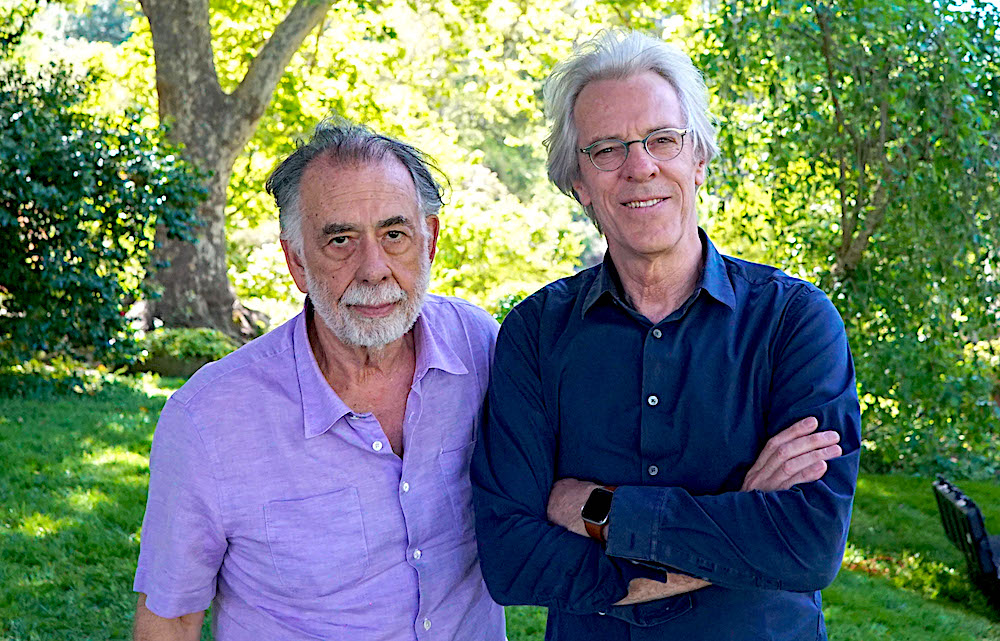 How explicit should music be? How much do we need lyrics? Sting told us that he created lyrics to draw the listener into the narrative, writing the music first, with a beginning middle, end, and then the lyrics. "Every Breath You Take" was written in the back of the band’s bus on the autobahn in Germany. The chords are dark, music and lyrics are about surveillance, and deliberately ambiguous. On to French Cuban African singers who composed using the Yoruba language, and then to hip hop. Rap and hip hop hop is now the most consumed pop music on the planet, and it's certainly a genre for stories that which would never have been heard but for the music.
But we can also be easily manipulated. The power of music to brand and sell products was exemplified by the director Ridley Scott who, nearly 50 years ago, harnessed Dvorak’s New World Symphony to sell Hovis bread (still a most loved commercial). Now a German composer has created a three-note phrase to sell technology company Intel.
Assertion was always followed by musical demonstration. One good song is better than a thousand speeches. People are made up of their memories, and the memories and emotions are attached to music. At times, Copeland’s exuberant body language and almost manic enthusiasm could be exhausting to watch. But he has created an extraordinary visual and aural essay on the power of music to embed itself into our lives and its capacity to express sympathy and empathy.









Add comment