DVD: Far From The Madding Crowd

Carey Mulligan sparkles but Thomas Vinterberg's Hardy is only a partial account

share this article

Carey Mulligan as Bathsheba Everdene: her farm has plenty of bushels but her light remains on show

Danish director Thomas Vinterberg specialises in claustrophobic, asphyxiating atmospheres, from his breakthrough family abuse tale Festen to the more recent study of small-town paranoia, The Hunt. Moving from domestic close-up to the Wessex wide shots and cosmic panoramas of Thomas Hardy, there’s a grinding of gears, and choosing Far From The Madding Crowd as his Hardy debut, when John Schlesinger’s 1967 adaptation is so revered, seems provocative.

The Wessex countryside comes across as postcard-pretty rather than awesome and bleak

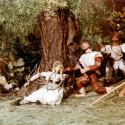
Vinterberg has cast well, and Carey Mulligan as Bathsheba Everdene brings the sort of endlessly dimpled coquettishness that ignites many a country passion, while Michael Sheen invests the character of Boldwood with a convincingly intense neurosis. Matthias Schoenaerts, as Oak, is perhaps too beautiful: it’s a wonder Bathsheba hasn’t tumbled him in the hay long before the final proposal. Vinterberg composes small, tense emotional scenes very skilfully. For me, this included Troy’s infamous sword-display seduction of Bathsheba, which here – controversially – ends on a clutch to the crotch that rather startlingly emphasises Troy’s serpentine opportunism.

Hardy’s other great character, the Wessex countryside, comes across as postcard-pretty rather than awesome and sometimes bleak, and this, along with the absence of most of the rustic crowd scenes, suggests Vinterberg’s immersion in Hardy was shallow and short-lived. His stories need both minor characters and open space in which to grow and develop, yet perhaps the most glaring contrast with Schlesinger’s version is the excision of over an hour from the running time. It’s almost as if he’s re-made Schlesinger for television, taking out the moody panoramas and chuntering rustics, to concentrate on the drama between principal characters. Despite excellent individual scenes and performances, what’s left lacks any clear aesthetic vision, and the sense of landscape and nature as agents in the story, essential in Hardy, is absent here. For once, the sum of the parts is greater than the whole, in this talented, but limited interpretation.
Add comment

The content of this field is kept private and will not be shown publicly.

Plain text

  • No HTML tags allowed.
  • Lines and paragraphs break automatically.
  • Web page addresses and email addresses turn into links automatically.
It’s almost as if he’s re-made Schlesinger's 1967 adaptation for television

rating

3

share this article

the future of arts journalism

You can stop theartsdesk.com closing! 

We urgently need financing to survive. Our fundraising drive has thus far raised £33,000 but we need to reach £100,000 or we will be forced to close. Please contribute here: https://gofund.me/c3f6033d

And if you can forward this information to anyone who might assist, we’d be grateful.

Subscribe to theartsdesk.com

Thank you for continuing to read our work on theartsdesk.com. For unlimited access to every article in its entirety, including our archive of more than 15,000 pieces, we're asking for £5 per month or £40 per year. We feel it's a very good deal, and hope you do too.

To take a subscription now simply click here.

And if you're looking for that extra gift for a friend or family member, why not treat them to a theartsdesk.com gift subscription?

more film

Love, loss and belief collide in rural India in Aribam Syam Sharma’s 1990 feature
Bing Liu directs a lukewarm adaptation of Atticus Lish's novel
Underwhelming parody of ‘Downton Abbey’ and its ilk
A tale of forced migration lifted by close-knit farming family, the Conevs
A chiller about celebrity chilling that doesn’t chill enough
The Iranian director talks about his new film and life after imprisonment
Inspiring documentary follows lucky teens at a Norwegian folk school
Seymour Hersh finally talks to a documentary team about his investigative career
Jafar Panahi's devastating farce lays bare Iran's collective PTSD
A queer romance in the British immigration gulag
The French writer-director discusses the unique way her new drama memorialises the AIDS generation