

The village of Cesinova has the largest white stork population in Macedonia; every chimney and steeple is festooned with the scruffy nests of these enormous birds. We see the flock arriving in spring to reclaim their nesting spots. Perched on a huge mound of twigs and leaves, each pair settles in by tossing back their long necks and clattering their beaks in greeting.
Once the eggs have been laid and the chicks hatched, the hard work begins; but the timing is perfect. The farmers are just beginning to plough their fields and we see the storks gobbling up any frogs, mice and snakes escaping the lethal blades and, back on the nest, regurgitating the catch for their hungry offspring.
Jean Dakar’s camerawork is superb. Getting this close to wild birds requires endless patience and the award winning director, Tamara Kotevska and her team spent three years befriending the storks, until they could get up close or send in drones without panicking the nesting pairs.
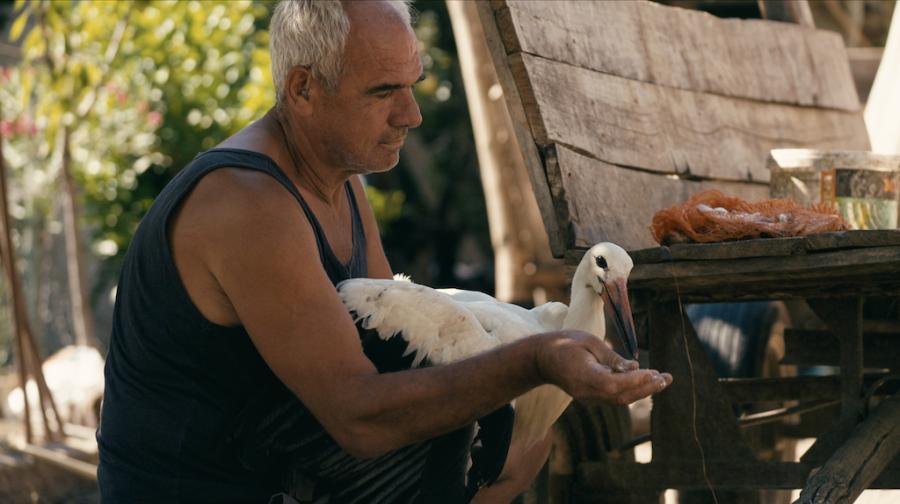
Filming the birds meant liaising with farmers such as the Conev family (main picture), who are absolute naturals in front of the camera. And the project soon developed into a documentary about this close-knit family, the problems they face and the impact this has on the birds.
Nikola and Jana Conev’s son has left for greener pastures, but the couple are extending their house to accommodate their daughter Ana and husband Aleksandar, who work on the farm, and grand daughter Ilina. They’ve had a bumper harvest and set off to market in high spirits only to find that prices have plummeted. Unable to get a reasonable return, they have to dump several tons of potatoes, cabbages and water melons and leave them to rot. A protest staged by local farmers falls on deaf ears. The government even refuses to buy their tobacco, declaring the leaves to be substandard.
The young couple have no choice but to leave. They take off for Germany and soon beg Jana to follow to look after their little girl while they work. Nikola is left behind and one of the saddest scenes is of Jana giving her husband a long distance cookery lesson over the phone. It’s the end of an era; he puts the farm up for sale and finds work bulldozing rubbish at the local tip.
With the fields lying fallow, there’s no food for the storks and one of the most heartbreaking scenes is of these graceful birds scavenging for scraps among toxic garbage, which kills many of them and their fledglings. Nikola adopts a stork with a broken wing (pictured above: Nikola feeding the stork) and this unlikely friendship encourages him to make a momentous decision.
The overall message is stark – a community destroyed and wildlife decimated – yet the film is infused with enormous warmth, humour and courage thanks mainly to Nikola who, totally at ease with the camera, is a joy to watch.
Over this real-life story a narrator recounts the Tale of Silyan, a popular legend about a son who plans to leave the family farm. His enraged father curses him, saying: “I hope you turn into a bird, so I may never see you again.” The son turns into a stork and leaves with the migrating flock; he returns the following spring only to find the farm neglected and his father desolate. Father and son are united once more when the lonely old man adopts the stork and begins to work the farm again.
The plan, I guess, was to enhance the power of the film by lending it a mythic dimension; but the real and imaginary stories are so close – the wounded stork is even named Silyan, as though it were an incarnation of the legendary bird – that it makes the Conev family’s predicament seem more like a fairytale than an actual drama with harsh consequences. And in a “post-truth” era plagued with fake news, for me clarity is more important than poetry.






Add comment