When news first filtered through that the Scouse comedian John Bishop’s marital woes were going to be turned into a film, my brain lazily filed its director’s name under the wrong Bradley: Whitford, not Cooper. Having seen Cooper’s Is This Thing On?, I almost wish my brain had got it right first time.
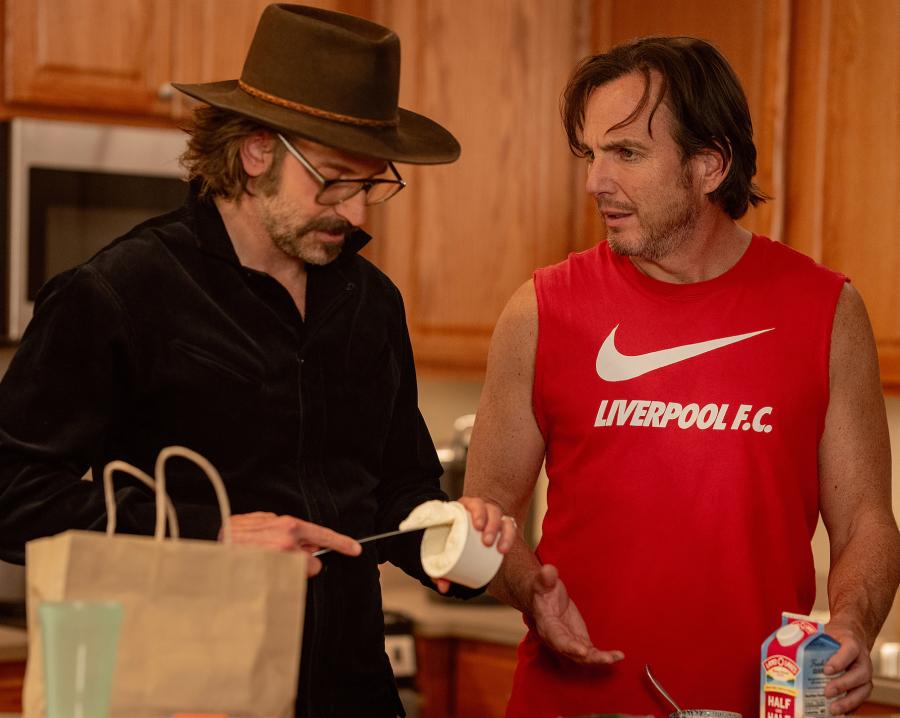
The brittle wit of The West Wing hasn’t yet made a film, alas, but Cooper has directed three. As in the first two, here he is a one-man band: co-writer, producer, director, performer. He could have added “scene-stealing space-cadet stalker of his own movie”, too. As delusional actor Balls (titter ye not), he literally falls into his first scene, tripping over his doorstep unkempt and wildly bearded, spilling (oat) milk everywhere. Later he reappears uninvited, beard trimmed to suit the new role he is going up for and bearing bagels (pictured below with Arnett), at the bachelor pad his friend Alex (Will Arnett) has had to decamp to as his marriage creaks. Why is Alex friends with this dopey man? Alex is clearly not a dopey man.
The script leaves many other questions in its wake. Who is Alex, beyond being a man who works “in finance” whose 26-year relationship with his wife Tess (Laura Dern), a former Olympic volleyball champion, has stuttered to a close? Arnett, a gifted comic actor, projects him as a decent but slightly off-kilter middle-aged man, loving father, loyal son, unhappy husband, the only miserable person at a raucous kids’ event featuring a giant Chinese lion-puppet.
We learn more when he signs up to appear at a local comedy club, to avoid paying the $15 entry fee, and begins the process of unpacking his life onstage. His marriage’s demise is a bottomless pit of material. It’s comedy as therapy, which a lot of standup indirectly is, though rarely delivered with such painful honesty and accuracy. (Standups are notorious fraudsters, inventing material for effect.)
Bishop is a leading light of this conversational style, which relies on a shrewd buildup of observational aperçus any audience can identify with, coupled with an amiable comic persona that can now sell out stadiums. He had once described to Arnett how he reset his marriage through standup and sparked this whole project. Arnett wrote the initial script, with Mark Chappell, his friend Cooper coming on board as co-writer etc later.
Some of Bishop’s experiences have ended up on the screen, notably the evening when, after he had worked the clubs for a couple of years without telling his family, his wife chanced upon his act and witnessed her marriage being disembowelled onstage. When this same thing happens to Alex, he has only been performing for what seems like a month or so. In fact, his instantaneous success — before a, frankly, unbelievably benign crowd — is something a comic narrative can get away with, whereas a real performer probably couldn’t. Arnett, he has revealed, spent six months developing his standup skills in real clubs before filming began.
That may sound like a trivial niggle, but it’s typical of the way the script shoehorns the characters into its schtick. It’s as if 20 episodes of Thirtysomething have been boiled down to just two. Characters played by top-notch acting talent come and go. The virtuosic Sean Hayes, for example, seen last year in London in the Tony-winning Goodnight, Oscar, shows up with his real-life partner (Scott Icenogle) to mooch around in kitchens and play board games. Amy Sedaris has what feels like much less than three minutes of screen time as the comedy booker who encourages Alex on his new path; Broadway star Christine Ebersole similarly has blink-and-you-miss-them moments as his mum.
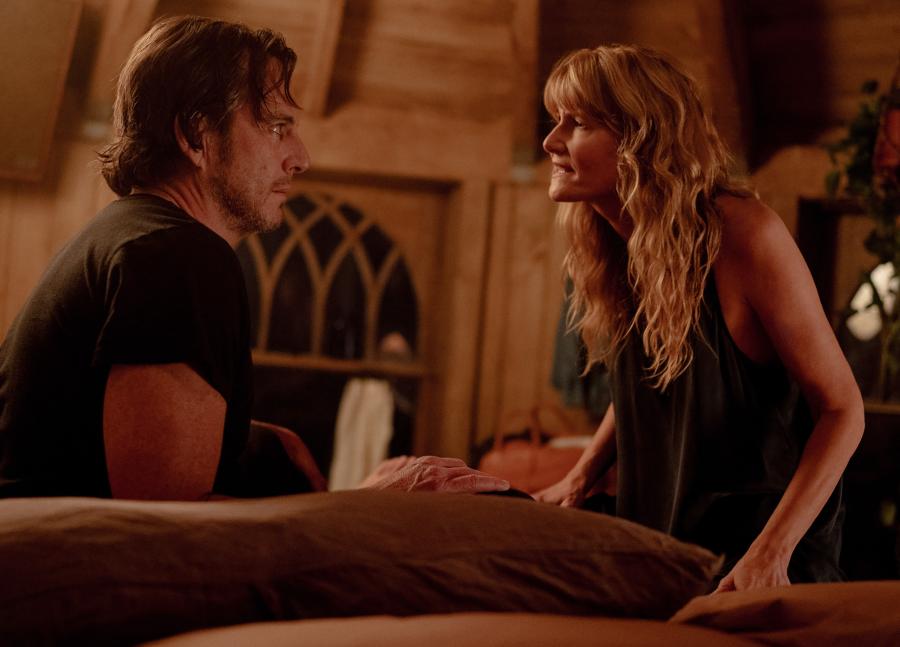
Alex's kindly dad is projected with more substance, partly because he is played by the estimable Ciaran Hinds. But the real loser in this script is Dern's Tess (pictured below with Arnett), who seems to be more an outline of a person than a fully fledged, complicated human being. Dern injects her with all her usual sass, but you wish she had more to work with, other than that Tess is a dedicated coach and mother with a pleasantly impish side, whose patience with her husband has run out. Cooper gives her only a few scenes of her own, where her point of view is primary and her substrata are explored. Alex is the main focus, appearing in almost every scene, typically in intense close-up, just as Cooper’s Leonard Bernstein dominated Maestro, leaving Carey Mulligan’s Mrs Bernstein to fade away like a dying echo.
Luckily, Arnett is a gifted comic actor who can command our attention with mischievous side-eyes or a pithy phrase that lands well, delivered in that distinctive deep voice. We view Alex as an affable lost boy with a palpable will to survive, quick to make friends. Perhaps his fellow performers actually would be as helpful to him as are the two (both women) he befriends, who show him the ropes and induct him into their community. Has he made terrible errors that have set him on course for divorce? Why are he and Tess really teeing one up? Why is he unhappy, for that matter?
The dialogue is awash with shrink-speak, between not just Alex and Tess but also their friends Christine (Andra Day) and husband Balls too. By the end, after much proverbial wisdom of the kind people embroider on cushions has been lobbed in, I wasn’t any the wiser, except that Alex and Tess clearly have good sex. It’s an oyster in need of more grit, the possibility of real pain.