One should never pass up an opportunity to revisit an Ealing comedy. Invariably arch, ingenious and wonderfully played, these dozen or so films made between 1947 and 1957 offer a lovely snapshot of a Britain long gone, while the films themselves still feel remarkably fresh. The Lavender Hill Mob isn’t quite there with the very best of them, but a digital restoration on its 60th anniversary is still irresistible.
An Oscar-winning script by TEB Clarke offers a variation on a regular Ealing theme, of a common man (though not an Everyman) pitted against the Establishment. Alec Guinness is Henry Holland, a shy, rather meek low-level bank employee tasked with accompanying its deliveries of gold bullion. Henry’s is a humdrum life; he hasn’t been promoted in 20 years and lives in a hotel where the highlight of an evening is reading crime thrillers with his fellow guests. But it is enlivened by a dream – to one day rob his own bank.
Every day Henry overplays his anxiety over the transit arrangements, planting the seeds of his plan. Yet as long as the thorny question of how to smuggle bullion out of the country remains unanswered, the robbery remains no more than an idea. Then Henry’s ideal accomplice walks through the door of his lodgings: the loquacious, proverb-quoting Pendlebury (Stanley Holloway), a manufacturer of souvenirs who happens to have his own smelting equipment. Henry particularly likes the models of the Eiffel Tower, imagining that they would look very fetching in gold.
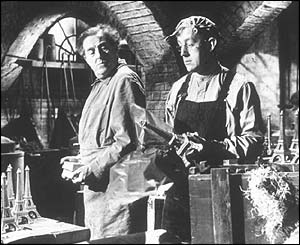 In one of the film’s most charming sequences, Henry and Pendlebury slyly hook two professional criminals – Lackery (Sid James) and Shorty (Alfie Bass) – and invite them to their amateur ranks. The gang in place, Clarke’s plotting and Charles Crichton’s brisk direction then offer up a racy account of the robbery’s planning, the crime itself and its slippery aftermath.
Just a year earlier, Clarke, an ex-policeman, had written The Blue Lamp, a police drama with a striking strain of realism. While it’s tempting to think of The Lavender Hill Mob as the writer’s own light relief to the earlier film, the comedy shares The Blue Lamp’s serious “police procedural” attention to detail: Henry’s plan is a cunning one, and even when accidents occur during the robbery they help the scheme along in a believable manner. The two films also share excellent location work, mostly in London, and a high-speed car chase.
But who knows, maybe the proximity to The Blue Lamp also explains why The Lavender Hill Mob isn’t, actually, laugh-out-loud funny? This is gentle, genial humour, fuelled by the exuberance of these unlikely villains as they make fools of the bankers and the police, their beginners’ luck only falling short with Pendlebury’s very English mishandling of the French language. His and Henry’s pursuit of their mislaid gold down the stairwells of the Eiffel Tower, breaking into fits of giggles as they run, is certainly delightful, as is their venture into the lion’s den of a police exhibition. But overall the film misses the deliciously malign comedy of the best of the Ealing comedies, The Ladykillers and Kind Hearts and Coronets, or the satire of The Man in the White Suit.
The film also fizzles in its denouement, as the Mob’s two subsidiary but very likeable members simply disappear from the action, and the caper’s resolution pales against the ingenuity that has gone before.
The common dominator in all the Ealing films mentioned here is the chameleon Guinness. Henry is the less showy of these roles, and for that reason perhaps his best performance. He makes a beautifully warm, nuanced creation, a man able to embody the master criminal and the humble public servant in the same moment. He also has a most appealing lisp, barely discernible, save for the most opportunely comic moment – as when Henry explains to his partners in crime that there is “a measure of wisk”.
- The Lavender Hill Mob is released on Friday
 Find Ealing comedies on Amazon
Watch the trailer to The Lavender Hill Mob