

“The film too often comes over as a prettily decorated edition of a sick spinster’s diary” was how the Monthly Film Bulletin concluded their review of The Innocents in January 1962. After seeing Jack Clayton’s intense adaptation of Henry James’s The Turn of the Screw more than 50 years on, the impression left now isn’t so much of an attractively presented chronicle of a breakdown, but a film which paints little of its substance in so clear-cut a fashion.
film reviews
Tom Birchenough

It’s usually documentary cinema that takes us inside societies of which we know little, revealing their structures and rituals. Occasionally feature films achieve something similar, and Rama Burshtein’s Fill the Void is one such, telling its story from inside the world of Israel’s Orthodox Hasidic community, specifically the Haredim.
Jasper Rees

Cinema Paradiso is having a third outing 25 years on. A commercial flop in 1988, Giuseppe Tornatore’s homage to the big screen as an escape route into other worlds excited love on a global scale only after it was re-released as winner of the best foreign film Oscar the following year. After so many films from New York's Italian diaspora had glamourised the mob, here was a bitter-sweet picture postcard from Sicily that had nothing to do with the Cosa Nostra (or very little: one local don does get popped off, but blink and you miss it).
Kieron Tyler

Lest anyone think that the measured performances in Borgen, The Bridge and The Killing or the personal cinema of, say, Susanne Bier, Pernille Fischer Christensen, Lars von Trier or Thomas Vinterberg define Danish drama, along comes the British release of Klown, a film which – despite a few local touches – plays to the familiar: the uncomfortable comedy of The Office and Curb Your Enthusiasm, and the gross-out, road-trip fare of The Hangover.
Nick Hasted

Tarantino calls Big Bad Wolves “the best film of the year”. With its Reservoir Dogs-style scenes of mutilation that are never quite as awful as you fear, a thick streak of brutal black comedy, and a twisting plot in a confined setting, Israeli writer-directors Aharon Keshales and Navot Papushado could almost have designed their second feature to appeal to Quentin.
Jasper Rees

Allen Ginsberg was once approached by two young acolytes eager to discuss literature. The bearded eminence of the Beats was the soul of generosity, giving up no small allowance of time to share his vast knowledge and experience. How they must have basked in the glow as a great poet treated them as equals. At a certain point, having put in sufficient effort, Ginsberg deemed it a good moment to change the subject. “So,” he said, “either of you guys suck cock?”
Katherine McLaughlin

Alexander Payne is at home with the road movie. From mid-life crisis in Californian wine country in Sideways to dealing with life after the death of a loved one in About Schmidt, he has a knack of tapping into the human spirit and an affinity with the American landscape. Taking great lengths to elicit the whirs and hums of vehicles and the many bumps along the open road, his exploration of the USA is always an eye-opening experience.
emma.simmonds

Although it begins, somewhat startlingly, with a 3D hacksaw to our collective mush - as it penetrates the ice on a frosted lake - the latest computer-generated offering from Walt Disney Animation Studios is far from an aggressive overhaul of Disney tradition. For the most part, Frozen marks a return to the studio's roots after the subversive, divisive Wreck-It Ralph (which I loved); it's a spirit-stirring musical crafted with finesse whose more schmaltzy moments are deftly (and thankfully) undercut by self-deprecating humour.
emma.simmonds

You wait ages for a French film about a teenage girl's sexual awakening and then two come along at once. Actually who am I kidding? As any filmic Francophile will tell you it's not exactly a rarity. Still, red-hot on the heels of the astonishing Blue is the Warmest Colour comes François Ozon's Jeune et Jolie.
Karen Krizanovich

Classic children’s stories often have a darker side; a shadowy area that lends an eternal quality to an otherwise merely durable yarn. Such is Mary Poppins. How and why it came to the big screen is one of Hollywood’s best tales, previously untold until now with Saving Mr Banks, a controlled yet poignant story hinging on the persistence and pain essential to bringing even the cheeriest film to fruition.
Blind Side director John Lee Hancock’s high-profile effort focuses on the psychological backstory of one of the most famous children’s stories of all. It is a big mission – even if few will know what PLTravers, the author of Mary Poppins, looked like. Nor will many younger viewers recognise Walt Disney, the moustached face so familiar to an older generation. Emma Thompson plays – with amazing focus – the picky, prickly, complicated and over-protective author resisting Disney’s lucrative offer to transform her adored children’s book into a feature film. Saying that it was the favourite book of his daughters, Disney (Tom Hanks, working his character’s calculated charm) won’t take no for an answer. Sending an emotionally sensitive chauffeur (Paul Giamatti) to pick Travers up from the airport is only one of Disney’s nice little ploys to soften her up. For the audience, returning scenes with Disney’s nimble team of incredible songwriters (Jason Schwartzman and BJ Novak) lifts the tension with the original film’s trademark songs.
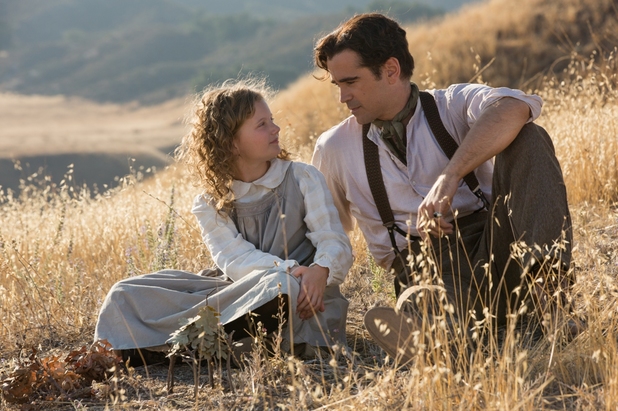 The clash between Disney, poised to succeed after 20 years of trying, and Travers, adamant to preserve her vision after 20 years of resistance, flashes back and forth from the 1960s to Travers’s girlhood in 1907 Queensland, Australia. Her father (Colin Farrell, pictured right) is a drunken dreamer, as adorable as he is unrealistic but, like most fathers, a hero to his daughter. His attempt to be a responsible adult is the emotional core of Saving Mr Banks – with a heady reveal at the film’s denouement. (But who is Mr Banks? If you don’t know, it’s worth watching the film to find out.)
Kelly Marcel’s script came through the Black List, a project that tracks the best unproduced scripts each year and its strength benefits from compelling performances. Saving Mr Banks relies too on sensational visuals: hair, makeup, wardrobe and production design cannot be discounted in its evocation of a period where manners, thoughts and actions were very different from today. This is an exploration of love, between that of an author and her work, between a daughter and a father but also between a creative businessman and a money-making film opportunity. The conflict between art and money – ever-present in filmmaking – is palpably displayed by Thompson as Travers protects not only her art from Disney but also her past.
Saving Mr Banks achieves the rare feat of taking us behind the candy-coloured curtain of fun to show how serious the world of Disney business really was. You may come for the story but you'll leave with a revelation. Make sure you linger through the credits to hear recordings of the real Travers, made at her behest.
TO THE RESCUE: TOM HANKS SAVES THE WORLD (AND SOME IFFY MOVIES)
A Hologram for the King. Tom Hanks is the reason to see Dave Eggers's sentimental Saudi comedy
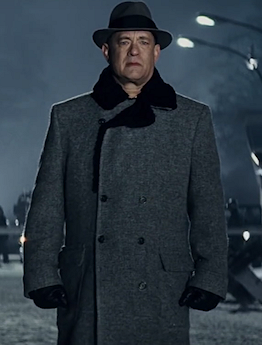
Bridge of Spies. Spielberg's warm-hearted Cold War thriller is lit up by Tom Hanks (pictured below) and Mark Rylance
 Captain Phillips. Piracy drama prompts bravura all-action display from director Paul Greengrass and captain Hanks
Cloud Atlas. Star company assumes various guises as David Mitchell's time-travelling masterpiece is lovingly told in under three hours
Extremely Loud and Incredibly Close. Oscar-nominated adaptation of Jonathan Safran Foer's novel is lacking in magic
Sully: Miracle On The Hudson. Eastwood and Hanks are the right men for an epic of understated heroism
Toy Story 3. To infinity and no further: Woody and the gang (sob) go on their final mission
PLUS ONE TURKEY
Inferno. In Dan Brown's dumbed-down Florence, Tom Hanks saves the world. But not the movie