Don’t blame the players: they did their considerable best. But what could they hope to achieve with a programme in which six of the seven pieces were on a hiding to nowhere, or too short to have much of an impact? A sequence, what's more, in which platform rearrangements took longer than two of the pieces in the first half?
Worse, the end sank the whole. Milhaud’s La création du monde, the penultimate offering, might have sent us out smiling. Instead the world premiere of Simon Bainbridge’s Counterpoints, for the indisputable jazz king of the double bass Eddie Gomez, was a throwback to the grim 1980s when a coterie of British composers had a stranglehold on the contemporary scene. Its labyrinth of atonal doodlings, with Gomez reduced to just a pizzicato bass support, weren’t going to please anyone who dropped in from the EFG London Jazz Festival, under whose auspices this event was held (it was advertised as a sell-out, but there were lots of empty seats. Did Cassandra Wilson, blaming LJF mismanagement on her erratic behaviour at the weekend, have a point?)
Long after he’d composed the two loosely jazz-inspired pieces featured here, Stravinsky had his eyes opened by his amaneunsis Robert Craft to the diversity of Los Angeles’ Evenings on the Roof, concerts of everything from Gesualdo to Webern and, of course, his own music. That kind of pick-and-mix programming with ensembles of varying size has made a very welcome comeback with the likes of the Britten Sinfonia and the Aurora Orchestra, and this mélange looked attractive on paper. But the first half, at least, badly needed a core or a climax.
That nuanced pianist Steven Osborne seemed seriously under-used. He kicked off the evening with a spring in Stravinsky’s Tango, prefacing it with a disclaimer that the following improvisation was to be not on the Tango but on the final chord of Tippett’s The Ice Break – ending on a hopeful note of almost pastoral possibilities wistfully realised here. Platform change, multiple woodwinds in Philip Cashian’s arrangement of Frank Zappa’s one-minute Igor’s Boogie, definitely missing the Woogie.
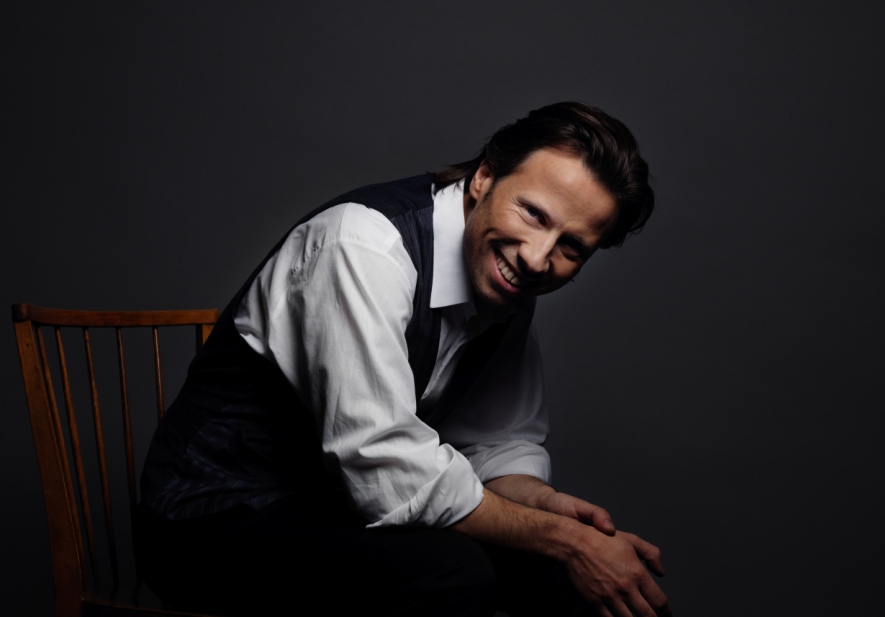 Affable, pliable Kristjan Järvi (pictured right by Peter Rigaud) zipped on for this and off to leave the seven or so stagehands to set up for Stravinsky’s Ragtime. Hail the Hungarian café twang of the cimbalom, expertly wielded by Tim Williams, the Soldier’s Tale interjection of Paul Archibald’s trumpet, the veerings of diminished Britten Sinfonia strings led by Jacqueline Shave. They were asked to bend further for the surprisingly dour caprice of Zappa’s The Perfect Stranger. The composer's description is decidedly more entertaining than the rather dreary result: "a door-to-door salesman, accompanied by his faithful gypsy-mutant industrial vacuum cleaner, cavorts licentiously with a slovenly housewife". Think how John Adams might make this scenario fly. Once past the opening doorbell, this is a formless straight “classical” piece, overscored even in its chamber version (muddying, amplifying Milton Court Concert Hall acoustics didn’t help). No whiff of jazz here.
Straightforward lounge-lizard drift went to Osborne in trio with Gomez and drummer Sebastiaan de Krom, the other musicians only adding minimal colour, in excerpts from “movement II” of Claus Ogerman’s Symbiosis. They kept sentimentality at bay, but this was instantly forgettable mood-music. The Milhaud jolted us to attention, its shoehorning of jazz thumbprints into classical forms taken at high speed by Järvi; the brief riots were impressive, the lyrical moments lacking in wistfulness – and the players far from note-perfect . If only they could have ended with that, or added Stravinsky’s Ebony Concerto, the audience might have got its money's worth. Brave try, Britten Sinfonia, but think it through next time.
- Same programme repeated in Saffron Walden's Saffron Hall on Saturday 24 November