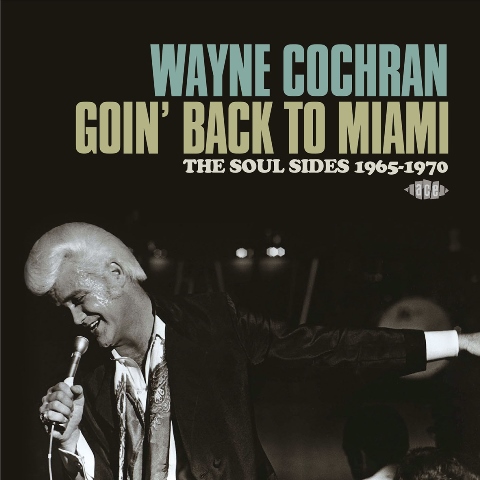
 Wayne Cochran: Goin’ Back to Miami – The Soul Sides 1965-1970
With his dyed-blond pompadour, Wayne Cochran looks bizarre enough. But once he opens his mouth, the weirdness level is kicked into orbit. He sounds exactly like a wild cross between James Brown and Otis Redding. Although white, his soul music is not the smooth or sweet blue-eyed fare of a Len Barry or a Righteous Brothers. Goin’ Back to Miami convincingly makes the case for Cochran as a soul great.
The compilation opens with the self-penned 1966 single and title track (watch a slightly fuzzy looking TV performance on the next page). The record’s backing musicians have the rigidity of James Brown’s J.B.’s and the bounciness of Stax house band Booker T. & the M.G.'s. It’s like Sam & Dave, but tougher and with a funk edge. Cochran sings of regional dance crazes, references Brown’s night train and testifies that returning to his girl in Miami always tops anything. His voice is rough, guttural yet still carries the melody. It’s actually topped by what follows. “Some-a’ Your Sweet Love” is more forceful, more kinetic and even better.
Not everything on Goin’ Back to Miami is quite so impactful, but this is exactly what a great reissue should be. It tells an unfamiliar story in a compelling way with great packaging, annotation and detailed, thoroughly readable liner notes which are mostly in Cochran’s own words. Cherry-picking 26 studio tracks from the second half of the Sixties, it paints him as a maverick white performer following a path which was his, and his alone. The second disc of the double set is a thrilling, previously unreleased live-in-the-studio set showing him and his brass-assisted big band as a non-stop musical tornado.
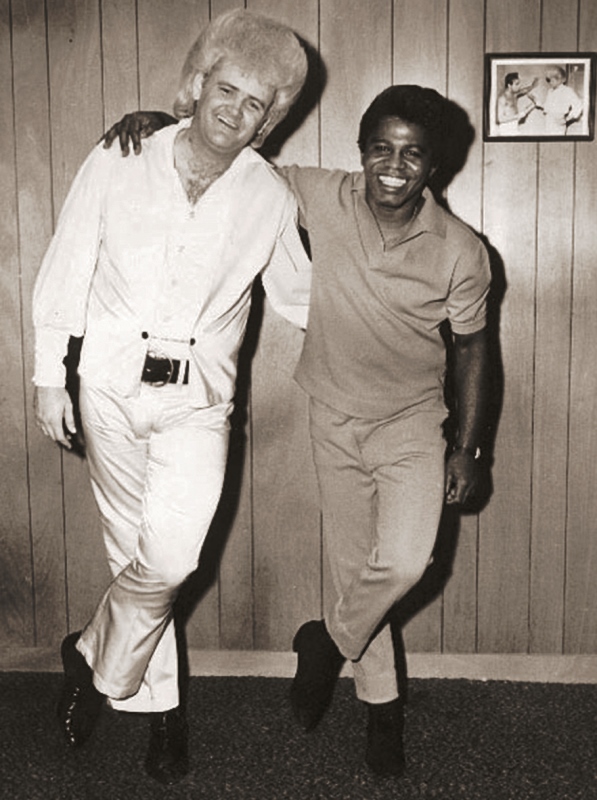 Cochran wasn’t aiming for a niche market. The tracks – some unreleased – here were recorded for Chess, King and Mercury. Although not major labels, they had national distribution and almost took him into the mainstream charts. An ad reproduced in the booklet from his Mercury period declares him “a blue eyed soul brother who’s rocking the industry”. In it, the music trade mag Billboard is quoted as declaring him “a discotheque giant with a wild blues-shouting vocal performance.” (Pictured left: Wayne Cochran with James Brown)
A product of his environment, Cochran was born in Georgia in 1939. Growing up close to Macon, he was exposed early to famous locals Little Richard and Otis Redding. Georgia resident James Brown was never far away. Initially, in the late Fifties, Cochran explored country and wanted to be Elvis Presley. But change was gonna come.
After plugging away with straight pop in the early Sixties he went where his heart was in 1965 with a version of “Think”, also recorded by James Brown. He and Brown became friends. Jackie Wilson was a pal too. Cochran even fell into the orbit of Elvis in 1968 when they played the same Las Vegas hotel. He also knew the pre-fame Redding and the pair went to clubs together. Cochran even sang with Redding on stage.
Listening to Goin’ Back to Miami leaves no doubt Cochran was a significant force. This collection explains how this one-off evolved into a performer who recorded at Fame studios in Muscle Shoals and played Harlem’s Apollo, wowing tough audiences used to what he drew from. This is essential.
Overleaf: watch Wayne Cochran perform "Goin’ Back to Miami"
Watch Wayne Cochran perform "Goin’ Back to Miami"