Faye is okay. Or, at least she says she’s okay. But is she really? And, if she really is, like really okay, why is she seeking help for her insomnia?
As Irish playwright Ciara Elizabeth Smyth brings her ward-winning Fringe Festival play, Lie Low, to the Royal Court as part of a nationwide tour, audiences will have a chance to see for themselves what the matter with Faye is. And something definitely is. In an early scene of this intense 70-minute psychological thriller, the thirtysomething woman is asking a doctor for help: she can’t sleep and we soon discover why.
About a year ago, Faye came back home from a party to discover an intruder in her house. He attacked her, knocked her out, and when she came around he was standing over her with his dick out. Traumatised but unable to get any medical help she is becoming increasingly desperate. So desperate in fact that she asks her older brother Naoise to come to her aid. Her plan is to try something called “exposure therapy”: in other words, to re-enact a scene from her trauma as a way of overcoming its shocking persistence. Naoise is initially sceptical, but then agrees to help his sister.
Smyth depicts the relationship between Faye and her brother with enormous empathy, perceptiveness and precision. She sketches in their back story, and Naoise’s current problems, with some well-timed revelations, while convincingly showing us how siblings can bicker and argue passionately, but also have a very strong bond. As the self-help therapy gets under way, with the help of a bizarre duck mask, Faye discovers both an unexpected sense of her own power and a side of her brother that she wasn’t very aware of. As a victim of abuse, she’s appalled to find out that – spoiler alert – Naoise has been accused of a similar crime. The really interesting aspect of Smyth’s writing is her insistence that the trauma of abuse makes a mess of your memory as well as of your emotions. Faye has clearly been attacked, but has she also been raped? When Naoise asks her outright, she hesitates before saying no. Why the hesitation? Is it trauma, fear or uncertainty? Likewise, sister and brother cannot agree on what actually happened on the night of the party. Each has a different memory of that appalling evening. A similar ambiguity is evident in the accusation of a co-worker against Naoise – is he a sinister predator, or just an unhappily married man looking for affection?
With an ending that likewise shouts ambiguity, Smyth reminds us that her play’s title not only describes the feelings of a traumatized agoraphobic, but also includes the verb “to lie”, as in telling lies. And, of course, Faye is feeling very low. Her repeated insistence that she’s okay, and her unreliability as the narrator of her own experiences, gives a subtlety and intensity to her situation in a piece that examines the guilt of the survivor as well as the trauma of the victim, and also represents the sensations of PTSD in a particularly powerful way. And what’s brilliant about this sharp shard of pain is that it has its comic moments too.
So this entertaining play begins with Benny Goodman music and swing dancing, and there are a lot piercing one-liners that get flung around Faye’s deliberately unfurnished room. An absurdist atmosphere gives the events a kind of glow that shifts from dreamy to nightmarish, both sugaring the pill of the main themes and setting up some nasty shocks. The big questions about what it means to lie about how you are feeling, and whether such untruths are deliberate attempt to hide behind a facade of wellbeing, hang in the air, making us feel suitably uncomfortable and uncertain.
For if the past is fractured through unreliable memories – and there’s a great passage about Faye and Naoise disagreeing about a childhood incident – what happens to guilt and responsibility? Such difficult questions are not make explicit and the piece is stronger for that. The humorous episodes are deliberately provocative because sexual assault is no laughing matter, but then perhaps Smyth is saying that trauma affects people in different ways, unexpectedly, unpredictably. Of course, a short show is also inevitably a bit superficial and this is true here too.
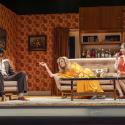
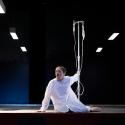
Oisín Kearney’s production is designed by Ciaran Bagnall and this two-hander boasts a couple of exciting performances which give the evening moments of electricity. So while I’m not convinced that Smyth’s dialogues have enough individual character, I am bowled away by Charlotte McCurry’s Faye (pictured above) and Thomas Finnegan’s Naoise, who gradually increase the tension and finally deliver the expected intensity with energy and conviction. A banging soundtrack features Kelly Marie’s bouncy “Feels Like I’m in Love”, whose words such as “My knees are shakin' baby/ My heart it beats like a drum” can be both a description of the after-effects of trauma as well as dance floor disco joy, and the use of the duck mask is truly grotesque (in a surreally good way). A dark, darkly disturbing comedy.