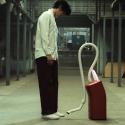
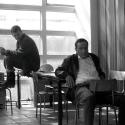
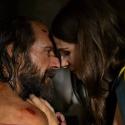
Verbatim drama, long established in theatre, has rarely been used in film. But director Clio Barnard uses the device to magnificent, and sometimes deliberately disjointing, effect in The Arbor, to tell the story of Bradford playwright Andrea Dunbar, who wrote The Arbor and Rita, Sue and Bob Too (made into a film in 1986) before she died at the age of 29 in 1990.
Dunbar, one of eight children and the daughter of a violent drunk, had packed a lot into those 29 years - three children by three fathers, a number of failed relationships and a handful of plays - and who knows what her early talent would have developed into had she not died from a brain haemorrhage after years of alcohol abuse. She wrote without a trace of sentiment about what she saw around her - the decline of industrial communities and with it the breakdown of families, casual sex, teenage pregnancy, alcohol abuse and racism. Plus ça change....
In The Arbor Dunbar’s story is told mainly through the eyes of her eldest daughter Lorraine (Manjinder Virk). A 10-year-old when her mother died, Lorraine was subject to racist abuse because her father was of Pakistani origin, and became a teenage drug addict and then a prostitute to pay for her habit. She was jailed for manslaughter when her toddler son died after consuming her methadone, but has now served her sentence. We see all too clearly how neglectful parental behaviour becomes a pattern through the generations.
Virk and the rest of the fine cast, some of whose members worked with the playwright, speak the words of those who knew Dunbar - friends, family, colleagues - recorded over two years by Barnard. It slightly throws one initially, but then you relax and completely accept the construct. It neatly makes the point that fact is often fiction, while fiction may actually tell the truth, as shown in the early scene in which Lorraine and younger sister Lisa (Christine Bottomley) give very different recollections of an incident in their childhood, when a fire starts in their locked bedroom. It’s immediately evident that Lisa adores her mother’s memory, while Lorraine is still bitter about the lack of mothering they all received. It’s almost funny as she recalls: “My mother had the audacity to drop down dead five days before Christmas, and she hadn’t even bought us a single present.”
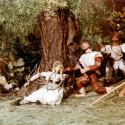
Barnard uses another theatrical device, a play within a play, as scenes from Dunbar’s work are re-enacted on a patch of grass near Brafferton Arbor, the road where Dunbar was brought up on the Buttershaw estate, built during post-war slum clearances, but which quickly became a slum itself. Barnard also interweaves extracts from a TV doumentary made in 1980, which includes interviews with Dunbar and her parents when Dunbar’s first play, the autobiographical The Arbor, about a working-class Bradford girl’s relationship with a Pakistani man, was about to open at the Royal Court Theatre in London.
The Arbor, a co-production with the avant-garde Artangel, may be too tricksy for some, but it’s deeply affecting and won the Best Documentary Award at the Tribeca film festival. And strangely enough, bleak as it often is and given the tragedies it explores, it's ultimately uplifting as Dunbar’s distinctive voice - full of wry, hopeful humour - shines through.
- The Arbor is on general release from 22 October
- Find Andrea Dunbar on Amazon
Watch a scene from Rita, Sue and Bob Too: