A phlegmatic, dryly humorous septuagenarian in blazer and regimental tie, Campbell does not look like a pugnacious sort. But when Mount Carmel, the mango farm he and his family had owned for 30 years, was earmarked for reallocation to a poor black family under Mugabe's Land Reform Programme, Campbell turned to a tribunal of the Southern African Development Community (SADC) in Windhoek, Namibia.
Mugabe, he submitted, was guilty of racial discrimination against white landowners, 4,000 of whom had already been evicted from their homes. Zimbabwe was to be reserved for Zimbabweans, the President had decreed, and if the result was violence and racial hatred, so be it. This particular white African, however, refused to become a living oxymoron.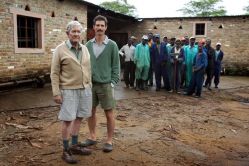 The trial dragged on for over a year, thanks to the defence's endless petitions for postponements: Campbell and his son-in law, Ben Freeth, pictured together left with some of their employees, only learned of one of these in the newspapers after flying to Windhoek for the hearing. Eventually the case against "Robert Gabriel Mugabe in his capacity as President of the Government of the Republic of Zimbabwe" was augmented by a second charge. Soon after the contested elections of 2008, Campbell, his wife and Freeth were kidnapped and tortured to within an inch of their lives. Only their religious faith, and a determination to preserve their self-respect with a spirited fight, gave them the will to continue.
Directed by Andrew Thompson and Lucy Bailey, the movie was shot in Zimbabwe under conditions of great, evident and continual personal risk. You can hear the catch of anxiety in the film-makers' voices as they grab snatched footage of street thugs through a car window. Campbell, by contrast, when Mount Carmel is staked out by a posse of men with knives, declares airily, "I'll go out when I've finished my drink," in a scene that reveals both his sang froid and the fact that such incidents were virtually an everyday experience. Later, Peter Chamada, the son of Nathan Shamuyarira, a former government minister and Mugabe's official biographer, pitches up in a brand-new Toyota 4x4: he is the poor black Zimbabwean who claims to have been allocated the Campbell farm. The ensuing altercation (each side filming the other all the while) is both absurdly comic and freighted with menace.
The documentary is a very revealing counterpoint to Claire Denis's fine forthcoming feature, White Material. In that film, set in an unnamed African country in the throes of revolution, Isabelle Huppert plays a quixotic, almost demented landowner determined to hold on to her coffee plantation at any cost. Mugabe and the White African, on the other hand, is told fairly and squarely from the personal viewpoint of Campbell and his family. If there are criticisms to be made of the movie, they are that the directors make no attempt to examine the wider issues or to give the black Africans on both sides of the case much of a say.
Campbell, as we know, won. But the precise manner of this winning is edge-of-the-seat stuff. African justice does not come out of the affair with flying colours, and the victory turned out in any case to be a Pyrrhic one. since Mugabe merely declared Zimbabwe's land laws exempt from the strictures of the SADC tribunal. Campbell's home, and his daughter's, were both burned down last summer.
- Mugabe and the White African opens on Friday 8 January.