

Black Panther arrives with all the critics displaying superhero-sized goodwill for its very existence. It’s a big budget mainstream Marvel movie that not only features a nearly all-black cast, but it also has an African-American writer director (Ryan Coogler) and co-screenwriter (Joe Robert Cole).
film reviews
Adam Sweeting

Guillermo del Toro has laid down markers as a wizard of the fantastical with such previous works as Pan’s Labyrinth and Crimson Peak (though we’ll skate nimbly around Pacific Rim), and now he has brought it all back home with The Shape of Water, as its 13 Academy Award nominations might suggest.
Tom Birchenough

After the anger, the emptiness… Russian director Andrey Zvyagintsev’s Loveless is his fifth film, and harks back to the world of complicated, somehow unelucidated family relationships that characterised his debut, The Return, the work that brought Zvyagintsev immediate acclaim back in 2003. His previous film, the tempestuous Leviathan from four years ago, was defined by a degree of social involvement that was new in his filmmaking, and engaged with contemporary Russia through the prism of politics. Its story of a lone individual’s clash with the corrupt society that surrounded him could not but provoke strong emotion.
Loveless sets out to do something different. It’s a film of wintry emotional withdrawal – a perfect pairing of season and subject – about the absence of almost any natural human core in the world it depicts. It’s as critical of its society as its predecessor was, but on a more oblique level, and arguably bleaker for that remove. There’s something of a loss in translation, too: the Russian title Nelyubov means, literally, “not-love” – almost “anti-love”, closer even to “hate”, but not quite that extreme. “Loveless” lacks the necessary muscle, as well as that particular Slavic antonymic essence that can assert absence as something far more visceral than simply a lack of presence. (The film’s French-language title, Faute d’amour, perhaps comes closer to the sense of the original.)
Zvyagintsev makes us view these proceedings almost as if we are observing animals
It is not a film defined by over-complexity. There’s a luminous clarity to the world that Zvyagintsev and his co-writer Oleg Negin (the director’s collaborator since his second film, 2007’s The Banishment) have created, which hints at the simplicity of parable. And “clarity” is as good a word as any to describe the particularly composed, poised cinematography of Mikhail Krichman, who has worked with Zvyagintsev from the very beginning. The sense that a style has evolved between them is strong.
The spare script drops us in medias res into the painful throes of divorce. Any love between Zhenya (Maryana Spivak, pictured below) and Boris (Alexey Rozin, lower picture) has eviscerated itself long ago; the final, symbolic dissolution of their marriage awaits the sale of their flat, which is one of those typical Russian living spaces where middle-class comfort within belies a coldly imposing, anonymous exterior. Desperate to leave their old lives behind, both have new partners, and the only remaining impediment to their assumed (separate) future happiness – one to which they have clearly not paid overmuch attention – is their 12-year-old son, Alyosha (Matvey Novikov, main picture). The only thing they still spar about is what to do with him, each wishing to offload responsibility onto the other.
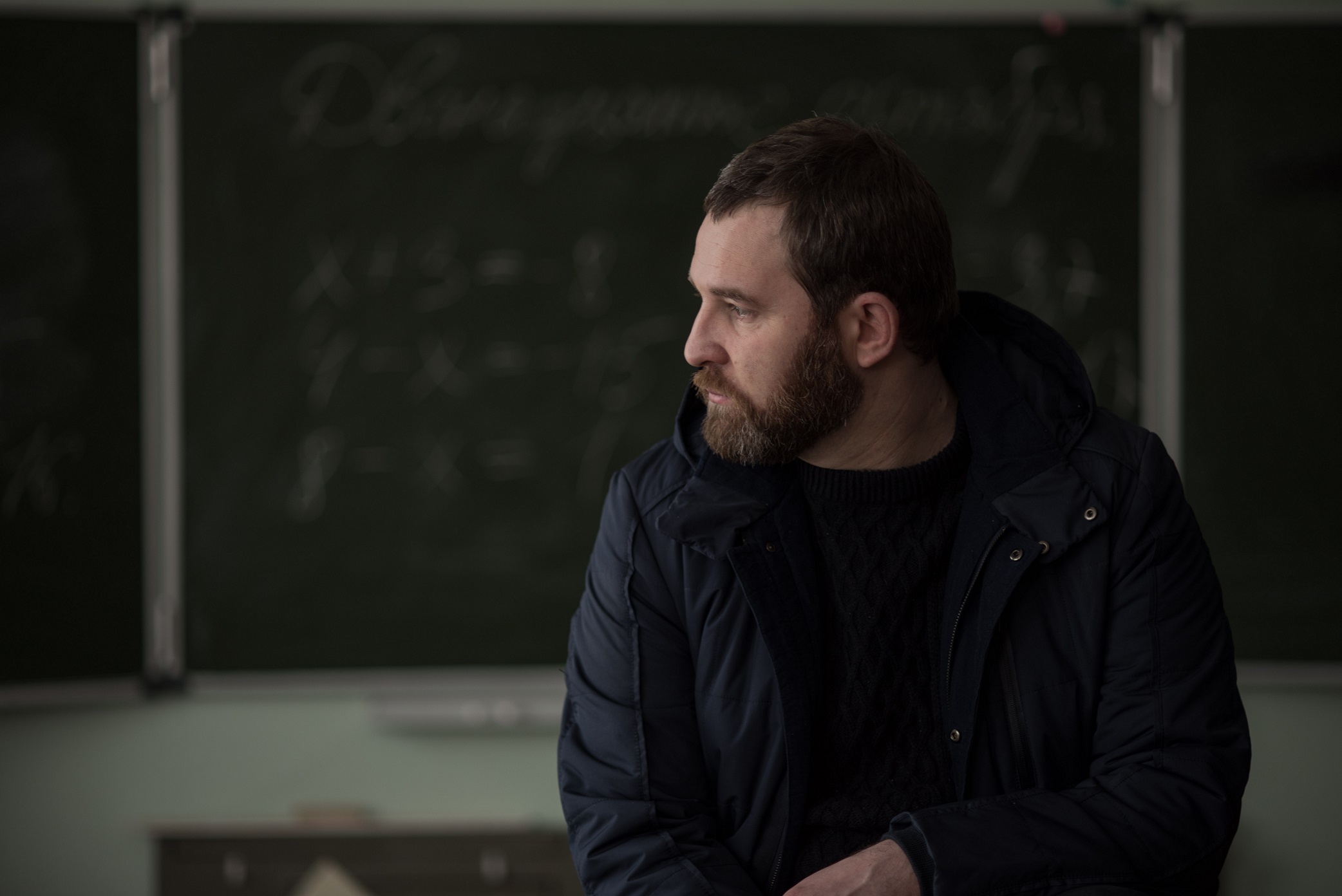 Our sense of the boy’s alienation is conveyed practically without words, but speaks so powerfully: Zvyagintsev builds towards an unforgettable scene that defines the extreme of his agony, all the more shocking for its being set against the banality of his parents’ ongoing lives. We see them in their separate professional environments – Zhenya runs a beauty salon, Boris is a middle-management salaryman – as well as with their new partners. Boris fears that his divorce will be unacceptable to his ultra-religious employer, which is almost more of a worry than that he and his heavily pregnant girlfriend, the younger Masha (Marina Vasilyeva), are going be living with her mother. Zhenya has found new security with the older Anton (Andris Keishs), drawn as much by the attractive way of life that the prosperous single businessman offers her as by any attraction of the heart.
The director is engaging again with the differences of social class (which in Russia is defined as much as anything else by economic status) that were at the centre of his 2011 film Elena: it’s clearest in early scenes in which the couples are eating, one in an exaggeratedly posh restaurant, the other bringing their supermarket purchases back to the kitchen table. Then we watch them as they make love. The way that Zvyagintsev presents all this is characteristic: somehow he makes us view these proceedings almost as if we are observing animals, subjects engaged first with appetite, then recreation (sex-ercise?). The alienation is double, not only in the world of the director’s characters, but in his perspective, too.
This 'lovelessness', we come to understand, extends far beyond the present divorce
When Alyosha disappears – he’s reported missing from school before his distracted parents even notice his absence – the couple is forced to reengage, while the plot takes on an element of ongoing urgency and some rather welcome procedural tension. The police won’t take action immediately, recommending instead a volunteer search-and-rescue group (it's based on real-life Moscow precedents) to take over the investigation; it initiates increasingly large-scale searches of the area (the anonymous suburb in which the family lives borders on woodland). But there’s surely something ambiguous in how we perceive this citizen group action: it’s all impressively efficient and coordinated, especially when set against the lethargic reluctance of the police – yet do we wonder, in the wider context of Russian history, about the ramifications of such collective energy?
If Zvyagintsev leaves us to make up our minds on that one, he pulls no punches in the night scene in which the couple drive together to check whether their son has run away to his grandmother. Natalya Potapova plays Zhenya’s mother as a harridan haunted by history – her son-in-law describes her as “Stalin in a skirt” – and we begin to appreciate how her daughter has become who she is. The reception the old woman gives them is matched for acidity only by the bile they throw at one another along the way.
It’s a revelation that proves as terrifying as anything brought in the film’s resolution, which develops incrementally towards a conclusion that has all the inexorability of the territory (it comes with some exterior locations that match even Tarkovsky’s Stalker for wondrous dereliction). The dimensions of terror widen, becoming somehow ontological: this “lovelessness”, we come to understand, extends far beyond the present divorce, right “back to the beginning”. Is it fanciful to think of those moments of birth (rebirth) in Russian history of the last century, to go back to 1991, the collapse of the certainties and seeming securities of the Soviet world, even to 1917? It’s for the viewer to decide.
Of course, there’s another context behind Loveless too, the cinematic one that Zvyagintsev has alluded to not least in his acclaim of Ingmar Bergman, whose Scenes from a Marriage is, not surprisingly, a film he has referenced directly. But what is most potent in the way that the Russian director depicts his homeland is the sense that no alternative outcome could finally be possible, so rotten is this world in which the concept of empathy seems to have been entirely lost. Zvyagintsev may have altered his register – where Leviathan was painted with a broad brush, Loveless is a scalpel dissection – but his message remains constant.
Overleaf: watch the trailer for Loveless
Jasper Rees

Fakery is promised in the opening image of The Mercy. A smiling beauty water-skis over sunny seas, only for the camera to pull away and reveal she is part of a maritime expo in a vast exhibition hall. One of the other exhibitors is an inventor called Donald Crowhurst (Colin Firth), who enlists his beaming sons to demonstrate his Navicator, a simple tool to guide sailors on the high seas. Optimism is laced with a tincture of despair.
Owen Richards

We follow Kabwita Kasongo on his morning routine, lingering over the shoulder as he treks through the village. A pastel sunrise greets vast landscapes, the morning breeze visible for miles around. He heads to a tree at the edge of a mountain, and begins a day’s work chopping it down. It’s a stunning opening sequence which prepares you for the visceral journey ahead.
Matt Wolf

A perfectionist says goodbye to an art form he has done so much to nourish by playing – you guessed it – a perfectionist. From the minute Daniel Day-Lewis first appears in Phantom Thread, looking sartorially splendid and more aquiline than ever, there's no doubt that the thrice Oscar-winning actor (and a nominee again this year) owns this movie as he has so many previous ones.
Adam Sweeting

With Dunkirk and Darkest Hour threatening to storm the Oscars, it seems there’s suddenly plenty of mileage in portraits of the British at war.
Markie Robson-Scott

This Vietnam vet/road movie is a warm-hearted, meandering piece, but any similarities to Linklater’s Boyhood or the Before…trilogy end there. This is a darker story, but not dark enough, and you wish it could have been less conventional and harder-hitting. Set in 2003, its first scene is in a run-down Virginia bar with Sal, a jaded alcoholic ex-marine (Bryan Cranston in a stand-out performance) at its helm.
Saskia Baron

Nick Park’s utterly charming new animation channels the spirits of so many cinema and comedy ghosts that its originality can be overlooked – but it shouldn’t be. This is a fresh narrative in an era where films aimed at young audiences are dominated by sequels, prequels, remakes, comic book and TV adaptations, and it is all the better for it. The in-jokes and references come thick and fast and it’s fun spotting them. From the outset there’s a homage to Douglas Adams and the Pythons; we may be in the primordial soup but captions tell us we’re near Manchester, around lunchtime. Meanwhile two dinosaurs battle it out to the death – the end credits will identify them as Ray and Harry, homages to stop frame maestro Ray Harryhausen.
Moving rapidly on through meteors and apocalyptic fires, the noble game of football is invented by some Neanderthals who kick around a meteorite and record it in cave paintings. Their Stone Age descendants forget the skill but are pretty good at hunting rabbits and live happily in the arcadian idyll of their own verdant valley (their camp, pictured below) until some Bronze Age folk with clanking machines (shades of Heath Robinson and Studio Ghibli) come along. They are determined to take over the valley and mine it for more bronze. Can a game of footie save our loveable Early Men from being cast out into the gloom of the Badlands? Stuffed with brilliant sight gags and a witty script by Mark Burton and James Higginson, Park’s ingenious hand-crafted animation shines throughout. The Bronze Agers who sneer at the unsophisticated Stone Agers parallel the CGI aficionados who look down on old-skool stop-frame technique. The traditional Aardman-style plasticine pinched thick brows and googly eyes work brilliantly on the characters evoked here.
There’s some great voice work too – Tom Hiddleston goes all Peter Sellers’ Clouseau as imperious Lord Nooth – while Eddie Redmayne is endearing as the lead Cave Man, Dug. Park himself voices the grunts and squeaks of Hognob, the Grommit-like boar who is desperate to be of service to his friend Dug. Rob Brydon plays a giant messenger bird relaying memorised edicts between Queen Oofeefa (Miriam Margolyes) and Lord Nooth. There’s a wealth of great characters, including a gargantuan mallard with scary teeth and Goona, a feisty football player (Maisie Williams), who isn't allowed to play for Real Bronzio because she's a girlie. Instead she jumps in to train up the "plucky band of knuckle grazers" with nifty footwork and team tactics.
Where Dreamworks and even Pixar occasionally lob in sleazy jokes aimed at adults and use retro pop to please parents, Nick Park and his collaborators play it straight. If some of the references and gags go over a child’s head, none of them are embarrassing to explain. Perfectly timed for the 2018 World Cup, Early Man is a classic David-and-Goliath tale of sporting underdogs. It should enchant even the most football-hating audiences and delight soccer fans and kids alike.
Overleaf: watch the trailer for Early Man
Jasper Rees

Alexander Payne’s best-loved film is Sideways but that title may as well work for everything and anything in his oeuvre. In Election, About Schmidt, The Descendants and Nebraska, he puts America and Americans under the microscope from a variety of quizzically oblique angles. There’s another tilt shift in his latest satire.