

Dziga Vertov’s narrativeless “city symphony” Man With a Movie Camera celebrates the modernity and energy of the post-Bolshevik Revolution metropolis – a composite of Kharkov, Kiev, Moscow and Odessa filmed over three years. Propaganda for the harnessing of machinery in the building of the Soviet Union’s future, it was much more besides – a masterpiece of avant-garde experimentalism and, fleetingly, an unexpected critique of the continuing class struggle.
film reviews
Adam Sweeting

The boxing movie has been a gift to filmmakers virtually since the dawn of cinematic time. In 1932 Jimmy Cagney was swinging for the title (and the gal) in Winner Take All, but some say 1947's Body and Soul, starring John Garfield as boxing champ Charley Davis, is the one most of the other screen boxers are indebted to, from Sly Stallone's Rocky to Robert De Niro's Jake LaMotta in Raging Bull.
ellin.stein

As Noah Baumbach moves into his forties, his youthful archness is becoming increasingly tempered with a wry melancholy. It adds depth and piquancy to this story of a forty-something couple trying to come to terms with the fading of youth’s infinite possibilities (“What’s the opposite of 'the world is your oyster'?”) by embracing, occasionally literally, a pair of Millennials who introduce them to cool enthusiasms such as cycling, walking in disused subway tunnels, and ayahuasca ceremonies (self-realization through shamanic ritual and copious magic mushroom-induced vomiting).
Tom Birchenough

Its title may hint at exotic worlds – a Western, even – but Robert Carlyle’s directorial debut is anything but. Carlyle himself plays the title character, one of life’s losers (“haunted tree” being one of the more memorable descriptions we get of him) who’s barely getting by as a Glasgow barber until the story, and his own unplanned actions, pitch his mundane existence to another level altogether.
Demetrios Matheou

We can’t seem to move these days without stumbling into the path of a zombie movie, making one wonder why walking dead with a penchant for fast food are suddenly so alluring.
When George A Romero effectively created the genre in the late Sixties and Seventies, zombies were a device for satire; today they seem to reflect a communal sense of societal breakdown. While comedies such as Warm Bodies and Zombieland make broad fun of post-apocalyptic decay, and the horror of World War Z is mitigated by its global scale, the zombie stories that truly strike home – such as The Walking Dead on television, and the new film Maggie – are those that posit the idea that killing loved ones might be the only way to survive.
It’s notable that the word zombie isn’t used in either The Walking Dead or Maggie; the word carries too many naff connotations these days. A key difference between series and film is that in the former the game really is up, with only pockets of humanity struggling to survive; in Maggie, society is hanging on by its fingertips, albeit in a state of martial law, whose modus operandi for keeping the warm-blooded in the ascendancy threatens to drain their humanity.
When we are confronted by a familiar zombie-in-the-woods confrontation, it’s without the customary fetish A global virus is turning people into (for the sake of this review) zombies. When someone is bitten, they’re hospitalised, then allowed to return to their lives for a few weeks more, before “the turn” approaches and they are collected by the authorities, for a fate that is equal parts execution and mercy. One such is Maggie (Abigail Breslin), a teenage girl bitten in the city, who is collected from quarantine by her father Wade (Arnold Schwarzenegger) and returns with him to his Midwest farm. Maggie’s stepmother (Joely Richardson) seems irritated by Maggie's presence and eager for the whole thing to be over; in contrast, as the days pass and Maggie’s condition deteriorates, Wade struggles with the idea of giving his daughter up.
Despite Schwarzenegger's presence, this is not an action movie in the slightest, but a sombre account of loss in the most horrific circumstances, with the bearded and haggard-looking Austrian stepping up to the plate to give a surprisingly affecting performance. Admittedly, the taciturn farmer is tailor-made for someone who lacks the chops for nuanced emoting; but actor and character dovetail to good effect as the practical and straightforward father struggles to deal with the unthinkable.
Having featured in Zombieland, Breslin now has a rare double-bill to her credit, having appeared in both comic and dramatic riffs on the zombie scenario. She quietly carries the heavier loads here, as Maggie comes to terms with her own fate while herself losing a close friend to the virus. The young actress also pulls off some of Maggie’s ickier physical moments with aplomb.
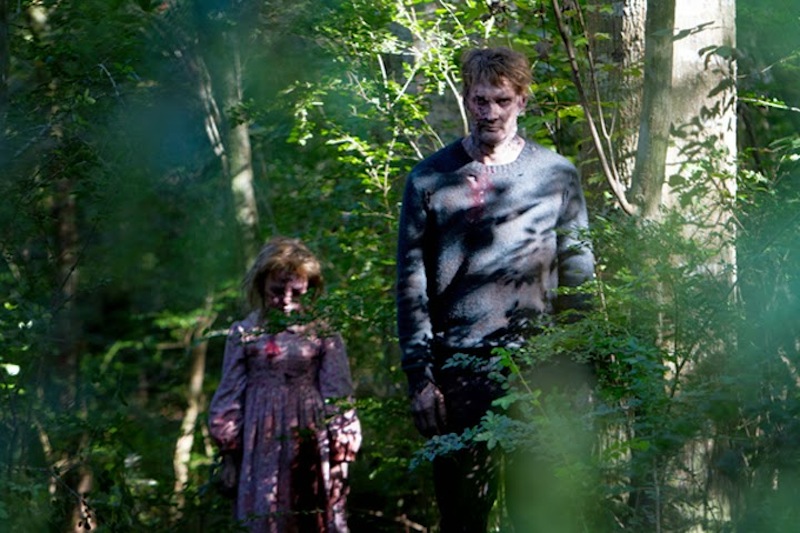 In his directing debut, Henry Hobson opts for restraint in depicting his dystopian horror. The initial sequence of Hank driving through a desolate, burning landscape is an effective shorthand for the bigger picture. Thereafter there are very few sensational scenes; and when we are confronted by a familiar zombie-in-the-woods confrontation, it’s without the customary fetish.
Indeed, the growing sense of unease is achieved mostly through dialogue, as when Wade’s doctor and friend warns him: “She’s going to lose her appetite. And then she’ll get it back again.” The most chilling moment has us on tenterhooks as to whether a movement towards a sleeping man is about to result in a tender kiss, or a bite.
Hobson could have breathed a little more air into proceedings, his downbeat tone eventually becoming wearing. But what he’s achieved is a genre film that resonates with the coping mechanisms related to real-life disease, one’s own impending death or an eventual loss, while suggesting a life after Terminator for its star.
Overleaf: watch the trailer for Maggie
Kieron Tyler

A film about 20 years in the life of a character acknowledged as peripheral to a movement in popular culture which spawned global stars is a difficult sell. Audiences are going to wonder whether the chronicling of a minor player not central to the bigger picture is the wrong focus. With Mia Hansen-Løve’s Eden the light is on Paul Vallée, a club DJ trying to make his way in the fertile early Nineties French electro-dance music scene from which Daft Punk became the global breakout phenomenon. And it’s the helmet-wearing duo which loom large over Eden.
Matt Wolf

All the charm in the world provided by two seasoned pros can't make a satisfying whole out of Ruth & Alex, a glutinous portrait of a longtime marriage that is gently tested when the eponymous couple decide to move house. Burdened with a bewilderingly wrong-headed pair of subplots, British director Richard Loncraine's film makes only partial use of the off-the-charts amiability and ease of leading players Diane Keaton and Morgan Freeman: so much so, in fact, that one wishes the two Oscar-winners had thrown away Charlie Peters's script altogether and started from scratch.
Nick Hasted

It wasn’t quite Ali vs Frazier. But the 1968 debates between William F Buckley, Jr and Gore Vidal were as bruising (nearly literally) as TV had seen, and haunted the protagonists for the rest of their lives. Morgan Neville and Robert Gordan’s documentary claims its aftershocks also damaged TV and America in ways we’re still suffering through.
Graham Fuller

Had Wim Wenders not used the title Until the End of the World for his most ambitious road movie, it would have suited his biographical portrait of Sebastião Salgado. Since 1973, the Brazilian photographer has traversed the planet to document its natural beauty and diversity on one hand, and the greed, destructiveness, and murderous ferocity of man on the other.
emma.simmonds

With its teeny tiny protagonist Ant-Man joins a movie tradition that includes The Incredible Shrinking Man, Honey, I Shrunk the Kids and Innerspace. And yet the 12th entry in the Marvel Cinematic Universe feels like a fresh perspective on the modern blockbuster, where bigger certainly hasn't always meant better. A miniature superhero might not seem hugely useful in the fight against contemporary cinema's monolithic threats but, in its surveillance and espionage themes and heist plot, Ant-Man does a sterling job of selling its premise.