The indomitable Nicolas Kent has devised a new theatre piece to prick our consciences and refocus our minds, after his sterling work on the ugly underbelly of the Afghan wars and the Grenfell inquiry, inter alia. This one is less polished though not lacking in grit.
Originally a project much like Kent’s The Great Game, a loose assemblage of full-length plays from leading writers about invasions of Afghanistan over the centuries, this has emerged as five much shorter plays about different aspects of the Russian invasion of Ukraine. The series has a chronological sweep, starting with Jonathan Myerson’s Always, set on February 21, 2014.
We join a well-heeled couple in a Kyiv hotel room near Maidan Square, home to a long-standing protest camp. The couple’s student son has been an activist there for 18 months, and his anxious mother (Sally Giles) wants to see him. His party-member father (David Michaels) does too, for a different reason. When he goes off to take a squirrelly phonecall, the government pushback begins, given human form by two aggressive men (Daniel Betts, Ian Bonar) who arrive at the hotel room claiming to be from room service. Their boss, though, is President Yanukovych, elected by over 60% of voters to take Ukraine into the EU, but reneging on that promise. These men are from the oblasts in eastern Ukraine already part-occupied by Russia. What unspools is the couple’s worst nightmare and the onset of Ukraine's occupation.
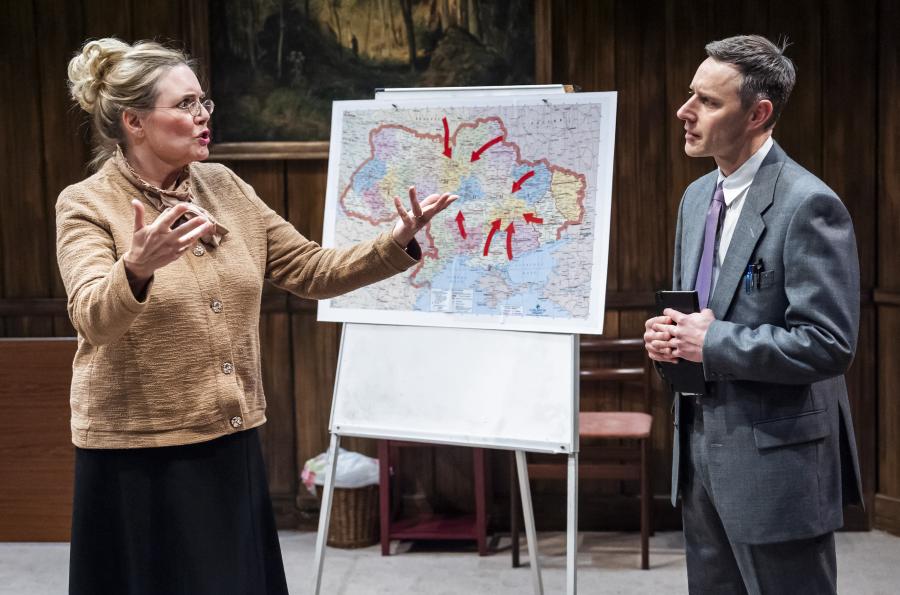
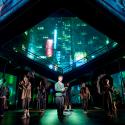
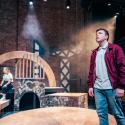
It’s left to the wife, who becomes a ferocious she-cat, to scream abuse at the two men and argue that the protesters are there to secure democracy for Ukraine. It’s a woman, too, codenamed “India” (Giles again, pictured above with Bonar), who is the most outspoken member of a group assembled at a hunting lodge outside Kyiv by a shadowy host, "Victor", in David Edgar’s Five Day War. It is now February 2022, and Victor is there to isolate the group (no phones) for the five days it will take the Russian army to cross the border, secure the airport and run the country. Or so the plan goes. This group of lesser administrators will be cabinet ministers soon, they are told. Or, as India rightly calls it, an “unelected junta”. Most “audition” for Victor with a healthy cynicism, though none are going to refuse a job offer.
The doublespeak comes thick and fast. They are told they have to endorse the “denazification” of the eastern oblasts, where “genocide” of the Russian locals is being carried out by the Ukrainians. Russia is the true “great liberator”; it is not carrying out an “invasion” but a “special operation”. The “news reports” the group are given to read out are pre-prepared, pure fiction, announcing the massacre of Zelensky’s family and government, even his household pets. It takes the teenage daughter of the lodge’s manager to break the spell, with a purloined cellphone that brings news of the massacre of the men of Bucha.
By the third playlet – the best of the five – Three Mates by Natalka Vorozhbit, we are 1,468 days into the war, and the enemy is no longer just the one outside dropping bombs on civilians. Through a pithy, funny monologue by insomniac Andriy (Ian Bonar), Vorozhbit nails the existential crisis now facing Ukrainian men. It’s too late to flee, as Andriy’s friend from the conservatoire, baritone Yaric, has done, but Andriy can’t face enlisting, like mezzo-soprano Max, who has been on the frontline from week one, a hollow shell now with the life sucked out of him. Even Andriy’s partner, Olga, has gone abroad, through a legal refugee programme. But Andriy is a prisoner of his cowardice, unable to leave his flat for fear of being conscripted.
His all too human response is a dark kind of cynical humour, which deplores friends who fled to Vienna texting him about their upcoming skiing trips while predicting (usually wrongly) the next rocket strike on Kyiv. He’s not a bad guy, he protests, just an ordinary man who loves watching football and singing. Now he can tell exactly which kind of ordnance is being deployed over his head: “Patriot – anti-aircraft missile!”. In a line that’s both sad and comical, he says at least he will have arms and legs still when his family come back. But, of course, he will fight when there is no other choice.
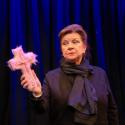
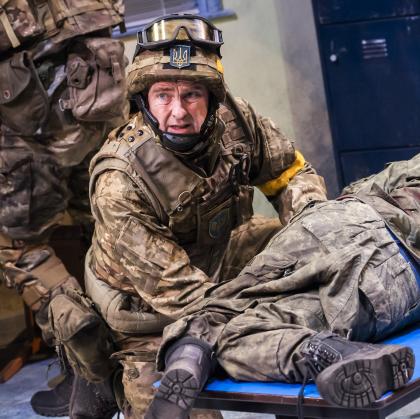
In David Greig’s Wretched Things, we move to the battlefield, where two Ukrainian soldiers have struggled to an abandoned school somewhere in the east. Children’s paintings are poignantly stuck on the walls – of Mummy, home, Jesus – while a dead “orc” lies in a corner. Except this orc is North Korean cannon fodder and still has a pulse, as the men’s revered Sarge (Michaels, pictured above left) discovers when he arrives. The three then debate what to do next: observe the Geneva Conventions by evacuating the wounded man and getting him medical help, or shoot him as he is probably doomed anyway, and they may be too if they stop to help him?
This is an engrossing piece, though seasoned soldiers finding time to deliver portentous statements like, “This man chose the wrong side of history” and to chew over what Nietzsche would have made of it all seems far from likely. But the piece leaves gnawing questions. Has the law disappeared from this half-life of theirs? Is power all there is left?
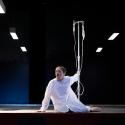
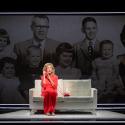
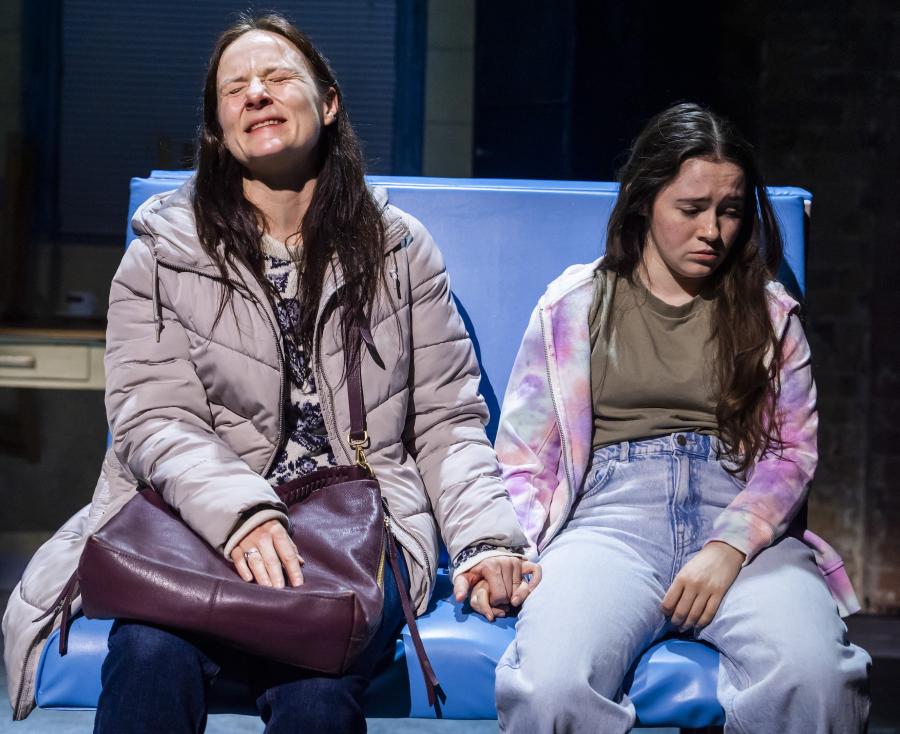
The final playlet, Taken by Cat Gosgovitch, shines another light on the experience of women in the conflict, such as the besieged Mariupol mother (Jade Williams, pictured above with Clara Read) here whose 12-year-old daughter Lilya (Clara Read) is taken by a Russian-speaking soldier to a “rest camp” in the Crimea for a two-week stay. Of course, Lilya doesn’t return, and a year later the mother has found another tough woman, a Kyiv lawyer, to help her get Lilya back. The outcome of this perilous mission is not what you expect.
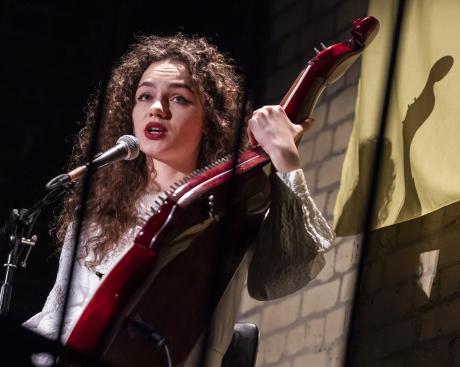
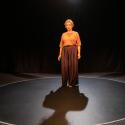
Kent, directing, makes the most of his excellent multitasking cast of six, but has to struggle with the logistics of creating five different settings, without any fancy stage machinery to help him. Props and furnishings have to be lugged on and off, some oddly elaborate, like the curtaining in the first play’s hotel room. To accompany the scene-changing, Kent uses musical interludes by Mariia Petrovska (pictured right), an eminent bandura player, now UK-based, who also introduces each song. But I’m not sure whether that was the best decision for either the production or the artist.
Although Petrovska’s 65-string instrument is fascinating, and her singing beautiful and plaintive, her haunting music might have been better deployed with no chat, the translated lyrics perhaps projected on the A/V screens above the action. Her story is worth saving for an evening of its own.