Maybe because we are aware now of too many cases of a paranoid schizophrenic suddenly unleashing violence on an innocent stranger, the teenager under treatment in Peter Schaffer’s 1973 play, who has blinded six horses, is no longer a character we feel that conflicted about.
Unlike Martin Dysart (Toby Stephens), the psychiatrist whose encounter with just such a lad upends his thinking about almost everything, especially his own motives for pursuing his career. While Alan (Noah Valentine) struggles with his desire for someone to inspire his life and settles on the divine presence he senses in the horses whose stables he mucks out at weekends — Equus — Dysart wrestles with his feelings of inadequacy, his longing for passion and not just a life of trotting off to ancient sites in the Peloponnese and scrutinising the old world in beautiful books.
The play has a double axis: as Noah starts to open up under Dysart’s probing and manipulation, his motivation becomes clearer to us, whereas his interlocutor is less and less convinced this kind of “truth” is worth unearthing and eradicating. Even praise from the magistrate who has argued for Alan to be treated by a psychiatrist, Heather Salomon (Amanda Abbington), makes no impact on his encroaching doubts.
So finding out what happened in the stables that night is just one endpoint; the play continues for another lengthy speech from Dysart in which he brands his treatment as the creation of a “ghost”, an empty vessel whose soul has been purged in the name of the great god “normal”. It’s as if the play is ultimately more concerned with Dysart’s inner turmoil than with Alan’s. But frankly Dysart’s anguish isn’t that novel: the predictable unhappiness of a middle-aged man in a sexless marriage who misses that zing of being young and wants new inspirations. It’s expressed with an orotund eloquence but unsatisfying. In the early 1970s, this anti-establishment, anti-bourgeois stance was revered; now it seems like a passing phase.
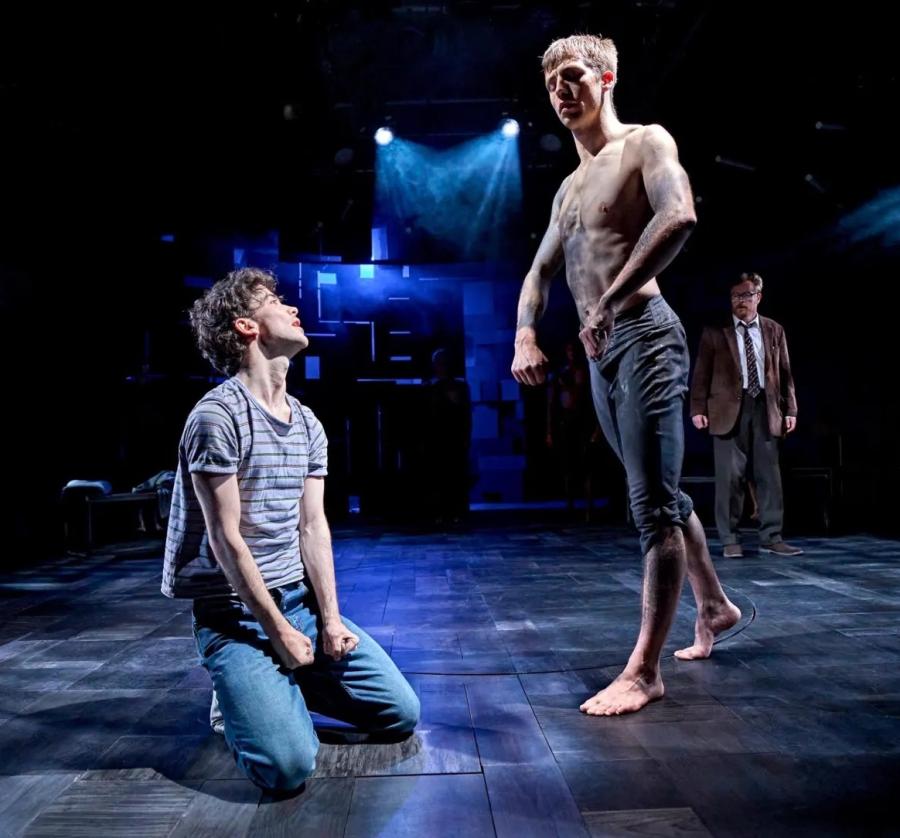
What draws you in at the Menier is the staging, along with some outstanding performances. Director Lindsey Posner has the task of presenting a character who strips naked and sits astride the shoulders of his favourite horse, Nugget (Ed Mitchell, pictured above with Noah Valentine), as he goes on one of his secret night rides, urging the horse on from trot to gallop and culminating in what seems to be an orgasm. As I have only ever seen the play in West End or Broadway auditoria, where Alan is many feet away, I wasn’t sure this would be comfortable for an audience in an intimate space (our phones had big sticky discs placed over their cameras as we entered). But the scene is performed with due solemnity and verve. Mitchell also plays the posh rider that six-year-old Alan and his family encounter on a beach, who invites Alan to sit on his horse: Alan has his first taste of the excitement that his devotion to these creatures will bring, replacing the severe religiosity of his mother (Emma Cunniffe).
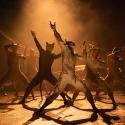
Mitchell and the other five “horses” are unexpectedly convincing. Unexpected because they have no props or prosthetics, just some body makeup on their bare chests and faces that makes them look “dirty”. What they do to embody the horses is a matter purely of stance, of holding their bowed arms forward and simulating the gait of the animal’s back legs. At any sign of danger, they all raise their heads in perfect coordination, looking alarmed. Their human-ness also gives Alan’s stroking of their heads and grooming of their flanks a sexual dimension. It’s a theatrical transformation as impressive as Matthew Bourne’s male swans: bravo to movement director James Cousins.
Stephens’s qualities as a deliverer of dialogue are well established; here he also has to move beyond a comic take on the character — his natural habitat, I suspect — to a dark and embittered one, which he mostly succeeds in doing. He can dismiss Mrs Strang’s dour beliefs with just the crisp phrase “drizzly kirk”, but his personal unhappiness can seem performative rather than inhabited at times. He gets the laughs but not so much the tears.
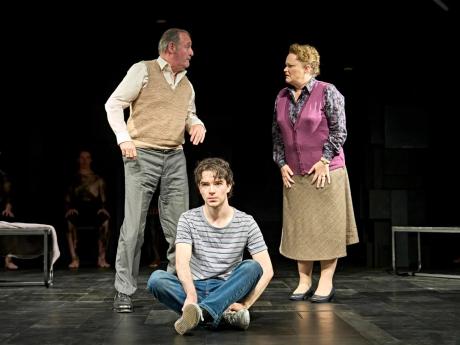
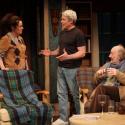
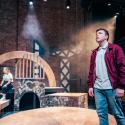
There is sterling support from Cunniffe and especially from Colin Mace (pictured above with Valentine and Cunniffe) as Alan’s dad, a sad figure who projects a no-nonsense, honest-working-class-man persona but hides a guilty secret. The revelation of the production is Noah Valentine as Alan, a slight figure whose eyes burn with a shocking intensity in his early meetings with Dysart. He has all the light and shade of the character, the mounting sexual attraction to his more confident stable colleague, Jill (Bella Aubin), with whom he has a fateful night out at the pictures; the roaring, savage anger of his attempts to keep Dysart at bay; then the poignant innocence when Dysart manipulates him into reenacting the blinding of the horses.
At the end, you have to decide how much Schaffer wants you to sympathise with Dysart. Is this a prototype of his Amadeus dynamic: Salieri or Mozart? Or is Dysart a proxy for Schaffer himself? This production may not help you decide the answer, but go for the exceptional, exciting staging, and Noah Valentine.