Cathy ★★★
Iconic Scottish actor Elaine C Smith towers over writer/director Eilidh Loan’s snarling, acid-sour comedy at the Traverse Theatre. Judging by chat in the hectic pre-show queue, getting the chance to see her in the flesh was a big attraction for many punters. And Smith was central, too, to Loan’s creative process: the character of Cathy is inspired by the writer’s own grandmother, who insisted that Smith should play her.
You clearly don’t mess with Loan’s granny. And once you experience her on-stage alter ego, you might tremble at the thought of what that real-life older woman is like. For her part, Smith’s Cathy is a foul-mouthed, cantankerous, impossible-to-please harridan who cares even less about the feelings of her family since the death of Tommy, her husband of five decades. She’s also a woman who’s clearly grieving and struggling to articulate that sorrow or even ask for help, and Smith’s hard-lipped, brittle and occasionally vulnerable performance captures that collision of emotions exquisitely, as well as delivering with calm authority the razor-sharp deadpan put-downs that Cathy seems to relish.
As a character study, or as a toe-curling dissection of family dynamics, Loan’s play succeeds brilliantly. Smith’s Cathy is surrounded by her fragile daughter Flo (a feisty Michele Gallagher) and her blundering Protestant interloper husband Colin (a wonderfully gormless Alan Orr), as well as their optimistic and heavily pregnant daughter Amy (touching played by Chloe Hodgson), who hopes to restore family tranquility before the birth. Loan’s lengthy opening scene etches the four characters’ relationships with fearsome precision and no shortage of killer lines.
But it’s in its broader trajectory that the play struggles to convince, as Cathy ends up miraculously finding a softer side helping out in the charity shop where Amy part-times, and where manager Lizzie (a warm and wholesome Sally Reid) dispenses homespun wisdom based on her own tragic experiences.
Cathy is brisk and often brutal as a brilliantly observed family comedy, but its narrative arc leaves many questions unanswered: not only is Cathy’s apparent conversion less than persuasive, but Loan also leaves the bigger issues of grief and new life relatively unexplored. Designer Kenny Miller’s set snaps nimbly between Cathy’s home and the Christmas lighting-bedecked charity shop, and Loan’s direction keeps things moving fluidly and authentically. Cathy offers no shortage of belly laughs, and quite a few gasps of shocked disbelief, but its emotional landscape feels surprisingly monochrome.
- Until 30 August
Mrs Stern Wanders the Prussian State Library ★★★
The very title of Jenny Lyn Bader’s tense but quite wordy drama – apparently explanatory but also rather opaque, seemingly cool, clinical and objective – gives strong hints about what’s to come. A well-to-do young woman is led into what we realise is a prison cell, where she responds politely, even eagerly to questions about her activities and associates, congratulating her guard on his recent promotion to the new political police, and sympathising with him about the increases to his workload triggered by recent changes to the law.
Those new laws are a crackdown on anti-state political activism in 1933 Berlin under martial law, and the woman – as Bader later reveals – is influential historian and political philosopher Hannah Arendt, fresh from finishing her PhD on love and Saint Augustine, and now suspected of attempting to undermine state security by disseminating controlled material, sourced in Berlin’s Prussian State Library.
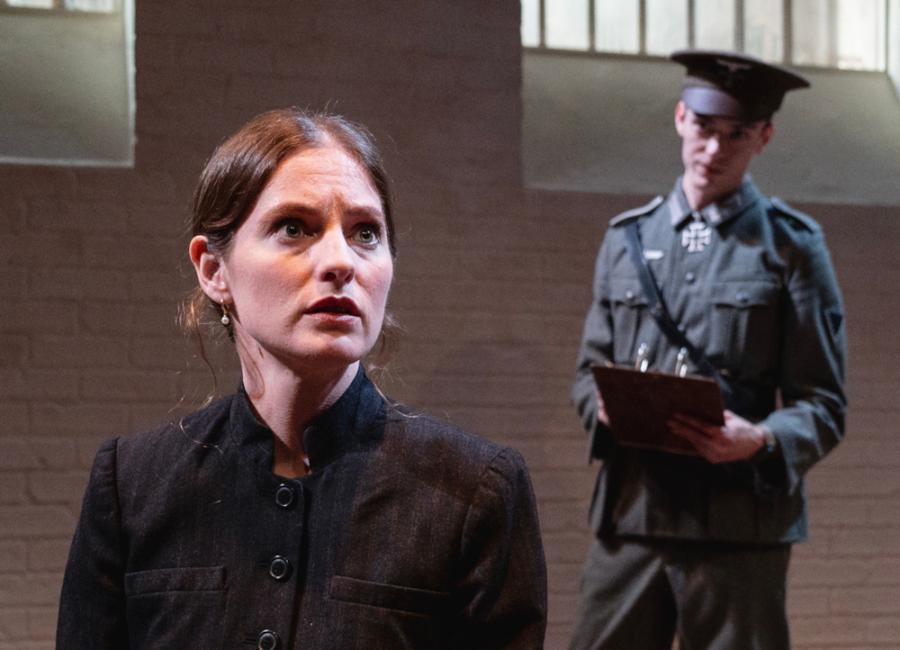
Bader’s slow-drip reveal of information and the remarkable restraint in her writing risks establishing a permanent distance between the audience and the events – the accusations, interrogations, denials and distractions – that we gradually realise are playing out on stage. Her cast, too, maintains that sense of polite coolness throughout, despite the increasingly dangerous cat-and-mouse game that’s unfolding in their discussions. Ella Kaille (pictured above, with Brett Temple) is clipped, well-mannered and respectful as Mrs Stern, but increasingly audacious in her quick-witted responses to her interrogator’s assertions. Brett Temple makes for a boyish officer Karl, switching between youthful excitement about his new senior position and a stonier-faced professionalism as he begins to realise the games that are being played.
There’s a danger that all the stiff politeness and oblique suggestion of Bader’s writing may somehow minimise the true horrors of what’s unfolding, and its broader implications. And yes, there are times when the regime seems a little too nice, a little too easy to confound or distract. But this is also a drama of two people, as Bader’s quietly moving conclusion make abundantly – and perhaps surprisingly – clear.
Director Ari Laura Kreith ensures that the duo’s sometimes tense, sometimes tender conversations flow clearly and naturally, and Lauren Helpern’s stony set is simple but effective. Whether the play shines new light on totalitarianism and resistance is open to question, but it’s nonetheless a high-stakes game of mental chess that’s fascinating to watch.