Sarah Kane’s Cleansed is a love story whose heart has been torn open on barbed wire. Yes, that’s what it feels like. Sounds intense? Okay, welcome, you’re already in the zone. It’s also a pioneering account of queer and trans sensibility, a difficult play that I’ve seen several times since its premiere in 1998. Most productions appear on the spectrum between cool abstraction (James Macdonald) and hot literalism (Katie Mitchell). This revival by the Almeida Theatre’s ace director, Rebecca Frecknall, is firmly in the literalism camp, only occasionally dipping its injured toes into the cooling waters of abstraction. Cleansed is an in-yer-face classic, but what’s it all about?
Set in a grim institution ruled by Tinker, a sadistic “doctor”, a place where young people are imprisoned and tortured, the play tells four stories. In the first, Grace, a young woman, searches for her lost brother Graham, an inmate who has been dispatched by Tinker. In the second, two men – Carl and Rod – explore the limits of their love. In the third, Robin, a disturbed youngster, becomes infatuated with Grace when she tries to teach him to read. And, in the final story, Tinker pays to watch a dancer in a peepshow, and then falls for her. Each of these strands asks the central question, of both the characters and the audience, what would we, could we, endure for love?
Kane explores this question, which is surely universal, in a way that is so extreme as to be positively perverse. Conjuring up a world of immense cruelty, she puts her characters through excruciating mental and physical torture. Grace’s incestuous love for her dead brother Graham, intensified by her grief, is not only necrophiliac, but also results in graphic transexual surgery; Rod and Carl’s love is tested through one physical mutilation after another, ending in death; Tinker’s love for the sex worker is based on abuse and sexploitation; childish Robin’s attraction to the older Grace is suicidal. As well as torture, there is graphic sexual violence. Well, I said this is a difficult watch.
Abstract interpretations of this story are both theatrically and intellectually fulfilling (we can be impressed enough by symbolic depictions of stage directions such as “the rats carry Carl’s feet away” or other gross incidents, of which there are many, to pay more cerebral attention to the play’s imagery and themes), but more literal productions just bombard us with disgusting stage pictures. So Frecknall’s version, like Mitchell’s at the National in 2016, is emotionally strong, but its power is so overwhelming as to be unbearable. After about the first hour of this 100-minute show, I was ready to leave. After all, there’s a limit to how often you can shield your eyes. To look away from the body horror, the injection straight into the eye, the ghastly mutilations, and the feast of blood: shed, spattered, splashed and spilt.
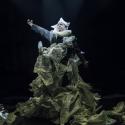
Yes, I know that this is faithful to one aspect of Kane’s visceral writing: she does challenge the audience to endure the unendurable; she does shock us out of our complacency about love and desire. No neat Instagram couples, with neat Instagram relationships and neat Instagram sex for her. Oh no, it’s blood and guts all the way. However, this does mean that you feel so rattled, so disturbed, by the horror, that there’s no mental bandwidth left to admire the poetry of the text, its Jacobean references and its moments of idealistic beauty. All I remember this time is the animatronic sunflower and – this is a highpoint – the sudden appearance of the field of daffodils shining in golden yellow.
So the central theme of personal identity, which has been written in an expansive way that embraces gay, straight and gender fluidity, is a bit lost in this production’s bangs, screams and brutal shocks. The idea that we have to struggle for self-discovery disappears in a welter of gore. The sense of a bloodbath drowns out important textual avowals of love being true in the moment, as against promises for the future for-ever-after, or evocative phrases such as “Love me or kill me”, although on press night one of the few laughs that lands followed Tinker’s disarming “I may be a cunt but I’m not a twat.” Instead the chamber of horrors begins to resemble a zombie movie, with the living dead sleepwalking into more and more torture.
So the keynote of Cleansed is that of nightmare, where nocturnal terrors, heightened to their utter extremes, express some of our deepest fears, whether that of physical injury or emotional betrayal. In this context, the famous quotations from the play, such as Grace’s “Love me or kill me Graham” or Rod’s “I love you now; I’m with you now”, have a kind of punk idealism, reminding us that Kane was a young absolutist. Her sensibility invites neither compromise nor shades of feeling. Likewise, the details of the tortures are partly symbolic – mutilation of the tongue (speech), hands (touch) and feet (movement) – and partly jejune, as in the story about the pole up the rectum.
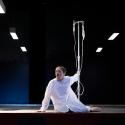
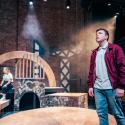
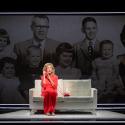
In this production, all this is obvious. Also, Frecknall’s stress on sex rather than love tends to obscure some brief moments of tenderness, the occasional gentle touch of the hand, or sympathetic glance, but the main sensation is despair. Desperation. Revulsion. Still, she does give us several moments of more abstract narrative, with balletic movement and stage pictures that look like dance sequences. These are great, and enhanced by Madeleine Girling’s set, which has a heavy institutional grime vibe, with the feeling of a dilapidated hospital whose corridor is as heavily used as its main room. And Lee Curran’s lighting and composer Angus MacRae and George Dennis’s industrial soundscape play a vital part in creating an atmosphere of confinement and dread.
This revival is extremely well served by its cast who, while not exactly as youthful as the story, turn in some unforgettable performances. Pearl Chanda’s performance as Grace is not only brave in its extended naked sequences, a characteristic shared by Lizzy Connolly as the Woman, but also finely detailed, from shocked freak outs to wild tremblings to numbed indifference to frank desire. I’m also impressed by Leo Bill’s expressively brutal Tinker, Luke Cinque-White’s convincingly agonised Carl and Stuart Thompson’s often bewildered Robin. Likewise, Jack Riddiford and Parth Thakerar lend Graham and Rod a real integrity. But first-rate acting isn’t enough, for me, to rescue a production that is too literal for its own good. A horrible ordeal.