Supposing: ★★★★★
Sally fell down a hole outside the local theatre. Since then, things have changed. She just… knows things that other people don’t. But rather than being a source of joy, help or hope, her new abilities feel more like a curse.
Writer-director Zinnie Harris’s taut, focused two-hander (well, for the most part) turns to ancient Greek myth – and to the chiselled definition of ancient Greek dramatic forms – to address the disintegration of personal freedoms, climate breakdown, rising intolerance, and everything else that’s falling apart around us. It’s an audacious conceit, and it’s breathtakingly convincing. On one level, Harris personalises her idea of a modern-day seer cursed never to be believed, and Sally’s dilemmas and frustrations feel compellingly real. On another level, however, it’s as if the forces unleashed around us are so brutal and primal that only rites and rituals from the ancient world are potent enough to convey or describe them, let alone address them.
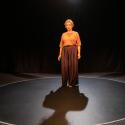
Harris manages a near-miraculous balance, too, between her unavoidable symbolism and a certain dark humour, certainly in the ever more frustrating exchanges between Sally and her long-suffering husband Richard. Nicole Cooper is magnetic in the central role, almost chanting Caryl Churchill-like litanies of normality as the world fractures around her, while also conveying her character’s determination and surprising resilience. Richard Conlon has less to play with as Sally’s husband, but he mixes humour, tenderness and quiet despair convincingly all the same. Harris surveys their relationship seemingly from all angles, as their attraction and history propel them together yet also drive them further apart.
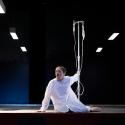
Alysa Kalyanova’s staging is minimal but highly effective, a simple circle representing the mysterious fissure that caused Sally’s affliction, and also an almost ceremonial space in which the play’s actions unfold. Harris’s own direction ensures a sense of restless, fluid movement, but also a ringing clarity for her bold ideas.
Compact and focused, Supposing: is almost jewel-like in its single-minded examination of things so chilling we may prefer to pretend they don’t exist, and it’s harrowing in its depiction of a lone voice in the darkness recognising things for what they are, yet being powerless to do anything about them. At the same time, as Harris’s enigmatic ending dares to suggest, there may yet be hope of reconciliation.
After Party ★★★
The family – or a select group of relatives, at least – are assembled for one of matriarch Vivienne’s famed parties. She was a glittering Hollywood star: the gathering is sure to be bursting with celebs. But sly Viv has a final surprise in store for her nearest and dearest. Tonight will indeed be a performance, and very much a celebration, but it will also be her last.
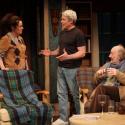
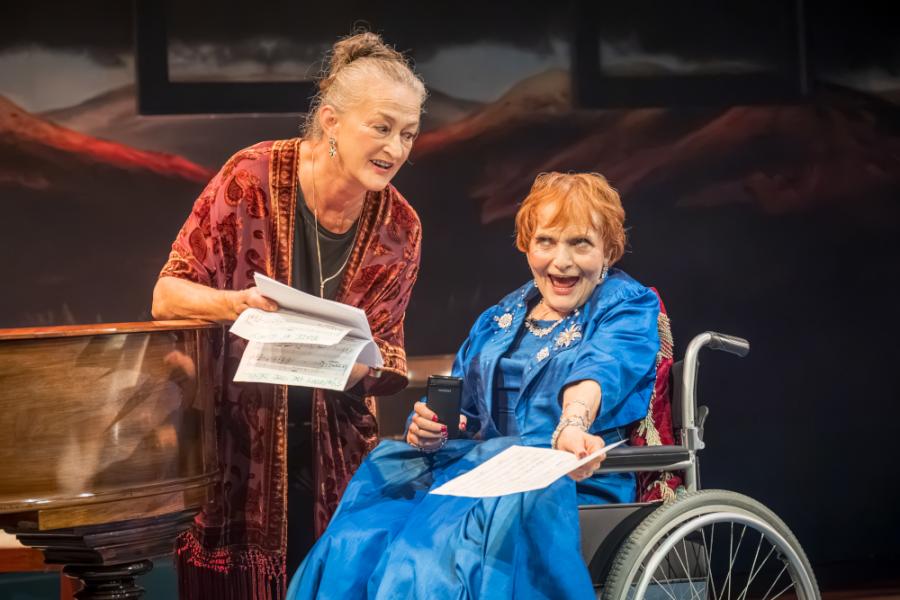
Morna Young’s engaging, enjoyable play is one of the Traverse Theatre’s longest this festival – there’s even an interval, something almost unheard of at the Fringe. And there’s much to savour in After Party’s soap opera-like plot twists, family intrigues, blazing barneys and tender make-ups. Alison Peebles (pictured above right, with Liz Kettle, image by Marc Brenner) is magnificent as a fragile Viv, imperious in her demands yet also terribly needy for attention and approval. It goes without saying that she proves the fading star around which the rest of the cast revolves, from Angus Yellowlees’s delicate grandson James to Liz Kettle’s warm-hearted ex-daughter-in-law Carol, by way of Gilly Gilchrist’s money-obsessed son Geoff. Katie Posner’s direction plays up Young’s mirthful, idiomatic dialogue very effectively, and Richard Kent’s set designs are beautifully lavish and effective.
So why only three stars? After Party is an undeniably diverting way to spend a couple of hours, but if you go expecting to peer beyond the humour and discover fresh insights into debates around euthanasia or familial responsibility for the elderly, you’re likely to be disappointed. In that respect, in fact, the play’s two-hour run-time feels rather too long. Writer Young seems frustratingly content to delineate her characters with curiously unchanging traits: James is the tearful one, his mother Lily (a nicely forthright Hilary Maclean) can apparently only talk about her Christianity, and her brother Geoff seems focused solely on his inheritance. Ultimately, though After Party is full of colour and comedy, it’s a bit of a disappointment: a large-scale production of a substantial play with a nine-strong cast, but a work that strangely seems to have little to say.