It’s been 35 years since Tony Kushner’s two-play, multi-hour epic gay soap opera-cum-spiritual meditation was first unleashed on the world in Los Angeles and San Francisco. And it’s been 18 years since director Ivo van Hove unveiled his own raw, stripped-back production with what was then Toneelgroep Amsterdam, now Internationaal Theater Amsterdam. It’s tempting, therefore, to see the Edinburgh International Festival’s revival of van Hove’s production as a classic traversal of a classic text, with all the nicely safe distancing and detached appraisal that that double status might invite.
That’s not unreasonable, certainly in terms of the work itself. In many ways, Angels in America is very much a creation of its times, reflecting a world in which a deadly new virus is spreading, apparently unchecked, and mainly among gay men, while a US administration under a reactionary President stresses individual responsibilities and socially conservative values.
But in the light of America’s more recent history – and, even more immediately, in the context of the International Festival’s American theme marking 250 years since independence – Angels in America speaks to us just as loudly now, certainly in its themes of greed, individualism and conflict, but also in its ideas about love, solidarity and survival in a hostile world.
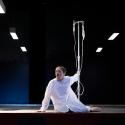
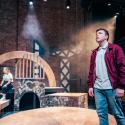
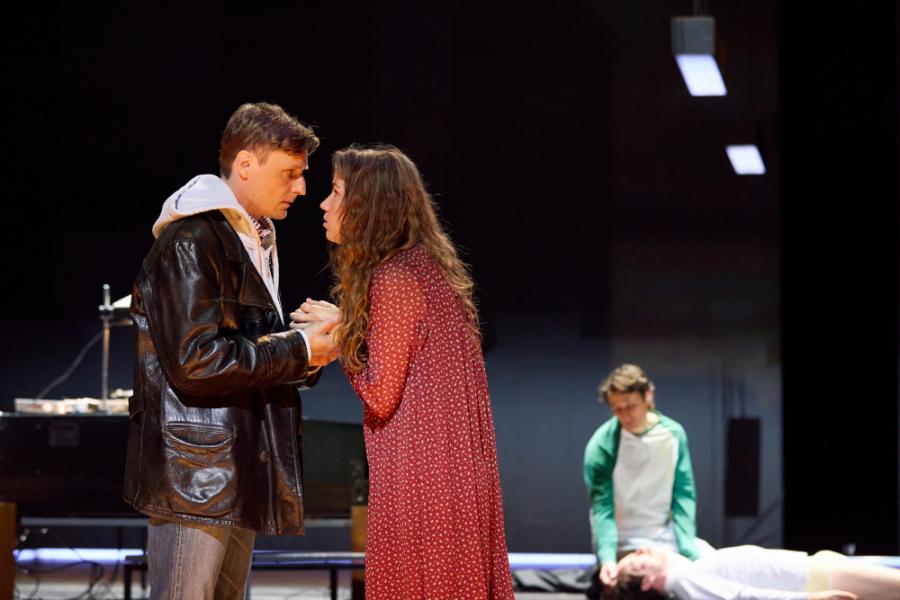
There is, indeed, a remarkable, austere power to van Hove’s conception of the work. From seven or eight hours, the director has somehow condensed it (it’s not immediately clear how) to around five, with a single interval separating its two constituent plays, Millennium Approaches and Perestroika. It makes for an admittedly intense and draining experience, but a thoroughly gripping, exhilarating one too. For a work of such visionary excess (and, it has to be said, considerable challenges in terms of its staging), van Hove and designer Jan Versweyveld strip things right back, too, with an empty stage (save a couple of turntables and a stack of David Bowie LPs) that seems to bleed into our real world, and with actors apparently emphasising that blurring of boundaries by stepping down from the raised stage onto audience’s own level. Costumes are permitted (courtesy of designer Wojciech Dziedzic) but they don’t always reflect the role an actor in inhabiting.
What’s left amid the near-empty space and the austerity, however, is Kushner’s remarkable storytelling, which emerges with breathtaking clarity – something that’s paradoxically aided by the written English surtitles translating the spoken Dutch. It’s a clarity that remains even in Perestroika’s wilder flights of fantasy, with the play’s visiting angels (or visions) and its freewheeling discussions of God’s intentions and humankind’s responses.
Similarly, van Hove’s cast delivers Kushner’s text with remarkable conviction, subtlety and passion. Eelco Smits is a surprisingly assertive, animated Prior, pushed to near collapse as his health deteriorates, but never less than convinced of the reality of his visions. Krisjan Schellingerhout (pictured above, left, with Eefje Paddenburg and Minne Koole) is wonderfully slippery as the conflicted Joe, contrasting deep affection for his wife Harper (a fragile but feisty Eefje Paddenburg) with animal passion for Prior’s sort-of ex-boyfriend Louis (Minne Koole, evidently navigating guilt and contradictions). Hans Kesting’s swaggering Roy Cohn bristles with demonic energy, through his character’s sheer conviction and self-belief, and his oblivious amorality.
What’s arguably most remarkable about van Hove’s conception of the work, however, is how its unadorned bareness blurs together Kushner’s real-life figures, his fictional characters and his fantastical creations so that it’s virtually impossible to tell one from another, and thereby to separate the facts from the visions. That stack of Bowie LPs is used to powerful and telling effect, too, with key tracks carefully selected to underline the work’s developing themes and ideas.
Yes, Angels in America’s five hours feel entirely like five hours of challenging, demanding theatre. But it’s a production to send you out in stunned silence from the recently reopened King’s Theatre, and in the inescapable awareness of where the conservatism so unflinchingly dissected in the work would lead three decades later.
- Until 20 August
- The Edinburgh International Festival runs until 30 August
- More theatre reviews on theartsdesk