Growing up in Liverpool, it’s usually not long before you visit the vast golden sands of Prestatyn, still the best beach I’ve ever seen, and the dubious arcades of Rhyl to roll a penny between the lines. Your accent and age announces you as someone to be watched - not without cause, most of the time - and you wonder how the locals can tell, as they seem to have the same one anyway.
Not long after, as a Scouser, you’ll hear of a lost underwater city, well, village, the local Atlantis. Nearly 150 years ago, the then thriving city of Liverpool decided that it liked the super soft Welsh water (it is really, really good) and built a reservoir in Powys with that now long gone confidence/bull-headedness of the Victorian Age. Lake Vyrnwy is still there: Llanwddyn, the village it drowned, is not, moved a couple of miles south by the powers that very much still be.
So when the numbers were crunched in the early 2000s and the seaside village of Fairbourne was forecast to go under the waves within the lifetime of its younger residents, it cannot have been a surprise for them to realise that the necessary sea defences were deemed economically unjustifiable. Like the villagers 30 miles or so east generations ago, they too would be left to their fates. Without, this time, a new set of homes to move into nor compensation. We’d have heard more about it were it Bognor Regis under threat. In England, repurposing a car-parking bay can excite an angry crowd and national debate in these febrile times.
The ongoing story of Fairbourne and the wider climate emergency provides the inspiration for Emily White’s new play, a co-production with Theatr Clwyd where it premiered recently. It tracks a family over decades as they fight for their home, squabble and splinter as families do and sends us a warning that it may already be too late. Observing the tinderbox conditions from the train window on the way to Chichester, I’d already reached that conclusion - Greta was right.
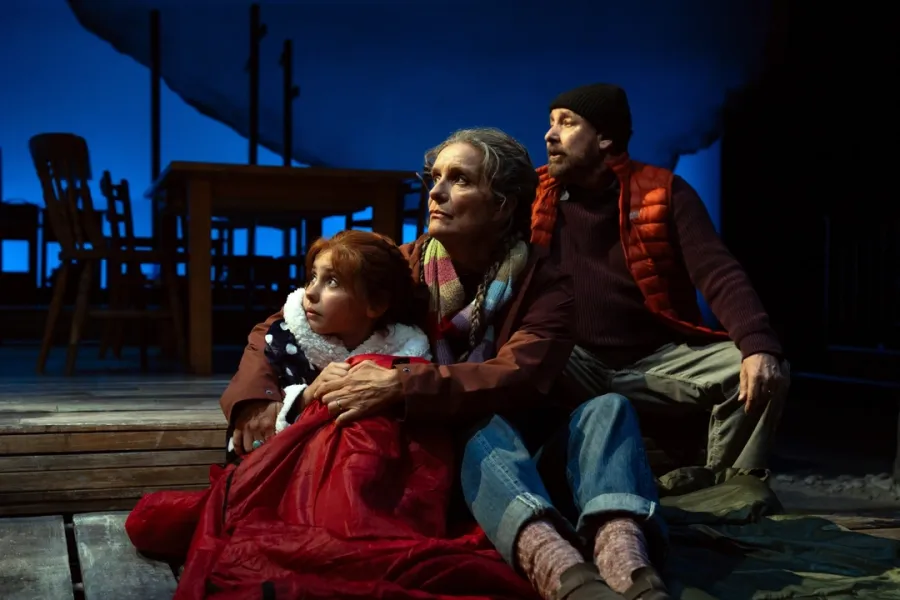
Gwen and Bryn live in a bungalow in the threatened village, she an alumnus of the Greenham Common protests of the 1980s, he a retired fisherman. Both are romantic Celts, telling stories anchored in the mythos of the mountains and the folklore of Wales and providing a bit of cover for the inevitable sentimentality that comes later. She is more radical, direct action in her blood; he rails against the council’s supine acceptance of the village’s fate and takes a dim view of politicians, but he's a 21st century King Cnut for all the good it does. There is a lot of foreshadowing - indeed, there's a lot to be foreshadowed.
Vivien Parry (pictured above with Eirlys Lovell-Jones and Richard Elfyn), in her Kaffe Fassett knitwear and long plaits, vests Gwen with the zealot’s perspective that a protest’s sacrifices should continue until the battle is won, the Pankhursts her role models - who did win, eventually. She passes that fire on to her granddaughter, Rhiannon (Eirlys Lovell-Jones) who makes her bones in Extinction Rebellion and goes on to be a radical journalist, much to the disdain of her mother.
Richard Elfyn’s Bryn cuts a more tragic figure as cynicism and anger displace his initial warmth and humour, eventually succumbing to dementia. His daughter, Claire, a no-nonsense Catrin Aaron, is a single mother with a bit of a booze problem, who views her mother’s political convictions as an indulgence and doesn’t get on with her father either - intergenerational conflict rearing up in a small home.
Rhiannon’s brother, Phillip (Alfie Llewellyn) and his middle-class girlfriend, later wife, Astrid (Sara Otung), drift away from the argumentative vibrancy of Phillip’s childhood home to set up their own. It’s more conventionally religious than Gwen’s low-level paganism that animates the bungalow, and it places a psychological distance between them and the home in which he grew up. That’s tricky for Phillip as he is very much attached to place, and you can’t help thinking that Astrid resents a bit of that - not many King's College law graduates dream of a life in Gwynedd.
With plays as passionate as this one, there’s always a danger of the nuance of drama being subsumed in the flood of didactic messaging that can lend a sophomore touch to the writing. Too often in the narrative, it can feel as though White has decided that it’s time for another issue (say abortion or zero hours contracts) and in it comes. Director, Guy Jones, keeps things moving, but the play feels longer than it is as you wait for the next talking point to hove into sight and be ticked off the list, as a chunk of exposition delays character development.
Though it’s an entirely unfair comparison, one can’t help thinking of parallels with The Cherry Orchard and Uncle Vanya, other plays about isolated worlds being swept away against the wishes of their powerless residents. Chekhov’s genius was to build wholly rounded, deeply flawed men and women and allow us to come to their concerns as their motivations dawn on us and the stakes are revealed. They are not primarily vehicles to vocalise a response to a range of Daily Mail editorials, as feels too often the case in Atlantis.
Not being as accomplished as Chekhov is hardly a stick with which one should beat a new drama, but this play is too keen to make its case (and has too many cases to make) for it to succeed as it might, were it to let the characters breathe a little, underwater or otherwise.