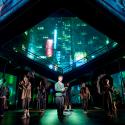
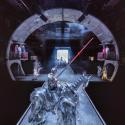
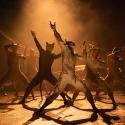
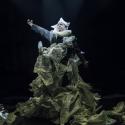
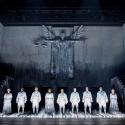
Just a flimsy music stand on the RSC’s biggest stage greets us. Sir Ken, no longstaff in hand as we might have expected, dons his coat, perhaps left over from Abanazar’s costuming in an upscale pantomime, and raises his weedy, reedy baton. Instantly, all hell breaks loose on Bob Crowley’s beautiful sparse, now tilting set, supplemented by Akhila Krishnan’s Donner and Blitzen videos. The game’s afoot all right.
The clue is in the title of course. Prospero, like a wizardy Leonard Bernstein, conjuring a storm to shipwreck his usurper brother, Antonio, Duke of Milan and shipwreck, amongst others, Ferdinand, Prince of Naples, a potential suitor for the exile’s daughter Miranda.
With a little help from his friend, the spirit Ariel, he seeks to orchestrate a return to his rightful throne, an alliance through marriage to the Court of Naples and a retirement to peaceful contemplation far from his wild island home these last 12 years. But Caliban, half-man half-monster, the only inhabitant of this remote spot before his enslavement by Prospero’s magic, has other ideas.
What to do about Caliban seems always to be the central question for a director of this play, one that Sir Richard Eyre, making his RSC debut at 83, never quite solves. Perhaps it is, at least for a 21st century audience, not solvable at all.
Caliban immediately declares his enmity towards his captor and is met with threats of magical tortures that have clearly been visited upon him in the past. He explains how he had been tricked by Prospero’s initial kindness, but then confined to a tiny corner of an island over which he once roamed free. It is impossible to avoid thinking of European colonisers trading shiny ornaments with Native Americans, before bringing out the firearms and the influenza that marked the birth pangs of Manifest Destiny, still underway on the streets of Minnesota and other US cities today.
Ashley Zhangazha, his line readings poetic and exemplary, lends Caliban an ardour for justice, but a dignity too - no crawling about on the earth, no undue obsequiousness - not a cowed dog, but a proud man standing up straight in the face of tyranny. Would I have been surprised to have heard a line or two from Martin Luther King’s “I Have A Dream” speech? No, I would not.
That gives Kenneth Branagh a problem in return though. We recoil, even accounting for the 17th century setting, from Prospero’s ruthless duplicity in subjugating Caliban and in his continuing unwillingness to compromise with his slave. What, we wonder, does a man with the power to direct the weather and much else, gain from such cruel coercion? It doesn’t help us as we get to know this Prospero as a man quick to anger, but also one who can find amusement in little things, transforming into a warm avuncular presence, Sir Ken’s inevitable charisma stretching out across the fourth wall. Men, even those without a wand and books of spells, who can occupy both those spaces, can be very dangerous.
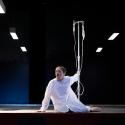
It is in the wizard’s relationship with his other slave that we see more of this personable side of his character. Amara Okereke is an extraordinary presence, on wires throughout, using her musical theatre background to sing beautiful songs (by Akintayo Akinbode and Stephen Warbeck), sometimes while spinning upside down high above the stage, a terpsichorean trapeze artist.
This relationship (crucially presenting no threat to the precious virginity of Miranda, Prospero’s ticket to Naples), is much more benign, Ariel doing his bidding and he always, but not quite, promising to bestow her freedom. With considerable magical powers herself, Ariel and Prospero meet as near-equals, not quite father and daughter, not quite lovers, but as respected friends who would be desperately lonely if separated - an issue resolved nicely at the curtain.
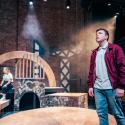
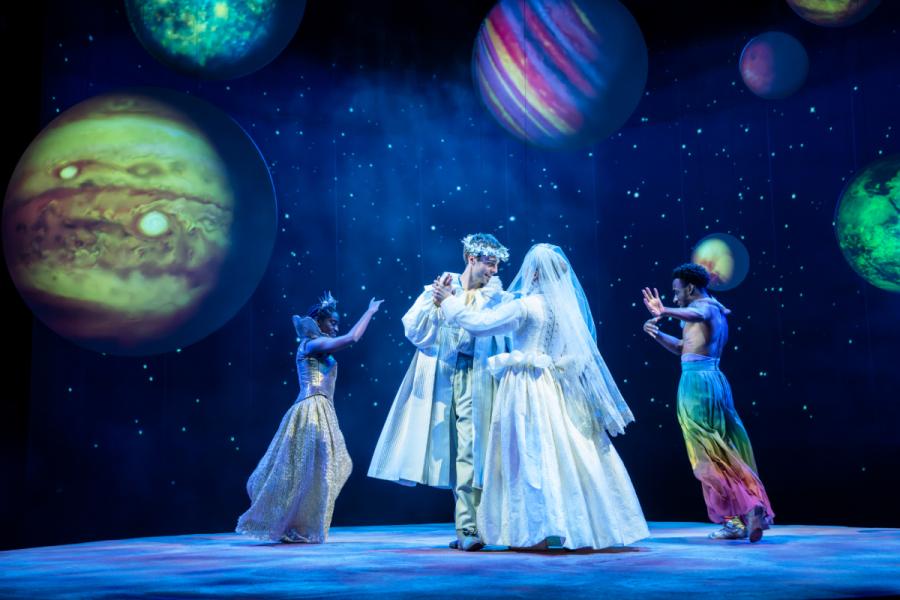
But ol’ Shakey knew how to please a crowd and his staple subplots soon kick in. Ruby Stokes (pictured above with Fred Woodley Evans) is very funny when spying a man (in the considerable shape of Fred Woodley Evans’s Ferdinand) for the first time, the two instantly, but understandably, falling in love at first sight. They are gauche, as teenagers must be, but they speak the truth about their feelings and, after passing Prospero’s somewhat halfhearted tests, you do give them a fair chance of living happily ever after. So no island full of little Calibans from Miranda, as the half-monster once dreamed and Prospero feared.
The comic cuts come from the boozed up servants, Stephano (Guy Henry) and Trinculo (Keir Charles), whose access to wine from the ship’s cellar makes them two merry islanders. They have a lot of fun with routines that call Frankie Howerd and Benny Hill to mind, all the while Caliban reflecting on his disillusionment with them as potential collaborators in a coup.
After a somewhat underpowered first half, the weight of Prospero’s speeches hit home after the interval, and you feel Shakespeare, in his last play as an individual writer, contemplating his own return to his boyhood home. There he will snap his quill, rather than a baton, relinquishing his own (near) magical powers. Sir Ken finds the elegiac poignancy in these valedictory words, ones that many Boomers in the house will feel striking home as we stare at what may be to come.
Though not a definitive Tempest by any means, it’s all beautifully done, spectacular and moving and with an undertow of the central question of middle to old age nagging continually. As our own powers fade, how and what do we do to protect our own psychological and physical wellbeing, while handing our home on to the next generation?
If it’s not already, that will become the essential conundrum for democracies the world over, one that they show little sign of addressing with the wit or the (eventual) compassion of Prospero.