

The Red Army Faction was Germany's key revolutionary force for a decade from the late 1960s onwards, and its story, especially the characters of Ulrike Meinhof and Andreas Baader, has proved highly attractive to the country's filmmakers. Uli Edel’s 2008 The Baader Meinhof Complex told the key political story in lengthy detail through to its end in 1977 when four of its key members (in the official version) committed suicide in prison. One of them was Gudrun Ensslin, who became radicalized after she became a lover of Andreas Baader.
film reviews
Emma Dibdin

Following her nuanced turn last year in Mike Mills’ quietly wrenching Beginners, Mélanie Laurent makes her directorial debut with another dimly idiosyncratic tale of thirtysomethings finding love and facing grief. Alas, while Laurent and her co-writers Morgan Perez and Chris Deslandes initially set up some intriguing dynamics, they give way all too swiftly to predictable scenes and a crushingly saccharine third act that’s no less risible for being heartfelt.
Matt Wolf

Travel, health permitting, knows few age barriers (if it did, there would be no Elderhostel), nor does charm, so there are two reasons up front why The Best Exotic Marigold Hotel fully deserves to win over the so-called "grey pound" market and much more besides. The story of a septet of British retirees abroad who need to leave home in order to learn any number of home truths, John Madden's film provides a welcome corrective to our youth-obsessed celluloid age without going to the opposite extreme and offering up an Anglo-Indian Cocoon, schmaltz and all.
In fact, the film's flintiness is one of its most appealing aspects, and not just because this adaptation of Deborah Moggach's 2004 novel These Foolish Things offers Maggie Smith (pictured below) in quite possibly the most unapologetically vinegary performance of her mighty career (well, at least until a redemptive grace note at the end that Dame Maggie graciously soft-pedals). The fact is, you don't hire talents of the calibre of Judi Dench, Ronald Pickup, Penelope Wilton, Tom Wilkinson, Celia Imrie, and Bill Nighy, not to mention Downton Abbey's star dowager, and ask them merely to play cute.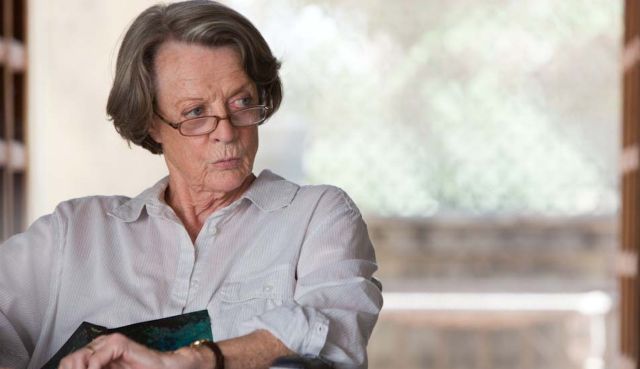 Sure, the prevailing arc of Ol Parker's script more or less requires that the oldies' travel should prove broadening, as per the time-honoured adage. But one is always aware of this ad hoc retinue's itinerant impulses furthering a collective sense that life exists not just to be endured but also explored. Where better to begin than with the Indian hostelry of the title? Even if what's actually "best" about the ramshackle if once-splendid Marigold Hotel only becomes apparent long after they have settled in.
The early scenes back in England deftly establish the personalities concerned, most concisely in a droll shot of the assemblage gathered at Heathrow, where departure lounge body language reveals all. Wilkinson, playing a gently spoken high court judge, is off to India to make peace with what he still regards as the defining love affair of his life, while Dench's newly widowed Evelyn hopes that fresh environs will enable her to cope anew with losses, financial as well as emotional, that she has suffered back home. Friction abounds in the ever-snappish tone of Wilton's Jean, playing the wife of a visibly worn-down Nighy, and in the rampaging bigotry of the wheelchair-bound Smith, en route to India for the hip replacement that waiting time and/or cost has prevented her from having in the UK.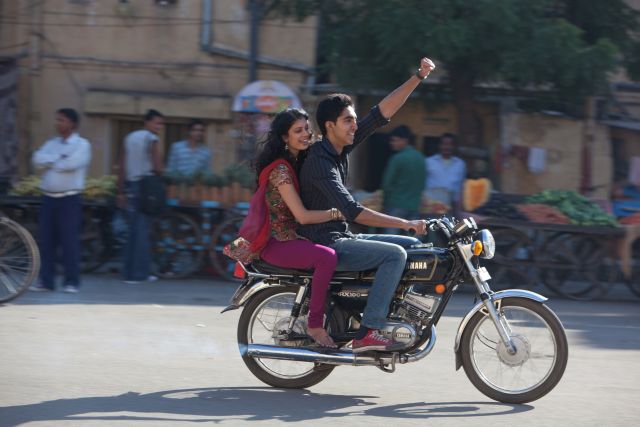 India proves transformative for almost (though not quite all) the assemblage, any initial resistance met head-on by the open-faced enthusiasms of Sonny (Dev Patel, pictured left with Tena Desae as his girlfriend), the lovesick entrepreneurial local who meets the Britons upon arrival at their new Jaipur home. While Sonny dreams of "out-sourcing old age", his visitors in varying ways allow the exoticism of their chosen destination to take regenerative hold, which in the case of Ronald Pickup's ever-libidinous Norman comes with a music-fuelled shedding of clothes.
The cast look invigorated by their buzzy, sprightly surroundings, as may those holiday-minded filmgoers who are spurred on by the movie to give the Indian tourism ministry a call. (On the other hand, if you thought traffic in London was bad, a Jaipur snarl-up costs one of the couples their marriage.) Among a thespian line-up awash in so many awards that they possibly traded acceptance speeches between takes, special mention must go to Dench, whose shimmering voiceover threads through the narrative, proving every bit as alluring as the bright colours of the climes to which she and her countrymen have all repaired.
I suppose you could describe the narrative as Shirley Valentine for seniors, with India here standing in for Greece. But anyone who's ever dreamed of a fresh start is sure to be touched in some way and if this delicately expressed paean to life's onward possibilities doesn't get you, well, then the flowering anew of Dame Judi surely will.
DAME JUDI DENCH ON THEARTSDESK
A Midsummer Night's Dream, Rose Theatre (2010). Judi Dench is a glorious Gloriana in Peter Hall's flat production
Jane Eyre (2011). Dench plays kindly housekeeper to Mr Rochester in invigorating version of the novel with Michael Fassbender and Mia Wasikowska
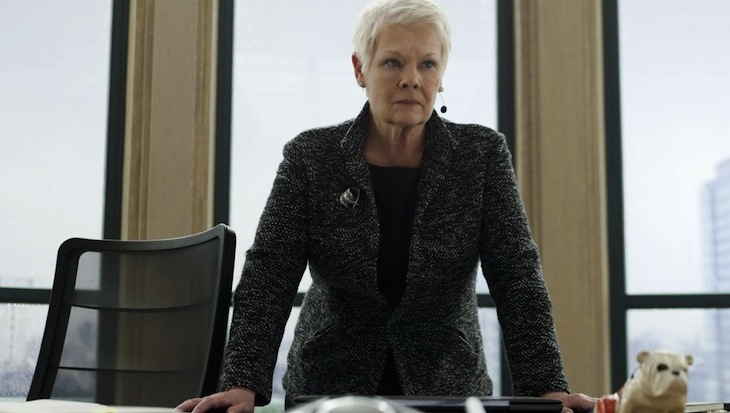
Skyfall (2012). Dench's M (pictured) is written out of the franchise in possibly the best ever Bond movie
 J. Edgar (2012). Dench as Hoover's mother lacks commitment to her American accent in flawed Eastwood biopic
Philomena (2013). Judi Dench touches the heart once again in the Dame's latest bid for Oscar glory
Peter and Alice, Noël Coward Theatre (2013). Judi Dench and Ben Whishaw step through the looking glass in Michael Grandage's elegiac production of John Logan's new play
Spectre (2015). Dench's M cameos in a video message beyond the grave as Daniel Craig and Sam Mendes carry on without her
The Second Best Exotic Marigold Hotel (2015). The expats are back in that rare sequel that betters its predecessor
The Winter's Tale, Garrick Theatre (2015). Judi Dench brings gravitas to Kenneth Branagh's West End season opener
The Hollow Crown: The Wars of the Roses - Richard III (2016). Dench is a matchless veteran opposite Benedict Cumberbatch chills's crook-backed king
Overleaf: watch the trailer for The Best Exotic Marigold Hotel
emma.simmonds

A bent cop movie with style, swagger and a sometimes questionable approach to characterisation, Oren Moverman’s latest at least gifts Woody Harrelson one of his best roles in years. Set against a backdrop of the Rampart police scandals of the late Nineties, it takes as its target one (fictional) Los Angeles law enforcer and his towering demons. Harrelson’s Dave Brown is an intelligent but difficult man, buckled into the straight-jacket of thuggery.
Graham Fuller

Hadewijch of Antwerp was a 13th-century mystic whose poetry had a formative influence on Dutch literature. Though influenced by the courtly love tradition, the subject of her poems was the love of God and the mysteries of the divine. She was probably not a nun but a beguine – a devout noblewoman in a self-denying contemplative order that carried out works of Christian charity. There is a suggestion in her letters that she may have been exiled from her sisters and yearned to rejoin them.
Tom Birchenough

Challenging the boundaries of reality and the way in which characters exist in and redefine their worlds has become something of a hallmark of director Pawel Pawlikowski. Considering his previous film My Summer of Love, one critic wrote of it as a study of worlds that “exist somewhere on the periphery of normality”. His new film The Woman in the Fifth pushes this further, revealing in a second-half twist that the boundaries of what we had assumed to be reality actually exist in the imagination, somewhere close to madness, to a darkness inside.
Emma Dibdin

Novelist Jonathan Safran Foer once described his approach to the writing process as “trying to stop making sense, and create something that just has an effect”. It’s an intention that’s easy to track in his sophomore novel Extremely Loud and Incredibly Close, which uses an idiosyncratic mix of prose, pictures and blank pages to spin its two narrative strands.
Tom Birchenough

Dutch director Leonard Retel Helmrich has spent a decade following the everyday lives of Indonesia’s Sjamsuddin family, a working-class clan with their roots in the countryside whose working lives have taken them into the hubbub of the country’s capital Jakarta. Position Among the Stars is the final work of a trilogy, its immediate subject the importance of granddaughter Tari going to college to receive the further education that will give her new opportunities.
emma.simmonds

In Susan Hill’s 1982 novel The Woman in Black, the protagonist Arthur Kipps concludes his narration with petulant certainty: “They asked for my story. I have told it. Enough.” With this film adaptation (an exercise in hair-raising horror, in contrast to the book’s chill grandeur and the play’s postmodern whimsy), director James Watkins clearly feels there is more to say and, though he often says it with style, it’s a film that sometimes lacks guts.
Veronica Lee

Those of a certain vintage will recall with fondness their childhood years (or those as parents of small children) gathered in front of the television on Sunday evenings between 1976-1981 to watch The Muppet Show. But The Muppets movie, their first big-screen outing in 12 years, is no lazy exercise in nostalgia; it's bracingly original and postmodern, with dollops of self-knowing humour and irony.