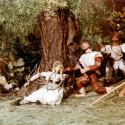
In his home country, the release of the latest film by Nanni Moretti is always an event, all the more so in the case of We Have a Pope – a bittersweet psychological comedy with tinges of tragedy about a cardinal who is elected to the throne of St Peter, has a panic attack, and does a runner leaving the Catholic Church in crisis and the world media with a bonzer news story. It arrives a full five years after his last outing, Il caimano.
A profound neurotic whose long-term relationship with psychoanalysis seems to have resolved little, but which has provided him with endless material for his sometimes satirical, sometimes left-field comedic oeuvre, Moretti is routinely compared to Woody Allen. Tall, ruggedly handsome and manic in a way that suggests a heterosexual Rupert Everett mainlining on an espresso drip, he not so much stars in all his own films as wrestles them to the ground until they cry out for mercy. There may be depth of feeling and political conviction in his work – both as director and actor – but subtle tones are there few.
Unlike Woody Allen’s dishevelled schmuck whose screen presence gives us a loser in a broad gamut of nuance, Nanni Moretti’s Alpha Male radical left-wing intellectual with existential issues fills the screen in a Marmitey sort of way; it is hard to remain detached and neutral about so vehement and hectoring a presence. He either does it for you or he doesn’t.
Piccoli’s perplexed Pope is magisterial, perhaps even divinely inspired
On account of his strident political views, Il caimano (2006) – his reptilian soubriquet for the slimy charms of Silvio Berlusconi – was awaited anxiously in 2006, but despite its reliably right-on message (down with the caiman, he’s destroying all that we hold dear) it failed to impress at any specific level. As satire it was clunky and obvious, as political rhetoric it was muddled and uneven; only Moretti’s interpretation of slithery Silvio stood out as a manic monument to overstated acting.
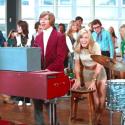
So it was with considerable caution that one approaches his follow-up. Michel Piccoli, almost 86, plays the cardinal elected – to his surprise and indeed horror - by his peers in the Conclave. Moretti plays Professor Brezzi, a militant atheist psychoanalyst called in by the shell-shocked Vatican authorities when their boss presumptive has a panic attack and refuses to appear on the St Peter’s balcony to bless the crowds (a necessary act for his papal election to be validated, under canon law). Moretti has a ball – quite literally in the overlong second half when he organises a complex international volleyball competition in the Vatican’s inner courtyards, and bosses the elderly cardinals around from the referee’s high chair (pictured below).
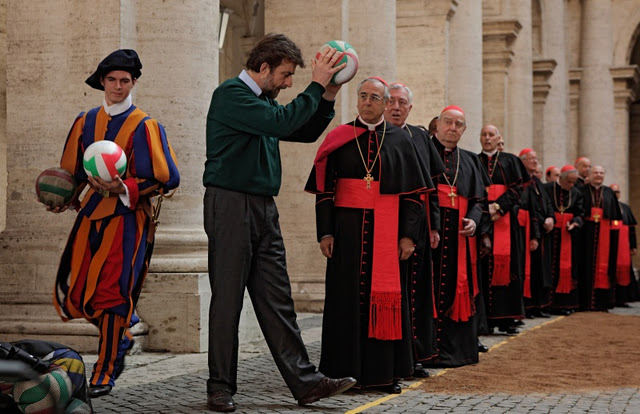 The best scenes in the film, amongst the funniest and the most effective in Moretti’s career, are of his interactions with the elderly cardinals, trying to explain both the protocols and finer points of psychoanalysis and the characteristics of the various anti-depressants and tranquillisers that they almost all seem to use.
Moretti’s martinet shrink seems to have little success with the troubled new pontiff, so he sends him to see his (now divorced) wife and professional rival (the blonde, bland and forgettable Margherita Buy, who passes for one of Italian cinema’s leading ladies). Her theory of “parental affection deficit” strikes a chord with the new Pope, who after his first session with her deliberately loses his discreet Vatican escort and disappears into the Eternal City, observing with puzzlement all he beholds.
Piccoli’s perplexed Pope is magisterial, perhaps even divinely inspired, and when interacting with Moretti’s shrink the film works a treat. It fully indulges the anti-clerical Moretti’s wishful thinking of a Catholic church collapsing from the very top (although with a welcome lightness of touch), while evading an uncomfortable reality that its author would clearly rather not address: that after the long stand-off between Communism and Catholicism (the so-called due chiese – the two churches of postwar Italian politics), it was Moretti’s beloved Left that fell apart.
But in an even more parlous state still is Italian cinema itself, which over the last 30 years or so has gradually lost those exciting and innovative characteristics that made it a world leader between the end of World War Two and the early 1980s. It is significant that such a patchy curate’s egg of a film, with much so-so acting among the supporting roles, should win six prizes at Italy’s prestigious Nastri d’Argento awards, including Best Director.
Watch the trailer for We Have a Pope