Chinese-American director Bing Liu’s first feature – his Minding the Gap, a wonderful documentary about himself and his skateboarding buddies in Illinois, was Oscar-nominated in 2019 – is based on Atticus Lish’s Pulitzer Prize-winning novel of 2014 about an undocumented Uyghur immigrant and her relationship with an American soldier who’s done three consecutive tours in Iraq and has severe PTSD.
The harsh reality of family abuse and violence in Minding the Gap might lead you to expect something as powerful here, especially as Liu has said that his mother’s immigrant experience mirrors Lish’s book. And of course it’s a story that's far more relevant now, in the face of daily ICE arrests and deportations, than it was in 2014. But Liu and screenplay writer Martyna Majok (with Barry Jenkins as a producer) have given us a strangely watered down version of Lish’s harrowing, vivid story. Perhaps it’s better to see the film before reading the book.
In an excellent performance by multilingual newcomer Sebiye Behtiyar, who is herself Uyghur, Aishe has arrived in Chinatown in Flushing, Queens. In flashbacks, we see her as a child running across the plains with her father, who died in the Chinese army. She tells him in Uyghur in a voiceover, “I ran all the way to America. I trained every day, like you taught me. How far did you run?”
She’s already spent time in a brutal immigration detention centre and is working long hours without papers in equally brutal Chinese restaurants. Lish’s descriptions of her resilience in the face of desperate poverty and determination to work towards a new life aren’t quite reflected in Aishe’s demeanour; she looks too polished and put together.
Skinner, played by a miscast Fred Hechinger (Nickel Boys, Gladiator II, The White Lotus) is wandering around New York, looking for a bar or a massage and a place to stay, carrying an enormous backpack containing what’s left of his post-army life. It dwarfs his slight, unmilitary frame, and he never seems entirely convincing in his role: he’s too hesitant, too boyish, though perhaps his youth, and the way it’s been ruined by forcible over-deployment in Iraq, is the point.

His eyes meet Aishe’s as she eats a bowl of noodles in front of the restaurant where she works, and although she’s reluctant at first, they end up going to McDonalds and then drinking in a Spanish bar, Aishe chugging back Coronas as fast as Skinner. She seems to have an iron constitution. She's older than him, more sure of herself and what she wants, and she looks at him, measuring him up. Can he help her find her next, better life? Can she help him? How will he react when she tells him she's Muslim?
They compare biceps, wrestle playfully, race laughing through colourful Chinese food stores and the noodle shops and tenement housing of Flushing, atmospherically shot by cinematographer Ante Cheng. She goes back with him to the cell-like, green-painted basement room with high, small windows that he finds in Queens; he takes her to his gym and helps her with the work-out regime she’s cut out of a magazine. He says he’ll marry her so she doesn’t have to worry any more about being arrested.
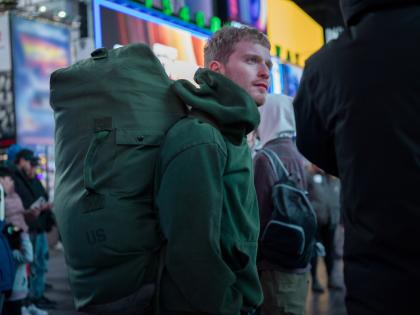
Of course, Skinner’s PTSD surfaces soon. He doesn’t turn up to meet her after work and spends his days asleep or in bars or looking at his gun; when she tries to encourage him to get a job, to get out of the house, he’s silent, then angry, pushing her away violently. His leg jerks uncontrollably. She hopes Chinese herbal medicine might help, and he’s prescribed roots that have to be boiled up. When, on a bad day, she asks him if he’s been taking his meds – he has bottles of them that she examines closely – he says, “I even drank the Chinese shit. I had two cups of it and it doesn’t do shit. Nothing does anything.” She gets arrested and detained again, but Skinner doesn’t answer when she calls him collect from jail.
After she’s released, her sadness sends her to a mosque, but religion doesn’t have any answers. It’s this life she needs help with, not the next, and she leaves Skinner and New York to take other jobs, ending up on an alpaca farm with Mexican workers. One night, after being woken up by a Spanish love song playing in a truck outside her trailer, she rings Skinner’s number. We see his emptied-out room with moonlight shining down from the windows on to the bare white mattress. It’s a beautiful, haunting image, with a depth of vision that you wish Liu had brought to the rest of the movie.