Expectations are high with Julian Lage; they always have been. The guitarist is one of the special ones: born on Christmas Day (1987)...appearing with Carlos Santana at age seven... a documentary made about him at eight...clocked by Gary Burton at the Grammy awards at the cusp of his teens...and performing in Burton’s group at an age when he still needed parental chaperoning.
Through the years, he has continued to deliver. That sense of being not only supremely gifted but also having worked to achieve a level of musicianship which can at any moment take him in any direction he chooses, of being completely at ease at the intersection of jazz, rock and country, came across best in Modern Lore (2018) in a superb trio with bassist Scott Colley and drummer Kenny Wolleson. Sweet sound, an empathetic partnership, it’s a great album. More recently, in lockdown, there has been some wonderful music on video in a domestic setting, where he appears as the ultimate top-flight uxorious accompanist for singer Margaret Glaspy.
Now, Squint marks his debut on Blue Note, and, naturally, the hype around him continues: it “should catapult him to the next level”, according to one commentator. Lage has explained that the Covid-imposed delay of several months before the album was recorded in Nashville late last year made him re-think what he wanted. Rather than “positive, beautiful music – a beam of light from three cats who love each other,” the native Californian has explained, he wanted to seek out a very different vibe: “It became really important to me to capture a certain sense of emotional complexity to the music, a little fuzziness.”
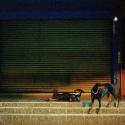
The entry point into the album is a solo number called “Etude”, which is curiously unrepresentative of anything else on the album. Lage plays gently on his Collings 470 JL, and the piece inhabits a classical world not unlike that of Agustín Barrios but with a more chromatic and bluesy palette. After that strange sideways glance into another world, the tone for the album is set in the second track when the trio enters. The dominant voice here, as it is on “Saint Rose” later in the album, is drummer Dave King’s metronomically insistent backbeat. King very often takes charge, whether running riot and then dictating the ending of the title track, or disrupting “Day and Age” with a petulant machine-gun rat-a-tat. Others are bound to have more appetite for this style of playing than I do. Jorge Roeder (photo above with Lage in London in 2018 by Monika S. Jakubowska) is a very fine bassist. His solo bass album El Suelo Mio from last year is thoroughly recommended, not least because it is the treat which any good hi-fi system deserves. Roeder and Lage have done hundreds of gigs together and their superb mutual listening, their close, hand-in-glove partnership makes “Twilight Dancer” perhaps the most satisfyingly achieved track on the album.
Overall, Blue Note have produced an album with a strangely homespun, indie vibe. Jazz-lovers will note that there is hardly a single track with a planned, shaped or poised ending. There is more than an occasional urge from Lage to go rogue, to release an outburst of grinding, angular discordant sound on his 1955 Gibson Les Paul. “Familiar Flower”, for example, is a strange exercise in wilful discontinuity. Another feature is the occasionally air of insouciance, of almost half-hearted detachment which seems to take hold of the trio in a track like “Short Form”. Surely the listener needs to be more assiduously engaged than this.
Squint, Lage has claimed opaquely, "sits comfortably in the unknown." Lage and Blue Note have made an album which feels more like work in progress, glimpses of things maybe still waiting to gel, rather than any clear statement of intent.
- Squint is released on Blue Note on 11 June 2021
- Julian Lage's Trio will be at the EFG London Jazz Festival on 12 November
- Read more new music reviews from theartsdesk