When David Byrne made a mention of heroes and superheroes, one audience member could not resist. "Like you" they yelled out, and while the former Talking Heads singer might not be able to leap buildings in a single bound, his current creative hot streak is a nifty power indeed.
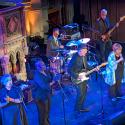
Several years on from his terrific American Utopia tour, and Byrne is back on the road with a 12-piece backing band and a seemingly empty stage. To begin with, he was joined by only three musicians for a pared back "Heaven", the Talking Heads track from 1979, but it wasn't long until more and more started arriving onstage, including a foursome to handle percussion. No instruments were set in place onstage, meaning everyone, all clad in blue jumpsuits, was free to roam across the stage.
It wasn't a case of strolling about as they saw fit, though. Every song was slick and regimented, to the extent that the night sometimes felt more like a theatre production than an actual gig, with several routines running through the evening, from pretend whispering to each other in the background to lifting Byrne himself up into the air at one stage.
Behind it all loomed a vast screen, which played a variety of videos, images and - at times - simply an intense light on the performers. Among the images were a few from West Dunbartonshire, where Byrne hails from. His shout-out to Dumbarton was heartily cheered, as even though he departed for abroad while still a young child there's still a tendency to perhaps optimistically claim him as a Scot.
And why not? The opening clutch of songs were exhilarating stuff, with the world-pop of "Everybody Smiles" being followed by another one from his old band, the upbeat earworm "And She Was", and better was to follow. The several minute long "Houses in Motion" featured a filthy groove from bassist Kely Cristina Pinheiro that eventually veered into a blissful, spaced out jam. It was intense, reaching an almost hypnotic finale, and the evergreen pop burst of "This Must Be The Place (Naïve Melody)" that followed shortly afterwards was pretty rewarding too.
Songs from his old band made up just over half the set, with only five drawn from last year's "Who Is The Sky?" album. Given the emphasis on visuals and the stage show, this was an interesting decision, to not feature as much of the new material as he could have. However, the sheer strength - and indeed joy - of some past material was undeniable. That isn't to say there wasn't enjoyment in the newer songs too, with "I Met The Buddha at a Downtown Party" possessing a dry wit, and "When We Are Singing" going towards a full musical number with some success.
Byrne's voice was sharp, and for all the amount of musicians on stage there was no attempt to let them do the heavy lifting. His stage presence remains forceful, and he was clearly in good spirits given he cracked a joke about Glasgow's claim to be considered the home of curry.
There were a few misfires. The eco-friendly "Nothing But Flowers" sounded rather twee both lyrically and melodically, before the salsa flavour of "What Is The Reason For It?" pushed the musical mix a little too far. Live, it sounded unconvincing. The sheer staged and well-honed nature of the night also meant there was rarely any chance of anything taking an unexpected turn, for better or worse. This was rarely an issue, but it did take away a little spontaneity, save the odd spoken word from Byrne himself.
Yet who could complain when the irresistible throb of "Psycho Killer" kicked in, still one of pop's most thrillingly oddball songs? There was a similar outpouring of joy when a funked up "Once In A Lifetime" brought the main set to a danceable and chantable close, a good times vibe that reappeared on the finale of "Burning Down the House".
It was two other songs that lingered longest from that stellar closing run though. "Everybody's Coming To My House" was re-invented in a near gospel way, with shadowy lighting adding to a hymnal feel. It felt almost reverent to watch, while a different feeling pulsed through a fiery, rhythmic "Life During Wartime", accompanied by video footage of American law enforcement using blunt brutality on protesters.
Such a furious display meant this song from the late 70s felt as timely now as the day it was written. Perhaps that ability to stay relevant is Byrne's own superpower.