The death of Dolly Parton has been a shock that reverberated worldwide. Not the fact that it happened: she was 80 and in ill health and passed after a life well lived. Rather it's been the aftermath – and specifically the outpouring of love – that has been unprecedented. From the moment the news broke you only had to glance at any social media to see everything dominated not by sadness but by that love, and from across multiple generations too. It felt, strangely, more celebratory than elegaic.
And that's just kept coming. More and more personal stories of what her music and vivid presence had met to people individuality, and more and more stories of her generosity, artistic commitment and wit. Her personal website is now just a repository of "letters" sent in: at the time of writing just approaching 2,000,000 words from 30,000 people in 93 countries. So in that spirit, rather than produce an obituary or comprehensive piece on her life and work, here four of theartsdesk's writers share their own very personal takes. We'd intended only to provide a couple of paragraphs apiece but, well... there's a lot to say about Dolly.
Liz Thomson
I twice had tickets for Dolly Parton. Neither time could I go – the first because my elderly father was hospitalized just as he was moving house, the second because a friend who’d studied music with me had composed a ballet for Sylvie Guillem and Russell Maliphant. I’d long ago promised to attend and now here was the first night. Ballet, my least favourite thing in the world. And now I never will see Dolly.
She had a voice like silvery rain, a delicate vibrato, which never seemed to age and, boy, did she write some beautiful songs to wrap it round. Her lyrics said so much with such great economy. I always preferred the folksy story-songs to the big production ballads (though of course in Dolly’s original version “I Will Always Love You” was not a big production ballad), and who doesn’t love “Coat of Many Colours”. But high in my top ten I’d have to put “To Daddy”, such a poignant and clever song which says the opposite of what it seems superficially to be saying, almost until the end. Then there are numbers like “Coming Down from Dover”, a story told with such tenderness and delicacy, and a total lack of judgment on the young woman’s predicament; only sympathy. And oh my God, the quiet understatement in the tragic, heartbreaking final verse:
My body aches the time is here
It's lonely in this place where I'm lying
Our baby has been born but something's wrong
It's much too still I hear no crying
I guess in some strange way she knew
She'd never have a father's arms to hold her
And dying was her way of telling me
He wasn't coming down from Dover
So many utterly brilliant songs.
But one should not neglect her many wonderful covers: The albums recorded with Emmylou Harris and Linda Ronstadt, most of the tracks now gathered on The Complete Trio Collection, recorded in the late 1980s and 1990s. And of course there’s the bluegrass trilogy, laid down between 1999 and 2002. The title track of the second, Little Sparrow, is exquisite.
Parton was full of wit and wisdom – plain-spoken sometimes, as in “9 to 5”, Dolly writing in the voice of a put-upon and abused secretary decades before the #MeToo movement curtailed the antics of lascivious alpha males like the fictional Franklin M Hart Jr, played by Dabney Coleman in the movie. In 1987, Parton was named as one of Ms Magazine’s Women of the Year. Gloria Steinem wrote:
“People who haven’t listened to Dolly Parton or to feminism may be surprised to learn that they go together. In fact, she has crossed musical class lines to bring work, real life, and strong women into a world of pop music usually dominated by unreal romance. She has used her business sense to bring other women and poor people along with her. And her flamboyant style has turned all the devalued symbols of womanliness to her own ends.
“If feminism means each of us finding our unique power, and helping other women do the same, Dolly Parton certainly has done both.”
Two friends of mine had dealings with her: Janis Ian invited her to collaborate on “My Tennessee Hills” from her 2004 album Billie’s Bones. “She’s the shit isn’t she! She’s Dolly,” Janis told me in a long-ago interview. “God almighty, she’s bright. She great, she’s talented, she’s a great writer, great singer, a really good guitarist, a terrific producer, a wonderful actress, a brilliant businesswoman – and she doesn’t take it all too seriously.
“There was one window for her to do it, at nine o’clock in the morning,” Janis continued. “The studio was so excited – it’s like a visit from a head of state. They bought her flowers and I sent a car and she came in with her assistant, with a bag of chips and a Coke – something sweet and something salty – and she looked like Dolly! And I was immediately really embarrassed because we’d cut it three weeks earlier and we’d changed the format a bit. She knew it inside out, but she knew the demo, and she was apologetic because it took her a couple of minutes to catch up and I was crawling, saying I’m so sorry I didn’t think to send you a copy, I thought you were too busy. But she knew both parts, and she’d worked out her entire part. There’s one line in there, ‘When I’m down to my last witness, I’ll be going there’, and I said, ‘To me that’s the key line.’ And she changed her part so it went up higher and she just threw herself into it. She was just fabulous, everything you think she’s going to be, and more. Posed for pictures, listened to the playback a couple of times to make sure she was happy, signed stuff for everybody. She was total class, total class.”
Marc worked for RCA, and on more than one occasion it fell to him to escort Dolly to FanFest, the annual Nashville bash where the stars turn up to meet the fans and spend a day signing autographs and posing for photos. He’d arrive at Dolly’s home around 5am and she would greet him at the door resplendent in fully monty, of course. She was, he said, a complete delight to be with. There were a lot of laughs – for Parton was a natural comedienne.
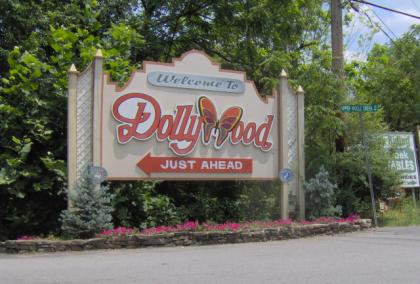
Some 25 years ago I went to Dollywood. The trip, which began in Nashville and included an evening at the famed Bluebird Café, was suggested by a couple of publishing friends. Both were senior in their roles, and at the time I was the associate editor of the leading weekly journal for book publishing. We drove though the Great Smoky Mountains, spotting bears along the way, to Pigeon Forge, where we stayed a couple of nights, the better to max out our time at Dollywood. And did we have fun! Shrieking with laughter on the rides, then listening to live music, made of course by members of the extended Parton clan. The recreation of her childhood home included the actual coat of many colours, which was tiny: it was touching, not mawkish.
Dollywood created employment for all manner of people in a part of America, the Appalachians, where work is scarce. And it raised money for the multifarious causes close to Dolly’s heart. She never forgot where she came from, never forget the deprivation of growing up dirt poor – but she didn’t see herself as deprived because she grew up in a loving home. She was proud of who she was and proud of who she’d become and what she’d achieved. Part of her role was to tell everyone that they too could achieve and, with initiatives such as the Imagination Library, to offer a helping hand.
For Dolly, enjoyment of her vast wealth involved not endless homes and private jets and fancy yachts but sharing it, giving it away – including to Moderna to help develop a Covid vaccine, and to the Pediatric Center Center at Vanderbilt Hospital in Nashville, where she died on Tuesday. She died, I imagine, fearlessly – as she lived – believing she was going to a better place, for she always seemed to have that wonderful folksy, easy relationship with her God. She once said: “I talk to God like He is my best friend. I just go around talking to Him sometimes… if something great has happened, I just kind of raise my hand and give God a high-five or a thumbs up.”
Dolly was a one-off. A singular talent. A bright shining star – indeed, she defined star quality. Even those with no interest in the kind of music she created have noted that the world is poorer (and duller) for her passing. Sing on, Dolly, in that heavenly choir. Sing out, sister, so we can still hear you.
Thomas H Green
I rarely feel sorry for an indie band. But I did feel a bit sorry for The Horrors at 4.00 PM on Sunday 29th June 2014. They were playing Glastonbury Festival’s Other Stage.
To almost nobody.
Everybody – and I mean EVERYBODY – is in the Pyramid field. It is absolutely chocka. Afterwards they reckoned around 180,000 people.
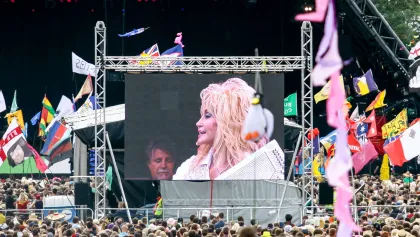
They are here because a true music legend is about to play. Most of them may only know three or four of her songs but that doesn’t matter. Her downhome Tennessee charm, her cheeky wit, and her lovable oversized personality have drawn us here, many in bouffant wigs and party shop cowboy hats. There are a surprising number of men sporting large fake plastic boobs. Glastonbury is used to hosting the biggest names in popular music but there’s still a truly electric sense of occasion. After two days of rain, even the sun is attendant and ready.
And there she is. Dolly Parton. Clad in a silvery white skintight rhinestone suit. She is an irresistible one-woman hoedown party, hugely likeable, the consummate entertainer. From metalheads to stern techno puritans, we are putty in her hands. She attacks guitar, banjo and dulcimer with consummate ease. Preposterously, she plays the Benny Hill theme on a saxophone. She sends us out-of-body-euphoric with “Jolene”. She leads an acapella singalong to a new song she’s written about the festival called “Mud, Mud, Mud”. She hauls on grizzled fret-wrangler Richie Sambora to add rockin’ to her gospel version of Bon Jovi’s “Lay Your Hands On Me”. And everyone goes completely bonkers when she kicks into “Nine to Five”.
Dolly was always for everybody. Upon her death this week lots of people are, rightly, saying so. I only own a couple of her records yet it stung when I heard she was gone. She was one of the good ones, huge of heart and talent. I cast my mind back to that Sunday in 2014. This five-foot tall woman with an infectious joy about her was as big as a crowd of 180,000 souls. And that is quite a thing.
Tim Cumming:
I never got to see Dolly Parton in concert. Not at Glastonbury, or at any of her UK dates in 2014, the last time she would tour here. And not at Páidí Ó Sé's pub in Ventry, Kerry in 1990, where she performed an impromptu version of “Coat of Many Colours” with a local guitarist while on holiday. But I will never forget her live performance on one of the revived Parkinson shows back in the early noughties. February 17, 2001, in fact, just as her album Little Sparrow was released. In conversation, talking about her start in life, as a songwriter and as a singer, all wrapped up in her looks and style, she was so personable, self-deprecating, down-to-earth and very, very funny.

And then she sang the title song of the new album he was touting, the second her of bluegrass trilogy, of albums, preceded by The Grass is Blue in 1999 and followed by Halos and Horns in 2002. There was nothing funny about the song she sang, “Little Sparrow”, nothing funny about her voice or how her musicians played behind her, leaving plenty of space, as if it was shadow for the song to shine in. The song itself, an old-sounding ballad freshly written by Parton, warning of false-hearted lovers, maidens fair and tender, and the crushing ways of fate and men. By the end of the song I was in tears. Not a trickle, a flood.
My memory tells me she also sang “I Will Always Love You” (AI disagrees, but who was actually there at the time, chatface?). After which I was essentially a pool of salty tears on the floor, flecked with spots of grease, transformed like one of Ovid’s metamorphs by the searing power of her voice and her song. I was a new dad at the time, maybe that had something to do with it. What is it about a singer, and her songs, that just makes you melt inside? I don’t know what it is about Dolly Parton, though obviously it is about her voice and its character, and her delivery, and her timing. It’s about all those things, and the tunes she wrote, the spooky chords that haunt “Jolene” from the get go, that mix of realism and sentiment she had, of the hardness and the yielding of love. But there’s also something unsayable, unknowable, unfathomable and bottomless about her and her music. And I love that, Losing Dolly is a devastation, but her music will always be in the present tense.
Joe Muggs
Twice in the last two weekends I’ve seen the Nigerian born poet-rapper Joshua Idehen perform at festivals. He has a bit he’s been doing for a while right at the beginning of his set where he takes his initial applause then says to the audience “now I’m going to walk off, and when I come back I want you to imagine I’m Dolly Parton. A multiverse Dolly Parton… an African Dolly Parton”. The premise, of course, was that nobody could draw more unabashed adoration as Dolly – as Idehen says on his Instagram tribute, “very few people in the world… were as universally loved as her” – and delivered in the context of his show, which is focused on love and community, it really works.
Last weekend at We Out Here, it was a moment of pure joy. This weekend, at Shambala, of course it was tinged with sadness. The DJ warming up for him had played a short set of Dolly favourites, and Idehen talked through his usual routine, explaining that he’d always hoped one day she would find out about this bit, and also singled out “Islands in the Stream” as a song he’d heard his father play in childhood. Then he did his usual routine, and it still worked: when he came back on stage, the audience went wild for him, for the imagined Dolly and for the memory of Dolly.
It is wild to see how much she had become, even before her passing, a kind of latterday saint: an emblem of joy and inclusiveness for younger generations perhaps more than ever. It’s right there in her recent guest appearance on a new version of Gen Z superstar Sabrina Carpenter’s “Please Please Please” and accompanying video. There’s nothing cynical about it – Carpenter clearly adores her and there’s a natural chemistry as they play out a trash cinema narrative, with mischievous and affectionate moments as Dolly lights Carpenter’s cigarette, or gives a knowing nod as she subs in the line “like the others” for the original “motherfucker”, and their harmonies are sublime.
The writer Ned Raggett on a social media post perfectly caught what this moment meant. Referring to the Carpenter video, he says: “Just thinking about the range and the history all down the line. Like you meet Johnny Cash backstage after performing as a teenager at the Grand Ole Opry in the late fifties and he encourages you to stay true to yourself and decades later you end up doing this because you can and you did.” And that is how it always went for more than 60 years. Johnny Cash is well worth mentioning. Hew as someone who always used humour, showbiz and folksiness as part of his armoury but was a consummate musician and always true to his roots – and that was Dolly’s mode her whole life long.
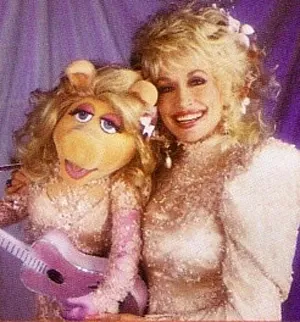
This was someone who embraced urban, cosmopolitan showbusiness, but never really left Kentucky. She could not just go on The Muppet Show but have The Muppets go on her show, she could be in a hit movie, she could grace the biggest stages in the world with unashamedly commercial sounds. But whenever she picked up a guitar and sang, whether in an Irish pub she happened to be passing or the Johnny Carson Show, nobody could ignore her virtuosity and soul. And she returned again and again to the Appalachian music of her childhood – notably on her 1987 Trio album with Emmylou Harris and Linda Ronstadt, and on the 1999 The Grass is Blue album which revitalised her later career – always with spine tingling results.
All of that is before we get to the well-documented philanthropy and personal generosity, the fact she was a lifelong trade unionist, her loving support for the LGBTQ+ community, her anti-racism, her embodied feminism, and the fact that to the very end, even in the Trump era, she spoke to white rural America and – again, with love – made sure people were reminded that they were the children of immigrants too. All without dogma or flag waving: she understood people and how to speak to them, and her message was for everybody. It is no wonder that she remains beloved of everyone from Nigerian dads to dancing crowds of all ages at modern festivals. In these turbulent times, we have never needed an emblem of joy so much – and it is very clear that even if no longer with us, Dolly remains that and will do for a long, long time to come.