In that wide field commonly known as world music, ancient traditions co-exist with cutting edge experiment.
At Bristol’s intimate city-centre venue Strange Brew, the opening act, Mohammed Errebbaa (pictured below), a Gnawa master from Morocco, alone on stage with his gunbri, the lower-register string instrument, a distant cousin and ancestor of the American banjo, summoned the spirits that accompany trance and healing. He was opening for Ata Kak, a similarly well-travelled West African, whose strange bouncy music mixes electronics, frantic rap and scat, and traditional call-and response.
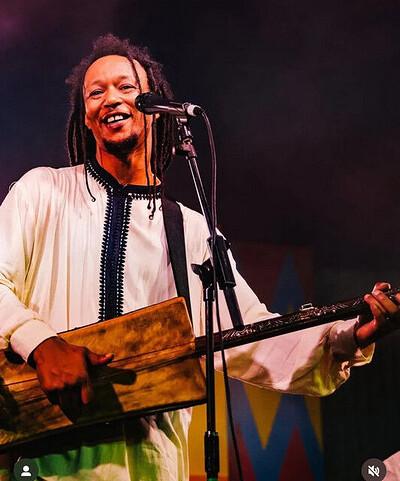
While the main act offered stripped-down fun, music for celebration and collective “unwinding” as Yaw Atta-Owusu explained in one of his contagiously eccentric introductions, Errebbaa worked more subtly, teasing complex and halting rhythms out of an instrument whose unique tone – laden with the soft but instant distortion produced by pieces of metal that vibrate as the strings are plucked – is designed to work magic on the listener’s ears and heart. This was, as he explained, not a ceremony, the usual context in which the gunbri player leads, coaxing with rhythmic breaks and deep sounds that summon otherworldly dimensions, but something stripped-down, without the insistent clatter of the metal castanets, the qrakeb. But we were in the presence of a master and this minimal version of Gnawa excellence revealed more clearly the musical intricacy at the heart of what is normally a noisy ritual. His yearning voice, and the throbbing yet delicate bass notes filled the space with magic and held the audience rapt.
The contrast with Ata Kak could not have come as more of a shock: from the mesmerising introspection of the trance master to the exuberance of an energetic entertainer whose joyous antics belied his white hair and self-confessed senior citizenship. Yaw Atta-Owusu hails from Kumasi in central Ghana, but he has travelled the world, lived in Germany, played in in a reggae band, and absorbed the high energy and communal vibe of club music. He recorded an album released on cassette in 1994 –Obaa Sima - his unique combination of traditional Ghanaian sounds with contemporary electronics was popular in his native country, but it wasn’t until Brian Shimowitz, better known as Awesome Tapes from Africa heard a cassette on one of his exploratory trips through West African, that he broke through to a wider audience.
Riding a constant groove of catchy riffs, with vibrant support from Pax Nindi (bass), PK Ambrose on mpc and Adinah Erb on vocals, Ata Kak fires off a breath-taking cascade of rap, scat and catchy lines in his native Twi, the language of central Ghana. As with the dizzying rhythmic vocalising of talas by Indian percussionists, and some of Bobby McFerrin’s vocal acrobatics, this is a performance that defies belief. He flies away on the on edge of risk as if it were the simplest of exercises. And ‘simple’ is indeed that key element in an act that never pauses, and keeps an eager audience of fans most happily engaged. The queue for the merch at the end of the set is indicative of Ata Kak’s faithful fanbase, they know many of the vocals as well, and join in when asked to do so with almost child-like fervour. Several of the tracks are very similar, and a little more variety would have been welcome. There were moments when they ventured off their chosen beaten track, not least when sounding surprisingly like those other category-busting musicians- Talking Heads of the African-inspired “Remain in Light” era, or the Shanghai Restoration Project, who shone at this year’s WOMAD. Ata Kak proved, albeit briefly, capable of a tonal and textural intricacy that escaped the default – yet hypnotic - sameness they seemed to rely on.