Late on Friday night at WOMAD, on the more intimate Charlie Gillett Stage in Charlton Park, there was an unusual cross-cultural treat. Ballaké Sissoko is one of Mali’s most accomplished kora players: not as well known as his Bamako next-door neighbour Toumani Diabaté and more firmly rooted in Manding musical tradition, but undoubtedly in the same class. Vincent Ségal is a brilliant French cellist who moves with consummate ease from the classical repertoire to free jazz. They are both technical virtuosi but neither of them plays to the gallery.
In a manner consonant with some of the most deeply held tenets of West African musical ethics, the two musicians shone brightly without outshining each other. The material is mostly drawn from Malian tradition, and Ségal, who has spent months living in Ballaké’s family compound, has absorbed more than the sophisticated architecture of the kora literature. He understands deeply the values of modesty and cool: a kind of heartfelt minimalism that allows music to do more with less, and understate expression while maximising emotional content.
The delicate ripples of Sissoko’s playing elicited washes of cello colour, both plucked and bowed, from Ségal, in a dialogue of great refinement. There was call and response as well as the magical combination of two distinct voices from vastly different backgrounds, a mix enabled by the duo’s willingness to listen to each other.
Ségal is familiar with the lyra players of Crete and the kemenche players of Iran and Turkey, and with the deft use of harmonics and a subtle command of microtonal slides, he extended the music’s field in a thoroughly beguiling manner. At times, his cello sounded like a Wassoulou soku, the one-stringed fiddle that conjures the spirits of the bush, and at others like an Appalachian fiddler, delivering short rhythmic bow strokes, with Sissoko’s kora, reminiscent of the banjo, an instrument whose origins lie in Africa. They claim the kora attracts the djinn, and it is said that it shouldn’t be played late at night, with the front door open. With Ségal beside him, Sissoko was undoubtedly weaving magic, but of a wholly beneficent kind, holding the audience in a very rare spell.
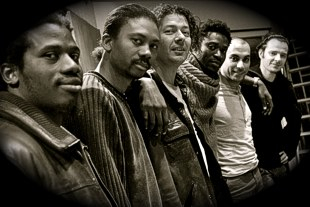 Later in the festival, Aziz Sahmaoui and his University of Gnawa (pictured right) were also in the business of contacting the spirit world, but in a much more extrovert way. Formerly with the Orchestre National de Barbès, the Paris-based collective who featured a number of different North African genres from chaabi to Rai, Sahmaoui, in an imaginative reconstruction, focuses on the music of the Gnawa, the itinerant Maghreb musical sorcerers, who perform very powerful healing ceremonies that often take on the form of collective psychodrama, as well as spiritual house-cleaning that puts Feng Shui in the shade.
The rhythm of Gnawa music is quite literally infectious – it is designed to take you out of your mind. The trance is activated by the repetition of magical incantations, the ear-splitting clatter of the kerkaba, large metal castanets, and above all the eerie sound of the gunbri, a gut-stringed sacred instrument associated with the sect. Sahmaoui played the lute as well, and the ngoni, a sub-Saharan cousin of the gunbri.
With several African musicians in the band, Sahmaoui is taking Gnawa music back to its roots in Guinea or Ghana – the etymology of “Gnawa" is clear about that - and the sect’s families are descended from West African slaves. The musicianship was spare, tight and ruthlessly effective. There was an almost scientific use of rhythmic breaks in the backing vocals, a characteristic splitting of the beat that feels as if designed to mess with the listeners’ minds and blow open the way for heightened awareness.
In Gnawa ceremonies, the adepts are moved to dance their troubles away as they whirl to the rising power of the music. At WOMAD, the audience responded in similar though untutored fashion, transported, albeit for a few minutes, to another realm.