The blurb on the front of the double-CD set The Hamburg Repertoire says it collects “The original recordings of songs performed by The Beatles on stage in Hamburg.” Disc One opens with Little Richard’s “Long Tall Sally.” Disc Two ends with Chet Atkins’ version of the “Theme From ‘The Third Man’.”
In between, 86 recordings of varying familiarity: from Chuck Berry’s “Roll Over Beethoven” and The Shirelles’ “Will You Love me Tomorrow” to lesser-known fare such as Duane Eddy’s “3.30 Blues” and Gene Vincent and His Blue Caps’ “Wedding Bells (Are Breaking up That Old Gang of Mine).”
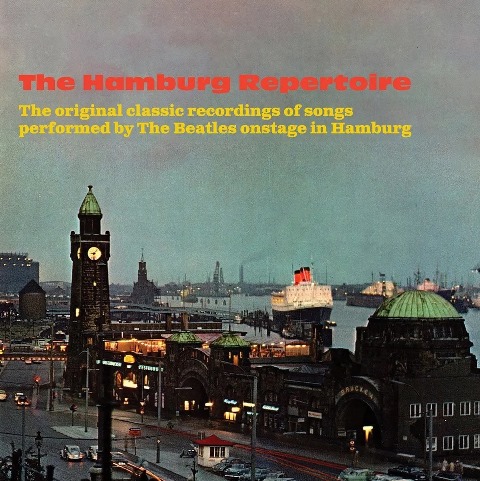 Hamburg and The Beatles are interwoven and an endless source of fascination, an interest confirmed by the 1994 Beatles-in-Hamburg film Backbeat. John Lennon is quoted in the booklet coming with this card slipcase-housed set as saying “'We were born in Liverpool but we grew up in Hamburg.”
His band had been booked for five sets of dates in the German port city: serially at The Indra and then The Kaiserkeller (17 August to 3 October, and then 4 October to 30 November 1960); The Top Ten Club (27 March to 2 July 1961); The Star-Club (13 April to 31 May 1962); again at The Star-Club (1 to 14 November 1962); and a final Star-Club booking (18 to 31 December 1962). Interpretations of the specific dates they were on stage and how many sets were played on each day vary, but the headline is clear: The Beatles played a lot in Hamburg. As the booklet’s uncredited text puts it, “800 hours over 273 nights across 29 months.”
Aurally, the only evidence for what audiences heard after they walked through the venue doors is what is on the Live! At The Star-Club In Hamburg, Germany 1962 double album, initially released in 1977. The source tapes, of three separate live sets, were recorded in the period from 25 December to 31 December 1962. The selection process for what ended up on vinyl was haphazard. Two of the tracks weren’t sung by a Beatle. Instead, the vocalist on “Hallelujah I Love her so” was Star-Club bouncer-come-Beatles-minder Horst Fascher. “Be Bop A-Lula” was intoned by his boxer brother Fred.
Although the album helped bring the Hamburg days into focus, it didn’t bring full clarity – especially as the sound quality was fair to middling, and processing before pressing added a layer of sonic smearing. Nonetheless, there it was, The Beatles in Hamburg. Thrilling, as-such historic stuff.
Otherwise, beyond those Star-Club recordings it’s been the work of Beatles scholars, most notably Mark Lewisohn, to figure out what was played in Hamburg. Lewisohn has determined what was in the Beatles live repertoire in 1960, 1961 and 1962: years during which they played Liverpool as well as Germany. A song performed was not necessarily exclusive to one place or the other.
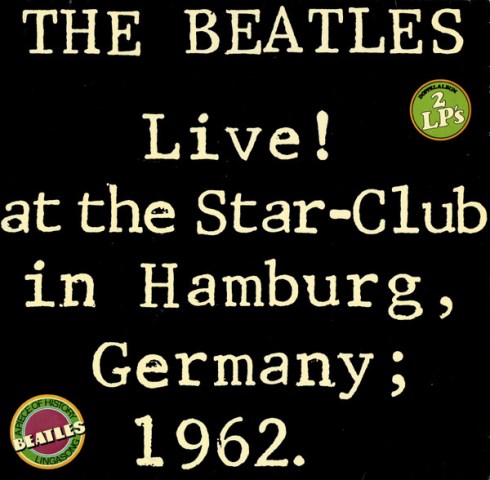 More is known about 1962 than the two preceding years. They signed with EMI’s Parlophone label and recorded for it in 1962 (the Hamburg sessions for Polydor were held in 1961). In the UK, there were four BBC radio appearances in 1962. There was also the 1 January 1962 audition for Decca Records. Add in the live Star-Club album material and 1962 has a lesser status as terra incognita than 1960 and 1961, the other two Hamburg years. (pictured left, the 1977 German issue of the Live! At The Star-Club In Hamburg, Germany 1962 album)
Thus, the outline of the framework within which The Hamburg Repertoire operates. The track sequencing is not arranged to reflect the order songs entered The Beatles’ repertoire. Late on Disc Two, Ray Charles’ “What'd I Say,” played live in 1960 and 1961 but not in 1962, appears before The Shirelles’ “Baby it's you,” which first figured in their live sets in 1962. After these, Chet Atkins’ version of the “Theme from ‘The Third Man’,” a tune absent from Lewisohn’s assessments of the material performed by The Beatles during any of the three years they played Hamburg. The same shortcoming applies to other tracks included on The Hamburg Repertoire: Bo Diddley’s “Mona” and “Who do you Love” (they did play his “Road Runner”) and Duane Eddy’s “Shazam” (they had, in 1960, played Eddy’s “3.30 Blues,” “Movin’ and Groovin’” and “Ramrod”: all of which are here). The Beatles may have played “Mona,” “Shazam,” and “Who do you Love” in Hamburg, but standard sources do not say they did. No explanation is given in the booklet for either the sequencing or the reasoning behind the choice of the tracks compiled.
The Hamburg Repertoire is a great idea and knowledge of its existence tempts, but it frustrates and perplexes. With so much study undertaken of The Beatles, their spells in Hamburg and the years 1960, 1961 and 1962 in general, it is baffling that some of the tracks collected have never-before been linked with them. Disappointing, then, that The Hamburg Repertoire needs treating with caution.
- Next week: John McKay – Sixes And Sevens. The early Siouxsie and the Banshees guitarist resurfaces to look back through his archives
- More reissue reviews on theartsdesk
- Kieron Tyler’s website