“She said her life was like a motorway… dull, grey, and long.” The lyrics of “Like a Motorway,” from Saint Etienne’s February 1994 album Tiger Bay see the titular highway negatively, signifying a life defined by a prolonged drabness.
Saint Etienne released their final album, International, last September. By that point, Bob Stanley, one third of the band, was already bedded-in as an author. He has also been behind a series of concept compilations. Rather than being devoted to a genre or style – maybe acid folk or Belgian popcorn – they aim to bring to mind a situation, a setting, particular cultural markers, usually within a specific time frame. Earlier this year, there was Wednesday Morning 6AM, a recreation of what might have been on early morning radio in the Seventies and early Eighties. Motorway City - The Golden Age of Car Travel 1966-82 is Stanley’s latest such venture.
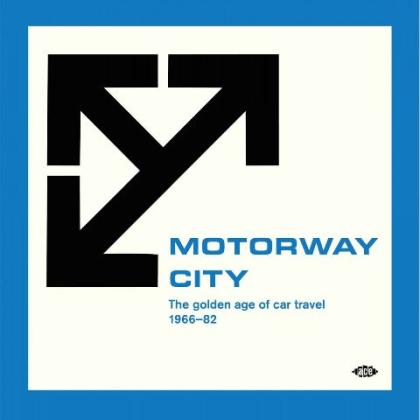
What’s on Motorway City is, as the promotional material describes it, music composed and recorded to “hymn car travel, back when the petrol-operated motor car was seen as the transport mode of the future, when motorways were new and thrilling. It was car travel’s golden age.” For Stanley, the motorway can now be celebrated – albeit by applying conceptual retrospection – rather than being used as an allegory for cheerlessness.
As he notes the accompanying booklet's fascinating, lengthy, scene-setting essay, one of British pop’s landmark considerations of the motorway is Chris Rea’s "The Road to Hell,” an extraordinary evocation of the anomie and self-reflection generated by being stuck in traffic on the M4 and M25. This was not the liberty inherent to Kraftwerk's “Autobahn”– itself a musical influence on Saint Etienne’s “Like a Motorway.”
Albeit from a non-musical angle, motorways were integral to pop music boom of the 1960s. They helped open-up the UK. Along the M1, which opened in 1959, Watford Gap’s Blue Boar eatery was a stop-off for groups journeying up, down and across the UK. A place to meet up, it became a stitch in the pop-cultural fabric. Thanks to the new national network of seemingly endless grey ribbons, connections within British pop were being made more speedily.
However, each of the 28 tracks Stanley has selected for Motorway City sat outside the mainstream of British pop. The collection draws from music library albums – LPs pressed by production companies in the hope that what was on them would be picked up for use on film or television soundtracks, as themes, as background or scene-setting music. Subscriber-only, none of the records were available in shops. While accompanying images are missing, bringing together this music with a theme for Motorway City is in keeping with what the production companies had in mind while pumping-out these LPs.
Motorway City opens with “Wire Wheels,” a rolling, jazzy instrumental – these are all instrumentals – which conjures motion, Compellingly kinetic, it might have soundtracked imagery of, say, water-skiing or a flashy Vauxhall Viva zipping down a snaking mountain road with a glistening lake at the foot of the slope.
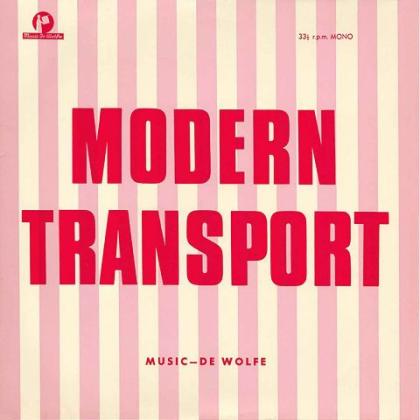
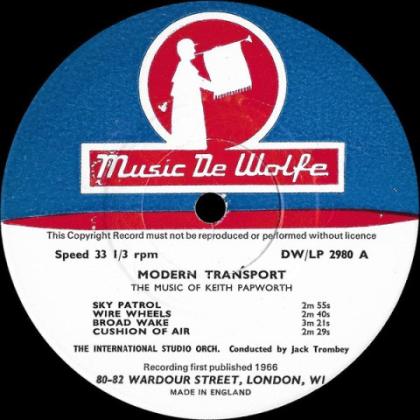
Attributed to the grandly named International Studio Orchestra – an agglomeration of uncredited session musicians – “Wire Wheels” first appeared on a 1966 Music De Wolfe 10-inch album titled Modern Transport. The composer is Keith Papworth who, from 1964, concentrated on library music. Others here, like Alan Hawkshaw, Karl Jenkins and Basil Kirchin, spread themselves more widely.
Next up, “On The Move,” a cool, swinging, vibes-infused Johnny Hawksworth composition taken from the 1974 Chappell album Brass and Rhythms. Again, there’s an inherent momentum: driving gloves on, roof folded down, moving fast. A world of leisure. Glamour, even. Driving as a lifestyle choice
Things get specific with the third track. Cliff Johns’ “Motorway” (1974, from the Studio G LP Light Movement Vol 2). Built around an organ groove, it features busy drums, a be-bop-styled trumpet solo and is busily arranged. It evokes junctions and stop-offs.
Elsewhere, Herbert Chappell’s “Driving Force” (also from Brass and Rhythms) is brassy, clean-lined and has a brave new horizons feel. John Scott’s “Motordown” shares this vibe (1979, the Bruton LP Thriller). With “Highway Song,” credited to The Cool (1969, the De Wolfe LP Pop Sounds By The Cool), things are bashier, fragmented, urgent.
Whether there was a golden age of car travel between 1966 and 1982 is moot, and an open question. Certainly, roads were less clogged back then and it was easier to hop in, start up and aim-off somewhere, anywhere. Maybe for a spin along a motorway with a pit-stop at a service area. Those days are probably gone, but the elegant Motorway City - The Golden Age of Car Travel 1966-82 is a reminder that, in the good old days, driving a car could be an end in itself, and that while a motorway was certainly long and perhaps grey it was not necessarily dull.
- Next week: The Absolute Grey - CBGB’s 1985. The moody Rochester, New York band are caught on stage
- More reissue reviews on theartsdesk
- Kieron Tyler’s website