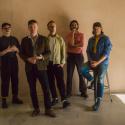
I love the fact that under the “genre” tab on their Facebook page, Orchestre National de Barbès have opted for “Other” from the dropdown menu. Obviously in Facebookland “Other” simply means not rock, soul, hi-hop, jazz, reggae, classical etc. However, in a metaphysical/philosophical sense “Other” can mean that which is alien, different or exotic. But what tickled me is that the music of this Parisian-based, largely Algerian band actually embraces just about all the Facebook categories they could have clicked on, even if none of them fully sums up the multilayered din they create.
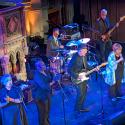
Although the Queen Elizabeth Hall was a third empty last night, that didn’t stop this multi-cultural collective from creating a vibrant party atmosphere from the off. Opening number “Chorfa” set up a mid-tempo roots reggae vibe held down by Youssef Boukella Jah Wobble-like bass. However, from the moment one of the band (this is not a band where one can speak of a single lead vocalist) asked, “Who said you must stay on the chair? Can you stand up?” The answer was affirmative. and 90 percent of the crowd rose to their feet, and remained standing and dancing for most of the set as pretty much every Facebook music category was hinted at, fully embraced, or in some way integrated into their music, if for only for a few bars.
One song began with some crystalline Congolese guitar from Fathallah Ghoggal (whose basic but effective style occasionally reminded me of Justin Adams) another had a ragga rhythm and vocal, and a third took Jamaican ska by the throat and pulled it along at a punk rock velocity. But perhaps the secret of Orchestre National de Barbes ongoing success (they’ve been together now for some 15 years or more) is that none of these ventures into fusion sounded in the least bit forced. Always in the background somewhere was a core throb of Moroccan gnawa blues or the fierce driving beat of Algerian rai, keeping the music earthed and elemental.
An organically cohesive sound combined with a rough-edged and infectious party spirit
Although it originated in the 1930s, Algerian rai has strong working-class roots and has leant towards critiquing traditional Islamic values. This makes it the perfect form on which to graft later 20th-century rebellious Western styles such as punk rock and dub reggae. Yes, there have been many bands that have gone this fusion route before, but few have produced such an organically cohesive sound combined with such a rough-edged and infectious party spirit as this multi-ethnic collective.
But perhaps the most involving part of the concert for me was when the two keyboard players took a break and Hafid Bidari and his dryly buzzing guembri (a three-stringed bass lute, distant cousin of the guitar) became the compelling focus of a long trance-inducing improvisation which built and built in intensity. It felt like a necessary reminder of the source of all rock and blues, just before the band spelt out exactly where we have ended up taking this music.
The Rolling Stones’ “Sympathy for the Devil” was one of the encore songs. The band’s quirky, not entirely successful version brought to mind that other France-based Algerian rocker Rachid Taha’s spirited take on the Clash’s “Rock the Kasbah.” It’s curious that bands such as the Rolling Stones are still so disproportionately famous that Orchestre National de Barbés (or their press department) feel they should mention that a track by them was played by the Stones prior to them taking the stage on their 1999 Bridges to Babylon tour.
But there we are: the tired western forms of rock and hip-hop still rule the world while musically adventurous and impassioned bands such as our riveting entertainment last night courageously battle on, making converts a few hundred at a time. At it’s most euphoric this music seemed to be from all cultures and from all times, a kind of universal folk in which one can hear Scottish and Irish as much as Algerian and Moroccan. “They could have had subtitles” I heard one grumpy punter complain in the toilet afterwards. I despair.