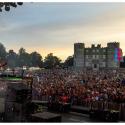
As I waited outside the entrance to the Royal Albert Hall, someone leaned over to me and said: “My cocaine is to your left.” I glanced in that direction and realised they’d actually said “Michael Caine is to your left”, and indeed he was, on his way inside to hear a prom devoted to music by his old friend Quincy Jones.
It’s hard to know where to begin with Jones’s musical CV. He’s had a towering career in jazz, film music and pop, and any one of these genres could enough provide material from him to fill a series of proms.
The Metropole Orkest, conducted by Jules Buckley and led by Arlia de Ruiter, opened with a medley of Quincy Jones’s compositions – “Roots”, “Sanford and Son” and “Ironside” – in propulsive, bold big band style, segueing to sunny funk. “Ironside” featured screaming trombones, crazed guitar and an ecstatic landslide of brass that swept the audience away. Singing the theme for “The Pawnbroker”, Laura Mvula (pictured below right) modulated from a gutsy opening into a delicate exploration of the song against a background of strings.
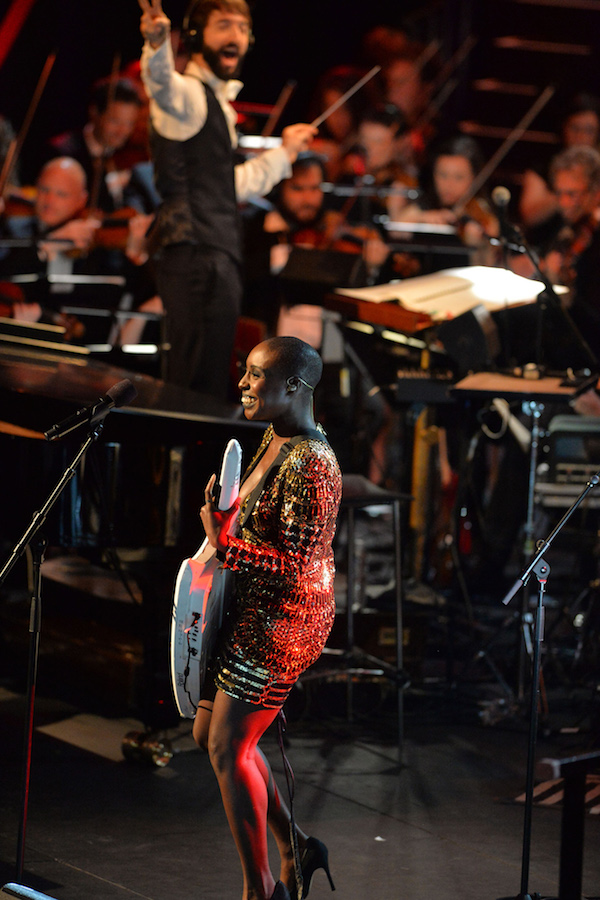 But the evening really got underway with “I Can’t Stop Loving You”, a song immortalised by Jones’s lifelong friend Ray Charles. The whole orchestra adopted an infectious down-home swing, capturing the earthy rawness of Ray’s original, with the shouts of the horn section evoking his vocals. The tune built and built, combining impressive speed with an unhurried loping beat which was true to its lazy country roots.
The theme “Separation” from the film The Colour Purple presented rolling, pastoral strings with their melancholy mood darkly outlined by the woodwinds and then choked off by the swelling brass. On “Please Don’t Stop”, Richard Bona’s sweetly chugging bass guitar gave us New Orleans-inflected funk, lighting the fuse for the whole orchestra and providing an object lesson on how uplifting the blues can be. The Royal Albert Hall was echoing with gospel handclaps, though this was nothing compared to the tumultuous applause that followed the song.
This concert never stopped, surging ever forward and changing gears as smoothly as a sports car. Dizzy Gillespie’s classic “Manteca” is the granddaddy of all Afro-Cuban jazz and Quincy Jones’s arrangement sharpened and hardened the sound of the brass as if it was metal being hammered in a smithy.
The piece began as a rolling barrage of sound, the brass stabbing upwards like searchlights in an air raid. Then Alfredo Rodríguez’s tumbling piano chords came to dominate, with the percussion keeping a steady, punching beat behind him until the horns came sliding back in, insinuating themselves like a burglar slipping a lock. It was a relentless, brassy Latin groove, narrowing down to a wailing, wonderful clarinet solo.
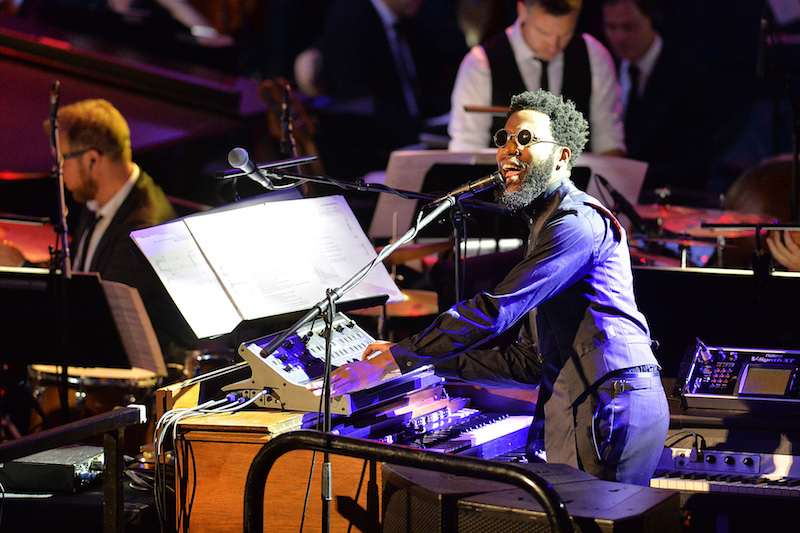 “They Call Me Mister Tibbs”, another Quincy Jones film theme, had the churning chug of the orchestra clear the way for the hip attack of Cory Henry’s Hammond organ (pictured left), reinforced by blazing brass. He conjured great washes of sound in a knockout performance. Jones’s “Soul Bossa Nova”, known to millions through its use in the Austin Powers movies, was a sweetly groovy colossus, with great blasts of sound from the horns strung along the irresistible percussion line like pearls on a necklace.
The encore for the evening was “Let the Good Times Roll”, bringing us full circle back to another Ray Charles hit. And now the man himself came on stage. Quincy Jones conducted the orchestra in a storming, sleek, gleaming performance with brilliant contributions from Laura Mvula, providing raw silk vocals, and Cory Henry, playing rich raunchy chords on the Hammond.
I trust Michael Caine enjoyed it all as much as the rest of us.