“Thank you for waiting. I know some of you have been waiting a long time – about seven years – but it takes me a while to get things done.” Thus did singer/songwriter Hayley Willis greet the audience at her return to active service. Two Willis albums have bookended that seven-year period: 2003's acclaimed Come Get Some, her debut for 679/XL, and its excellent follow-up, Uncle Treacle, released on 4 October on her own Cripple Creek label, for which last night's performance acted as a launch party.
The last few years have also seen the emergence of a particular kind of musical aesthetic informed by country, blues and folk, and spearheaded by the success of acts like Mumford & Sons, KT Tunstall and Laura Marling. While this development might suit a performer like Willis on a superficial level, there remains an intriguing otherness about both her and her music that sets her apart from those peers of hers who possess a more obvious mainstream appeal.
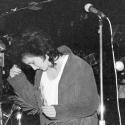
A little of this otherness was evident in the basement of The Slaughtered Lamb in Clerkenwell on Monday night. It's a venue with an easy intimacy ideally suited to the kind of acts favoured by The Electroacoustic Club, and in the normal order of things, it mightn't be too unusual to see yet another straight-from-central-casting hippy chick in a floral dress or plaid shirt gently picking out a few originals for a polite, attentive crowd. So when a woman around six feet tall, clad in what looks like 1950s schoolteacher mufti and with her face garishly made up to resemble a marionette, walks into the room, you do tend to notice. And when Willis and her guitarist, whom she later introduces as Pascal, begin to play, you're put in mind somewhat of Rain Dogs-era Tom Waits, or perhaps even PJ Harvey, rather than off-the-peg folksy Americana.
A laptop triggers noisy rhythm tracks that thump and clatter around the tiny room beneath sinewy, pre-rock blues riffs, while Willis herself rattles and scrapes a variety of percussion instruments. You quickly find yourself wishing the venue could cope with a bit more volume; not because the songs are apologetically quiet, but because you know they'd sound even better played loud. This is most assuredly not timid music.
Nor is the subject matter. “Hell-Money-O” is a caustic attack on modern vanity and the superficial celebrity culture that accompanies it, presented as a list of demands cherry-picked from the pages of a gossip weekly (“I need a Vuitton case, I need a camera in my face”), while other new songs like “So Nice to Meet You” or “Goosey Gander” take a similarly harsh look at the darker side of man/woman relationships. Willis's voice is rich and sonorous, able to handle a Badu-esque warble at the top end, and something akin to Tony Joe White's rumbling bayou growl at the other, but one of her many ace cards is her skill as an interpretive singer. Her inspired, sleazed-out cover of Cameo's “Word Up”, from 2004's Take You High EP, found its way into an episode of CSI, and the cover of Dolly Parton's "9 to 5" which closes Uncle Treacle is one of the highlights of this show. Scouring away the cheerful Cosmo perkiness of the original, Willis turns the song inside out and twists it into a bitter lament for anyone trapped amidst the desperate necessity of the recession-era hustle. It's really quite magnificent.
Nowadays, it's possible to throw a stone over your shoulder and hit any number of self-consciously rootsy female singer-songwriters, but just as there wouldn't have been many as extraordinarily talented as Willis when she emerged seven years ago, it's clear from this that there aren't very many equal to her now. If she were to become just another casualty of widespread public indifference or an over-saturated market, it would be an outrage.