Each new Beatles album offered a chance for other acts to record their own versions of songs which didn’t make it onto singles. What was on the long-player could pick up attention if it was covered. Revolver was no exception. Cliff Bennett & The Rebel Rousers’s version of “Got to Get You Into my Life” was in the charts the August 1966 week Revolver was issued.
Revolver’s “Here There and Everywhere” was recorded by The Fourmost. “For no One” was covered by Paul McCartney sound-alike Marc Reid, “Yellow Submarine” by The She Trinity. None were hits, and The She Trinity were gazumped by The Beatles themselves who released “Yellow Submarine” as a single.
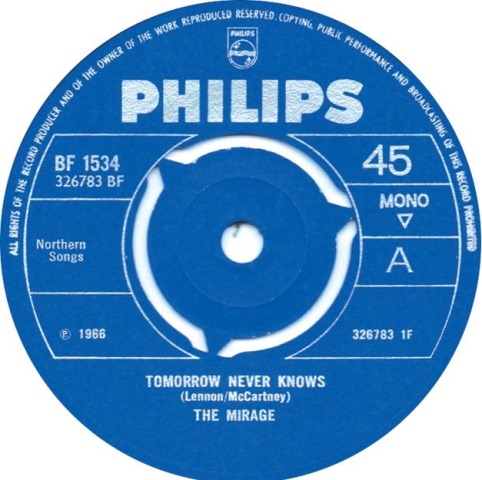
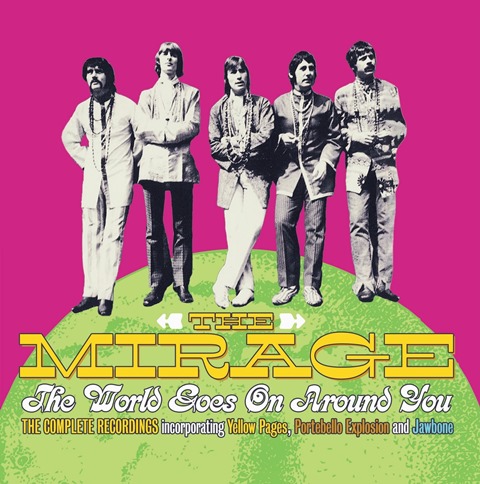 All of this was typical. A more curious entry in this Fabs-fed ecosystem was a version of Revolver’s full-on trip into pyschedelia “Tomorrow Never Knows”. The original did not scream commercial success, yet Hertfordshire outfit The Mirage went for it. Although the band had access to Revolver before its release and speedily recorded “Tomorrow Never Knows”, their single was delayed and came out in December 1966 – while The Beatles were moving forward and about to work on “Strawberry Fields Forever”.
The Mirage’s “Tomorrow Never Knows” – their third single – is a poor-selling curio which now sells for at least £200. It might have mustered some attention in 1966 had it hit shops in a timely fashion. Although faithful to the original, the vocal line was mixed high, production frills were lacking and, as an after-the-fact experience, it came across as a demo rather than a finished recording because it lacked the completeness of what had been heard on Revolver. Its tinnily produced B-side was the great psych-edged mod stomper “You Can’t be Serious”, written by band member Dave Hynes. No chart action. Their next single was the Hynes-penned “Hold On”. It borrowed from “Taxman”. The Mirage seemed to like Revolver.
An opportunity to set The Mirage’s “Tomorrow Never Knows” in context comes with The World Goes On Around You – The Mirage Anthology, an exhaustive, three-CD digi-pack set. The band issued nine singles: the first in June 1965; the antepenultimate as Yellow Pages; the last under the name Portebello (sic) Explosion. They also issued an album and a single in 1970 as Jawbone, both of which became their sign off. Overall, The World Goes On Around You collects 60 tracks – while there are six BBC radio session recordings, it’s obvious a lot of what they recorded was not issued.
 This might seem like overkill, but it’s clear there was more to The Mirage than the “Tomorrow Never Knows” episode. Their May 1967 single “The Wedding of Ramona Blair” is a soul-tinged psychedelic pop nugget and the then-unreleased “Ebenezer Beaver”, which first surfaced in the 1980s, is wonderful too. But still, 60 tracks?
It’s Disc Two’s collection of contemporaneously unissued material which makes the case. All but one of its 23 tracks are studio demos and the bulk are band compositions. When left to their own devices, The Mirage came up with the goods. The baroque-leaning “I See the Rain” (not the Marmalade song, but a Dave Hynes original) is wistful, in the Zombies bag. “My Door No. 4” features strings and woodwind and is as good as anything by Honeybus. “Is Anybody Home” has a Graham Nash/Hollies feel. However, an awkward version of “Wild Thing” is pointless.
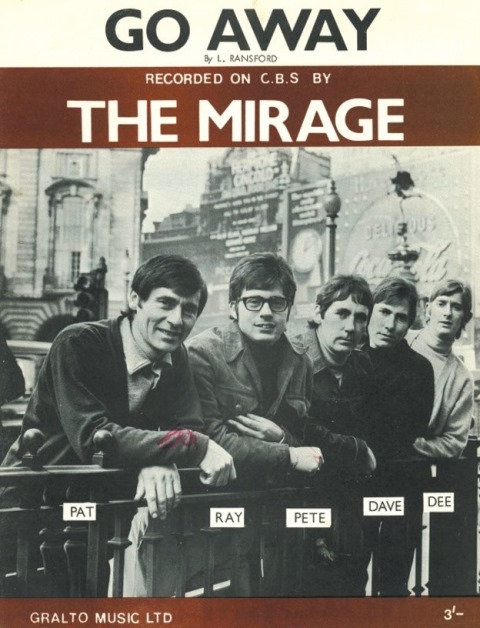
The latter two tracks point to where The Mirage were situated in music business terms. Early on, they were friends of The Hollies and “Go Away”, the zippy A-side of their second single, was an otherwise unrecorded Hollies song given to them. “Wild Thing” crops up as their sixth, seventh and eighth singles came out on Page One, the label run by Troggs manager Larry Page – also the home of The Troggs. Earlier, they were also under the wing of music publisher Dick James, who had The Beatles on his books – this is how they had early access to “Tomorrow Never Knows”. While with James they recorded extensively at his studio (hence all the demos) and worked with Reg Dwight as he became Elton John, playing on his demos. There’s no doubt The Mirage were well placed.
 But comparing Disc Two with Disc One, which collects what they actually released, shows that their records could be patchy. Their first Page One A-side, July 1968’s “Mystery Lady” was not a band composition. It’s weedy trumpet-dominated pop along the Ohio Express bubblegum lines and not great. “Ding Dong Bell”, their next single and another non-band composition, recorded as Yellow Pages, is a needless clone of The Troggs’s “Hip Hip Hooray”. Next up and back to being The Mirage, December 1968’s “Carolyn” is dreadful oompah-pop. There’s also no doubt The Mirage were badly handled in terms of what they issued.
After this, The Mirage took the name Jawbone – borrowed form a song by The Band. The album issued under that name in April 1970 mixes self-conscious Band-style downhome-ness with late-Sixties Beatle-ish workouts: there's a version of “Across the Universe”. Schizophrenic and lacking identity.
Ultimately, the through-line of The World Goes On Around You – The Mirage Anthology is a what-if. What if The Mirage had followed their own path rather than the direction of the music business figures they were contracted to? Beatles cover versions, Troggs sound-alikes and bubblegum inanity did The Mirage no good. As Disc Two and the best of Disc One attest, they could have broken through – they were as good as Marmalade and the post-Brian Poole Tremeloes, and had the idiosyncrasy of Honeybus. At least, then, all these years on it is now possible to appreciate what might have been.
- Next week: Looking back at 2022
- More reissue reviews on theartsdesk
- Kieron Tyler’s website