Founder rate ends 9th September.

We’re rebuilding theartsdesk to secure the future of real arts journalism. Be part of it by subscribing: if you do it now, the founders’ rate of just £40 yearly is yours FOR LIFE!

SUBSCRIBE NOW 

Anne Hardy, Katie Paterson, Eva Rothschild, Edinburgh review - three sculptors in their prime

The Edinburgh Festival may be over for another year, but there is plenty of art still to see

share this article

Eva Rothschild 'The Grit', 2026
Courtesy the artist, Modern Art and The Modern Institute/Toby Webster Ltd., Glasgow. Photo: Ruth Clark

Dublin born and London based, Eva Rothschild makes unapologetically urban sculpture. Its geometric forms and patterns are conveyed in thick, usually black, hard lines, evoking the silhouettes of buildings, furniture, infrastructure – very occasionally body parts. Her entire visual vocabulary is exuberantly present in this major survey show, at Fruitmarket Gallery – a pioneering location for contemporary art since 1974, in a refurbished warehouse beside Waverly station. It’s a treat to see so many of her angular and curving, hard and soft forms waltz across the floors and up the walls.

Rothschild even makes works for visitors to sit on, such as the stacked, Sponge Bob-esque, giant bricks Amphi, 2019, upstairs, which she made for her show in Venice, when representing Ireland at the 2019 Biennale. As a true urbanite, she closely observes how we humans interact with the grid, the apertures, the enclosures and elevations the city affords; how structures invite or deny exploration. The rough surfaces of these cubes and their muted splashes of pastel paint are evocative of her friend and former Slade colleague Phyllida Barlow. It was Barlow, I later learn, who effectively launched Rothschild’s sculpture career, when she hired her in 2001, fresh from a Fine Art degree in Belfast, to teach in the Slade’s sculpture studio. 

At the time, her speciality was printmaking, and you can see how that love of a dense, inky line translates into the work. But there’s always a twist of playfulness, sensuality. For example, Hangouts, 2018, is like a New York skyline, its painted rebar and jesmonite geometries softened by a stretch of draped fabric, slick with black gloss paint, dangling from the bars. The structure also has the aura of a nightclub dance platform – raised about a foot from the floor.
Image
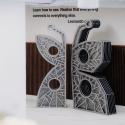
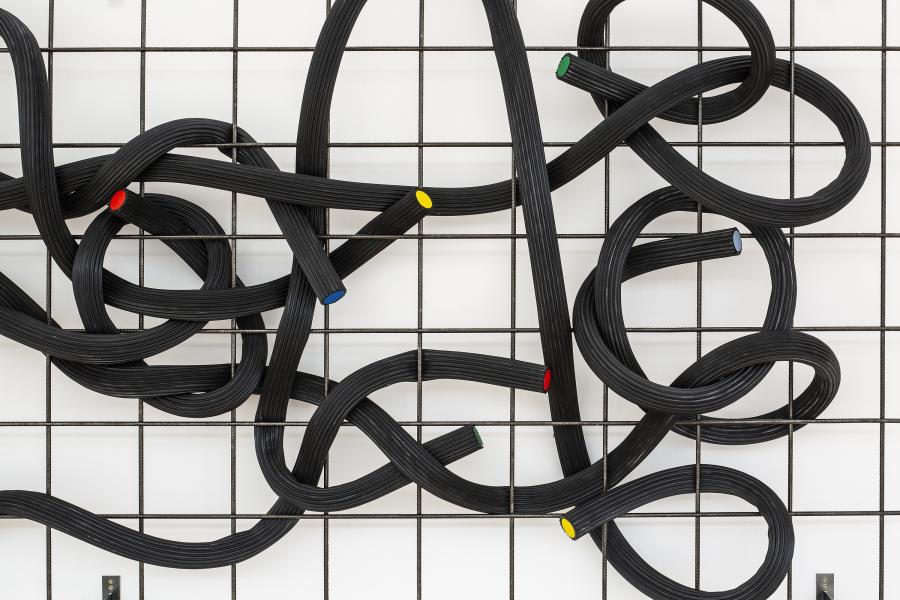
Eva Rothschild Shorthand, 2026  Courtesy the artist, Modern Art and The Modern Institute/Toby Webster Ltd., Glasgow.  Photo: Keith Hunter Photography

Rothschild leans into the Liquorice Allsorts-ish aspect of her ribbed columns and curves, tipping their ends with candy colours. There are many new works here, including Cursive and Shorthand (pictured above), both 2026: slender, bendy black tubes, tipped with pink, blue, yellow, weave around and beyond the restrictions of the grid that frames them. Rothschild has a witty way with labels. A pair of curvy cast forms in matt and glossy black ceramic on a white wall are titled Wink.  Initially, they look vaguely S&M – like a cold, hard housing for breasts. But when you turn your head sideways, you realise they are eyes. A ceramic statute, one of several that march along a plinth, comprises two elegantly draped limbs, in shades of cool green; a tall and slender thing with one coy "knee" bent in towards the other. Its title? Nymph.

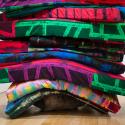
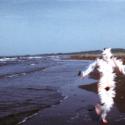
In the lower gallery, Rothschild is pushing into new territory with the scale and softness of her installation, The Grit, 2026: a tower of mattresses, in vibrant prints, criss-crossed with her trademark tyre-track graphic (main picture). They stack from floor to ceiling, creating a feeling of claustrophobia and (too)close encounter. A rounded stone is pressed beneath this mattress sandwich. From the flyer, we learn it is a "sculptural manifestation of Hans Christian Andersen’s The Princess and the Pea" (a meditation, perhaps, on the way women are pressured to meet impossible male standards or expectations).

Another new work in Fruitmarket’s rough-brick walled end gallery is a film, called Safe, 2026. In an east London park, Rothschild created a large, yellow, pyramid frame for teenage kids to climb on. A call out to local schools and youth clubs for teenage boys resulted in this informal crew we see roaming, tunnelling, sitting, footballing, nesting around it. There’s a calm, easy atmosphere between them: you can’t hear what they are saying but you recognise the tone of badinage and banter, interspersed with songs and beats, as dance moves spontaneously emerge. As a mother of three sons, Rothschild is all too aware of how groups of boys can be seen as threatening, but also that there are few "safe" public places for them to go. The title also hints at the common sign-off, where boys part company by wishing each other "safe". But this show reveals an artist determined to keep pushing boundaries, refusing to "play it safe".

A short walk up the hill, through the tourist moshpit of The Royal Mile is the Talbot Rice Gallery, another outstanding art space, where Anne Hardy has woven a very different kind of magic with her installations in a very different kind of building. Her show occupies the Georgian, Robert Adam-designed, balconied gallery, a temple to neo-classicism. Part of Edinburgh University and Edinburgh College of Art, it was first used as a Natural History Museum.
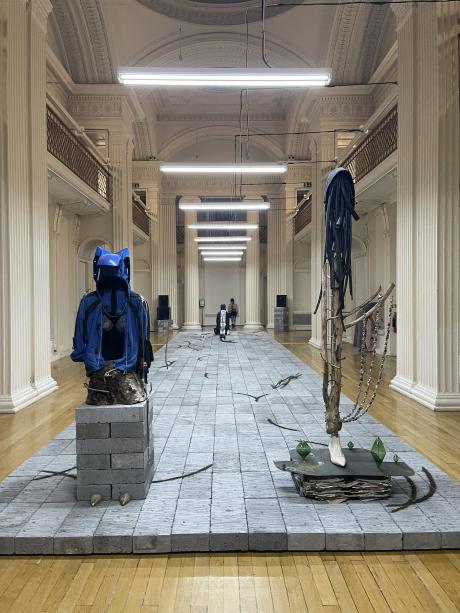
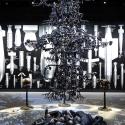
The soundwork Hardy has conjured sets the tone for a more weirdly imagined natural history. Wind rustles across the ground, among leaves; there’s the rush of waves, of rain on a tin roof. Moody synth chords meander: New Age ambient, with a hint of menace from footsteps, lightning flashes, tearing sounds, scampering. It amplifies a sense that something is about to happen, or maybe just happened thanks to the figures hunched at either end of the gallery. They occupy an extensive platform of grey, rough breeze blocks, scratched and scored, squatting on the antique parquet. Mysterious symbols are dribbled in mud on its surface. Industrial strip lights march like landing lights overhead – a harsh, utilitarian glow of unlovely illumination, it fades and brightens in synch with the soundtrack.  But the figures (pictured above right) are fascinating: partial people conjured with spare metal armatures, pewter breasts and preloved clothing, draped or festooned with amulets, chains, feathers and found objects. There is something of the fetish about these faceless creatures.

Image
Anne Ryan, Talbot Rice Gallery. Photo V Simpson

One wears a blue, vintage sports jacket, its hood/helmet formed from parts of a blue motorbike. The dark-hooded figure at the far end of the hall has a scaly tail. Up in the gallery, further found and imagined elements are framed where once fossils or ammonites were celebrated. It’s a compellingly realised and heady imaginary world that speaks of fragility and unseen but sinister – or magical – forces.

On the opposite side of Waverley Station, perched on Calton Hill, Scottish artist Katie Paterson shares her own musings on the geological and cultural richness of this planet, in an appropriately cosmic setting: Collective art gallery, which now occupies the former 18th century City Observatory, where enthusiastic astronomers once observed the transit of stars across the galaxy.

First seen at Folkestone’s Triennial in 2025, Paterson’s Afterlife is a potent and subtle declaration of love for earth’s endangered parts and practices. Over several years, Paterson sourced rare and precious materials from at risk spaces - rocks found under melting glaciers, coral from the Great Barrier Reef. She has transformed them into nearly 200 amulets, recreating treasures found across the globe and from all eras: pre-Columbian, Egyptian, Viking, Mesopotamian. Each of these amulets nests in a bespoke indentation carved into a curved wood table designed by Paterson’s architect collaborators Zeller & Moye in Berlin. This time-travelling platform sits at the centre of the Observatory’s iconic round tower. It invites us to contemplate the legacies of past civilisations along with the likely legacies of our own.

All three exhibitions are free and offer not just the delights of the work within them but a chance to explore buildings that reflect key moments in the city’s history and culture.

It’s a compellingly realised imaginary world that speaks of fragility and unseen but sinister – or magical – forces

rating

5

explore topics

share this article

Help secure the future of arts journalism

In this era of algorithmic recommendation, opaquely sponsored content and AI slop, theartsdesk’s mission to preserve real journalistic and critical values has never been more important.

If you like what you see here, please join us 
in this mission.

Subscribing to the site will help us in our coming 
redesign and expansion.


If you do this before the 9th September this will be at our guaranteed founder’s rate: 
your subs will never increase again.

Subscribe now for £5 per month. 
or yearly for just £40.

Or if you simply want to support us with a one-off donation, you can do so here.

more visual arts

The Edinburgh Festival may be over for another year, but there is plenty of art still to see
Ritualistic performances and evocations of fertility goddesses
The mood is blue, but profundity is in short supply